
Iran war puts spotlight on US defenses against Pacific missile, drone threats
The U.S. is strengthening defenses against missiles and drones in the Pacific as the Iran war highlights the potential risks to installations facing increasingly sophisticated Chinese and North Korean weapons.
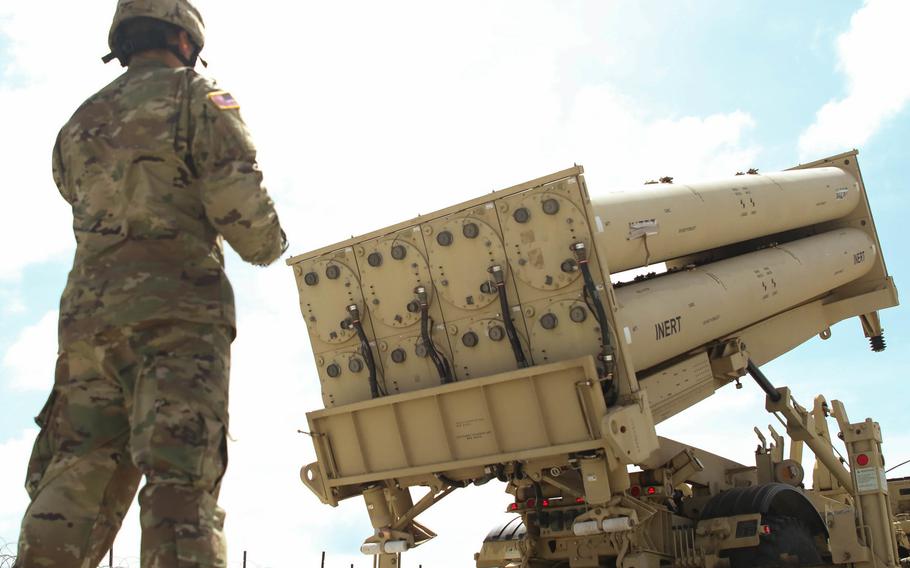
The United States is strengthening defenses against missiles and drones in the Pacific. A soldier takes part in a drill involving a Terminal High Altitude Area Defense, or THAAD, system at Andersen Air Force Base, Guam, Feb. 6, 2019. (Adan Cazarez/U.S. Army) The United States is strengthening defenses against missiles and drones in the Pacific as recent attacks on American bases in the Middle East highlight the potential risks to installations facing increasingly sophisticated Chinese and North Korean weapons. Projects include a $1.9 billion air- and missile-defense system on Guam, expanded counter-drone capabilities and a joint U.S.-Japan effort to develop interceptors for hypersonic weapons. U.S. Pacific Command is prioritizing efforts to protect its forces, according to an Aug.
22 unsigned email to Stars and Stripes. PACOM is “committed to establishing a robust defense by denial and creating a military posture in the Western Pacific that renders aggression infeasible, escalation unattractive, and conflict unbearable,” the command said. However, some defense analysts say the recent war with Iran demonstrates the need to move faster and invest more heavily in protecting U.S. facilities. U.S. bases and infrastructure in the Middle East “were not up to par” defensively before the war, said Seth Jones, president of the Defense and Security Department at the Center for Strategic and International Studies, a bipartisan think tank in
Source & Attribution
This One Place News story was acquired from stripes.com. OPN retains the source link and provenance for newsroom review.
Filed Under
Veterans News