
Trump Is Closing From Behind
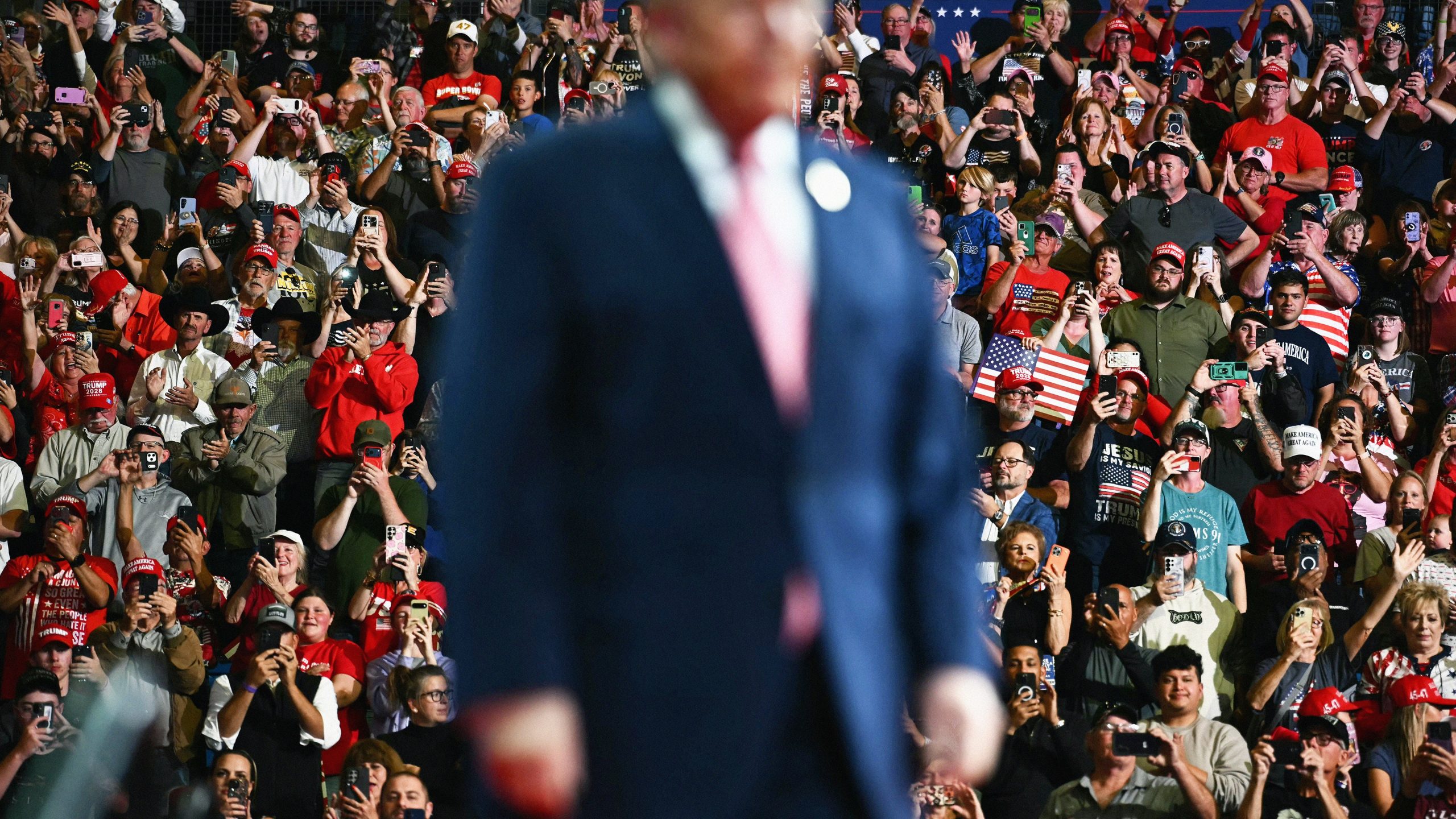
Modern political history offers few examples of closing arguments that appear more out of touch, self-defeating, or downright bizarre than what Donald Trump has offered his fellow Republicans ahead of next week’s midterm elections. In 1980, when Ronald Reagan told voters to consider Jimmy Carter’s presidency and ask themselves, “Are you better off than you were four years ago?,” it helped turn a tight race into a Reagan landslide. But many stretch-run messages prove deeply ineffective and are quickly forgotten. Ahead of the 1998 midterms, Republicans went all in on investigations that led to the impeachment of President Bill Clinton only to be rebuked by voters. President Obama’s insistence in 2010 that the country was coming out of the financial crisis led to his party enduring a “shellacking.” And during the 2018 midterms, Trump and his fellow Republicans tried to stoke fears about an alleged caravan of migrants headed toward the United States, only to have skeptical voters hand the House of Representatives to Democrats.
This time around, Trump’s primary rationale for why voters should support the GOP, as best I can tell, is that the affordability crisis is a “hoax,” Bill Maher is a “loser,” and Senator Jon Husted of Ohio has a nice physique. That easy-to-mock message has been accompanied by a staggering number of missteps. Just for starters, he’s belittled the impact of his stalled war with Iran, sided with Russia as it continues to pummel Ukrainian cities, defended an attack ad from the GOP candidate for Ohio governor that repulsed other top Republicans, downplayed high energy prices while boasting that U.S. oil and gas companies are “making a freaking fortune,” embraced AI as the nation turns against it, obsessed over White House construction projects, and spent a lot of time talking about handsome men, Husted being just one.
Many Republicans, and even some in Trump’s orbit, don’t quite get it. What has happened, they ask, to the instincts of the man who authored two of the most improbable victories in American political history? Trump’s superpower was his intuitive understanding of what motivated his supporters. Many Republicans privately tell me that he’s lost that feel. Trump now lives, they think, in a gilded bubble, palling around with billionaires, oblivious to—and, even worse, uncaring about—the problems facing so many voters. His approval rating has slipped to the low 30s. He’s become so toxic that some Republicans in tight races don’t want him anywhere near their state or congressional district, believing his rallies will harm more than help.
Strategists in both parties expect Democrats to take control of the House, while the Senate is a true toss-up—a stunning reversal from the beginning of the year, when the upper chamber’s map looked so favorable for Republicans, and Trump cut a dominant figure. Suddenly, Republicans find themselves fighting to keep Senate seats in deep-red states: Kansas. Alaska. South Carolina. Ohio. Iowa. Mississippi. Texas.
Trump is campaigning across the country, imploring his supporters to turn out for him one last time. But he’s given Republicans next to nothing to run on, and polls show that voters believe his economic policies are failing, his deportation program has gone too far, and his war is misguided. He instead has leaned hard on the political battles of the past, reheating fears about transgender surgeries (from his 2024 campaign), Muslim terrorists (all the way back to 2016), and even communism. (The guy does have a fondness for the ’80s.) For good measure, Trump’s Department of Justice charged the former FBI Director James Comey for a third time—the first two didn’t stick—because nothing screams being in tune with the everyday concerns of voters than trying to revive a faltering retribution campaign against a political foe your administration once targeted over a photograph of seashells.
One Republican up for reelection who would speak with me only on the condition of anonymity, so as not to alienate the president, put it succinctly: “We may have lost the plot here.”
Not that long ago, the president was tossing Trump 2028 hats around, and Democrats were freaking out that he might be powerful enough to defy the Constitution. But that headgear now seems dated, as does the apparel line trumpeting that Trump Was Right About Everything! Many Republicans tell me that their party’s biggest problem just days from the election is that voters feel like Trump hasn’t kept his core promises.
End foreign wars? Nope, there’s a new one in Iran that’s sent gas prices up and depleted the U.S. munitions supply. Plus, Trump has appeared to side with Russia over Ukraine in a conflict he once promised to end in 24 hours. Bring prices down? Well, the war in the Middle East has made that impossible, as have Trump’s haphazard trade wars, including tariffs on once-friendly trading partners such as Canada and the European Union. And while many Americans are struggling, Trump and his family are growing exponentially wealthier. Deport the worst of the worst? Trump’s massive roundups are targeting not just violent criminals or gang members, but also longtime community members, neighbors, parishioners, teammates, and friends with no criminal records. Many Americans have been horrified by the violence unleashed by masked federal agents, especially the killing of two U.S. citizens in the streets of Minneapolis.
[Read: Trump’s gamble to end the Iran war ]
That Trump wants to focus on anything other than these broken promises while out on the campaign trail is perhaps unsurprising. At his Monday rally in Corinth, Mississippi, he spent seven minutes—nearly 10 percent of his entire speech—discussing his efforts to redecorate the White House.
The day before—when Trump traveled to a rally in Port Huron, Michigan—the president’s talking points included faulting President Biden for the war in Ukraine; falsely claiming that more oil passes through the Strait of Hormuz than before the war; deeming Norway a “shithouse country”; calling Abdul El-Sayed, the state’s Democratic nominee for Senate, a jihadist (five times); saying that, should he win, El-Sayed will be the only senator who must go through a metal detector to get to work; comparing a vote against El-Sayed to stopping a deadly terror attack; asking the Trinidadian rapper Nicki Minaj to stand before thousands of his supporters so that they could appreciate her butt; and lauding the boulder-like shoulders, thick fingers, massive feet, and firm backside of (who else?) Husted, his preferred candidate for Senate in a different state. Over the course of that day, he spent three and a half minutes talking about Husted’s football career, which is three and a half minutes more than he talked about the lawmaker’s policies.
Rather than dispel the notion that he has lost sight of what actually matters to voters, Trump on Sunday night released a social-media screed of more than 1,300 words (his longest Truth Social post ever) that assailed Maher for being ungrateful after the president hosted the comedian and talk-show host at the White House for dinner. The president has also fumed that Obama said over the weekend that Trump’s new White House decor is “looking like Saddam Hussein opened a Cheesecake Factory.” Trump angrily complained about the dig multiple times just yesterday.
[Read: Leave the Cheesecake Factory out of this]
Trump has also found himself on the wrong side of the day’s top issues. He misses few chances to mock the affordability crisis. Republicans and Democrats alike have swiftly turned on artificial intelligence, blasting the industry’s data centers as loud and expensive, and warning voters that the rapidly developing technology could take away their jobs or even their lives. Yet Trump has refused to regulate AI, knowing that the industry is propping up the stock market. His only nod toward change is trying to rename it “Super Intelligence.”
Last week, Trump loudly supported a controversial ad from the campaign of Vivek Ramaswamy, the Republican candidate for Ohio governor. The video features the estranged mother of the Democratic nominee Amy Acton, Donna Arthur, who accuses her daughter of lying about her past. It doesn’t mention that the two women have not spoken for decades, after the candidate’s stepfather was indicted for molesting her. The backlash was fierce and bipartisan; the state’s current Republican governor, Mike DeWine, denounced the ad and demanded that it be pulled. Trump not only supported it but also urged Ramaswamy to “say thank you, God, very much” for such political good fortune. Divine intervention or not, several GOP strategists believe the ad could doom Ramaswamy.
Some GOP candidates in tight races—Susan Collins in Maine, John Sununu in New Hampshire—have sent word to the White House that Trump isn’t welcome to campaign alongside them. The president has instead been dispatched to deep-red states with the hopes of turning out enough of his die-hard supporters to avoid losing once-safe Senate seats.
Olivia Wales, a White House spokesperson, insisted to me in a statement that Trump is remaining focused while “crisscrossing the country with unmatched energy and enthusiasm to deliver a simple message: with Republicans in control of Congress, Americans can expect safer streets, lower taxes, a secure border, and energy dominance.”
The most eyebrow-raising October surprise has been Trump’s unfiltered and rather randy assessments of the male form. His motivations remain a mystery, but some in the president’s circle have theories. One outside adviser who is close to the president told me that it began when Trump, while rallying for Husted two weeks ago, was first told that the senator had played college football in the late ’80s. Trump was impressed and began publicly ruminating over the next few days about Husted’s physique, including declaring that the senator’s “ass is like a pile of muscle.”
That admiration quickly became a subject of interest on social media and cable shows, some of which resurfaced clips of Trump praising the good looks of Secret Service agents, generals, and a quarterback for the New York Giants. All of that prompted amused chatter about the 80-year-old president. But Trump has always been keenly interested in appearances, female or male, and has long made hiring decisions based on wanting looks out of “central casting.” As that adviser noted to me, Trump has spent decades in the public eye, obsessing about how his tan or hair looked on television; he’s given a lot of thought to his own appearance, so it’s not surprising that he’d think about how others look, too.
[Read: A different kind of fading president ]
What is more surprising to many around Trump is just how freely he is expressing those thoughts. Any filter appears to be long gone. Then again, there may be simpler explanations: Once the Husted comments went viral, Trump’s rally crowds have come to expect the lines and have begun to laugh along, reinforcing the president’s sense that the material is working. And Trump would rather discuss almost anything besides the price of gas—even Husted’s posterior.
Jack Rodriquez-Vars contributed research to this report.
Source & Attribution
This One Place News story was acquired from theatlantic.com. OPN retains the source link and provenance for newsroom review.
Filed Under
Culture & Society • Economy & Finance • Politics & Law