
The Unlikeliest Democratic Win of All
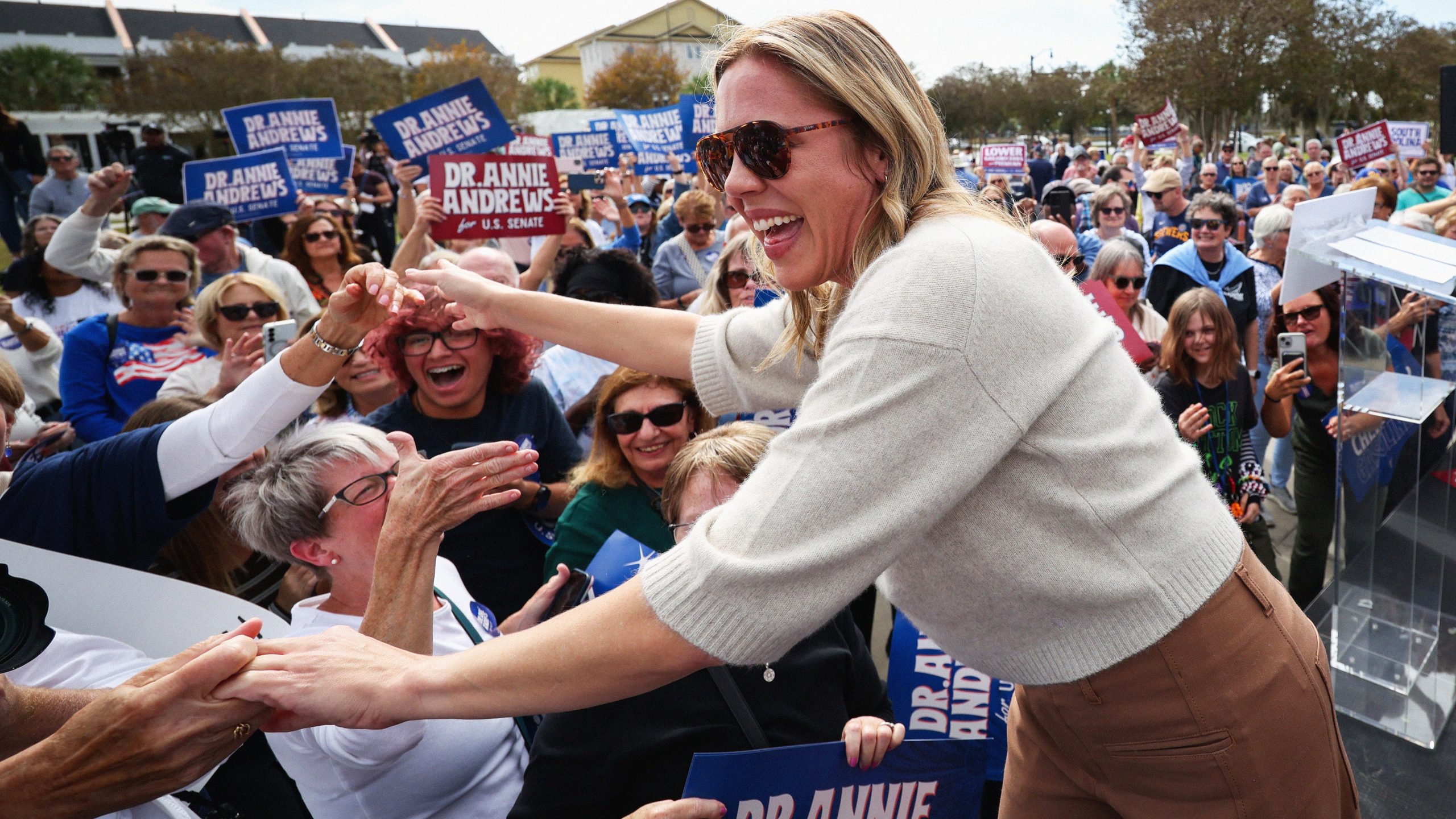
The last time South Carolina elected a Democrat to the Senate was in 1998, and until around 8 o’clock tonight, there wasn’t a lot of reason to think that streak would end anytime soon. The Palmetto State has been steadfastly Republican, launching the careers of some of the biggest stars in GOP politics, including the late Senator Lindsey Graham. With Graham’s sister running to succeed him, a continuation of Republican dominance seemed all but assured.
But tonight, South Carolina, where Donald Trump won by almost 18 points two years ago, sent a Democrat to the Senate. Annie Andrews, a pediatrician, flipped a seat held by the Republican Darline Graham, who took office after her brother died in July. “I don’t imagine you’ll find anybody in South Carolina who will say, Oh, I knew this was going to happen,” Kaye Koonce, a member at-large for the Democratic National Committee, told me.
So what did happen? Andrews benefited from a convergence of factors that seemed impossible just a few months ago, including a Republican candidate who struggled with the realities of electoral politics, a historically favorable environment for Democrats, and downballot organizing that helped turn out voters across the state. “The stars aligned,” Jaime Harrison told me. (The former chair of the DNC ran to unseat Lindsey Graham in 2020 and lost by more than 10 percentage points.) “We had a superior candidate. Darline Graham may be a very nice woman, but she wasn’t ready to be in the United States Senate.”
A majority of South Carolinians appeared to agree. Darline Graham was a surprise pick when Trump tapped her to fill out her brother’s term soon after his death. Graham then stunned many by announcing she wanted to run to serve a full term. A political novice, she struggled on the trail and made early gaffes that haunted her, including saying “national security is not my thing” in a primary debate against her opponent, Representative Ralph Norman. At times, it seemed almost as if Graham didn’t really want the seat. She hardly campaigned and she didn’t raise a lot of money. (Graham pulled in less than $600,000 during the first two weeks of October, while Andrews raised $4.5 million.)
After polls showed a tightening race, Trump stumped in the state twice last month to try to save Graham. But it wasn’t enough—and, in some areas, his presence may have even hurt her. (Civiqs’s state-by-state tracker found that as of today, his approval in South Carolina was down to just 40 percent.) Neither did it help that some Republicans had launched a grassroots write-in campaign for Norman after his defeat, and that his son, Warren Norman, wrote an op-ed titled “Why This Lifelong Conservative Won’t Vote for Darline Graham,” slamming the Republican for campaigning on fear and praising Annie Andrews.
Then you had Andrews, who was able to portray herself as a Washington outsider. “I really think the story is that people, no matter if they’re traditionally voting for Republicans, Democrats, or if they consider themselves independents, they’re tired of the Washington party politics,” Andrews told me when we talked by phone on the morning of Election Day.
Andrews said she never wanted to go into politics. She’s worked as a pediatric hospitalist at the Medical University of South Carolina Children’s Hospital for 14 years, but said she became so frustrated by how policy decisions were affecting her patients that she decided to try to change careers. “I knew that those families needed a voice, and that’s why I got involved. And I think that’s why my campaign is resonating and really kind of breaking through typical partisan voting patterns down here,” Andrews told me. After the Parkland school shooting in 2018, she joined the gun-control advocacy group Moms Demand Action, and in 2022 ran against Republican Representative Nancy Mace—and lost by nearly 14 points. But much has changed in the past four years.
Democratic organizing capacity has surged throughout the state—driven in part by South Carolina becoming the first state in what will be a highly competitive Democratic presidential primary in 2028. An array of Democratic hopefuls has visited the state this cycle—Gavin Newsom, Andy Beshear, Cory Booker—bringing energy and name recognition. For the first time in decades, all 124 South Carolina State House races had Democratic challengers, regardless of how safe the Republican incumbents may have been. Each one of those candidates worked to turn out the vote in their district, doing Democratic organizing that also helped Andrews. “Our theory of the case was, if you run a Democrat in every race, you’re giving everybody a choice. And when you’re giving people a choice, they turn out,” Harrison told me.
[Read: How the Democrats beat Trump]
They did turn out, with a record percentage of voters casting ballots in a midterm. Andrews won rural and suburban counties outside of Charleston that Lindsey Graham handily won six years ago. She even won rural Chester County, which Trump carried in 2024 by 17 points. Richie Gergel, a lawyer in Charleston who runs a Democratic voter-engagement group, told me that Andrews has a talent for turning out people who are “Democrat-ish”—as well as for converting Republicans. Gergel said he had been canvassing throughout Charleston and met many lifelong Republicans who said they were going to have to hold their nose and vote for the Democrat this cycle.
Of course, Andrews was also buoyed by the blue wave that swept the country Tuesday night, campaigning on the same issues that helped Democrats flip other tough seats: affordability, diesel prices, and tariffs. South Carolina has a large agricultural community that has been hammered on all three fronts. Andrews also heavily focused on the issue of health care, speaking from her experience as a doctor, criticizing the closure of rural hospitals and the surge in health-insurance premiums. Darline Graham, on the other side, ran a race that heavily focused on culture-war issues—which may resonate with the base but didn’t help with less ideological voters just looking for help gassing up their cars.
As the scale of GOP losses became apparent tonight, Trump posted on Truth Social that had he been on the ballot, “we would have won IN A LANDSLIDE!” We’ll never know if that was true. But his decision to back Darline Graham, an unexpected candidate whose heart didn’t seem to be in it, created an opening in South Carolina politics that many Democrats thought they would never see in their lifetime.
Source & Attribution
This One Place News story was acquired from theatlantic.com. OPN retains the source link and provenance for newsroom review.
Filed Under
Culture & Society • Economy & Finance • Politics & Law