
MBDA plans to fly ‘fat’ hypersonic interceptor demonstrator before end-2029
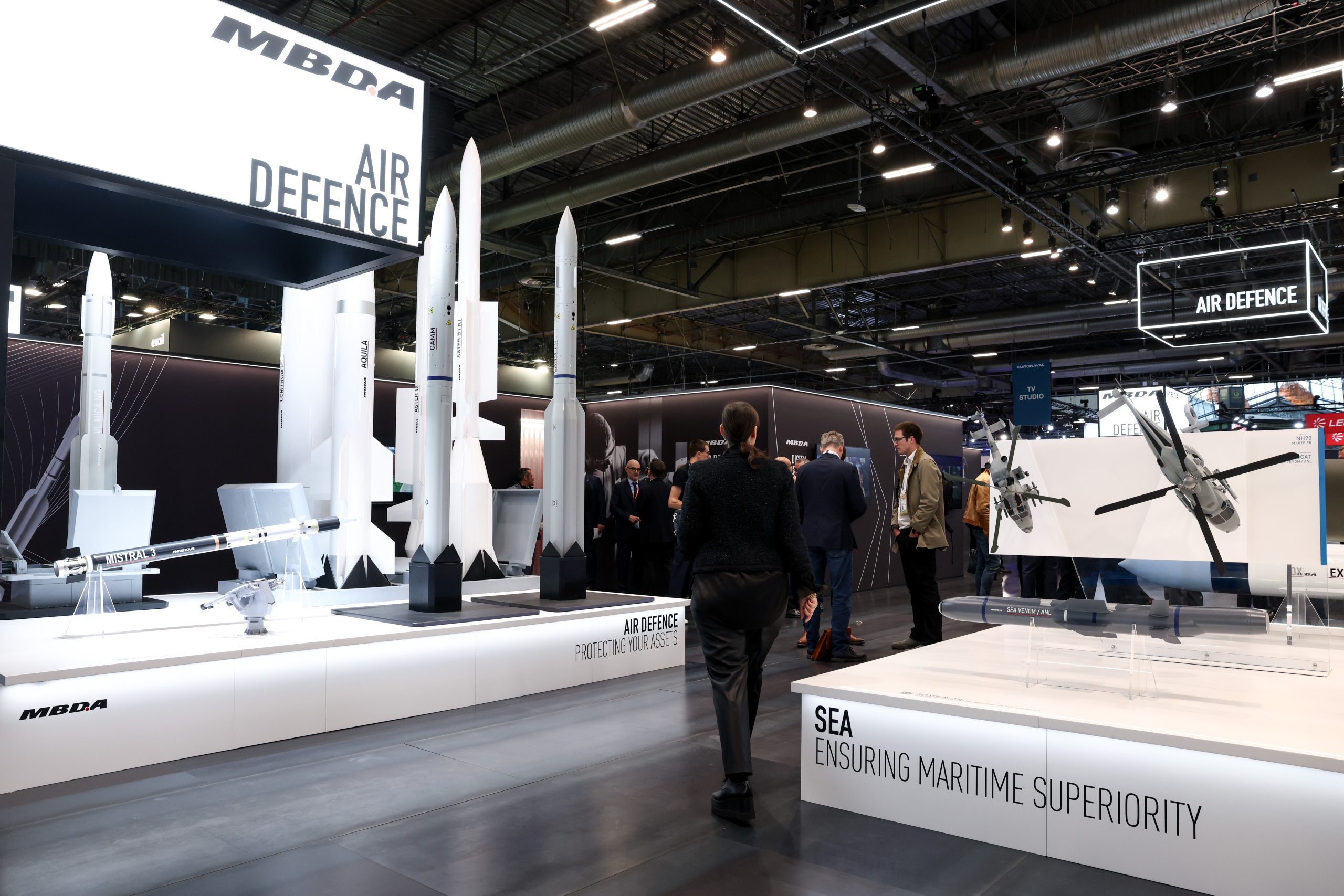
PARIS — An industry consortium developing a European hypersonic interceptor plans to fly a full-systems demonstrator by the end of 2029, project leader MBDA said in a briefing at the Euronaval maritime-defense exhibition.
The program, named Hydis, is competing with the Hydef program coordinated by Spain’s Sistemas de Misiles to secure €100 million (US$112 million) in European funding for the second development phase of the interceptor. A decision about who will get the financing is due at the end of the month, Lionel Mazenq, MBDA’s vice president for program incubators, said Nov. 4.
While China and Russia have been developing hypersonic glide vehicles for attack, Europe lacks capabilities to intercept them, something Hydis and Hydef seek to address. Both projects received European funding for their initial development, but the European Defence Funds plans to fund only one of the two proposals as part of its 2026 work program.
The Hydis interceptor is designed to address a large number of threats that are “very diverse in terms of behavior,” Mazenq said. “Today nothing is able to intercept this portfolio of threats, absolutely nothing.”
With the final concept selected, the consortium is now undertaking a number of on-the-ground demonstrations to bring technology readiness to level 3 or 4 as part of the first phase of the project, the executive said. The commonly used technology readiness scale spans nine tiers, with the highest level representing a system completely developed and proven to work.
For the second phase, Hydis will expand to 36 industrial and research partners as well as 14 subcontractors, from the current 19 companies involved in the project, according to Mazenq. Companies joining the consortium include Safran, which will provide terminal-guidance sensors, as well as Thales, Saab and Leonardo for capabilities such as communication and data links.
The current three-year phase of Hydis, which runs until May 2027, has received €80 million in European funding, with additional funding of €57 million from the four supporting countries France, Italy, Germany and the Netherlands.
The project will expand to 17 countries for the second phase, with 11 member states contributing a combined €133 million of funding in addition to the European money, MBDA said. Germany is dropping out as a partner country for the second phase of the project, according to the briefing documents.
The companies involved in the project will also provide more than €10 million in combined funding, Mazenq said. The consortium is “working on fallback options” should the European Commission choose Hydef instead, though Mazenq said “we are thinking that we will win.”
The second phase is set to run from mid-2027 to mid-2029, and will include full-scale flight trials, according to Mazenq. At the end of the second phase, Hydis aims for a level of technology readiness between 3 and 6 for all functions, with a full-systems demonstrator “by the end of the decade, so very soon after.”
Production of the interceptor is scheduled to start in the first half of the 2030s, the executive said.
France, Italy, Belgium, the Netherlands, Sweden and Poland will provide “massive contributions” to the project, with smaller contributions from other countries, he said.
The MBDA executive presented a design for a four-stage missile, a “multi-stage stratospheric hypersonic interceptor” capable of dealing both with hypersonic threats arriving horizontally at medium altitudes, as well as ballistic missiles that approach with a relatively steep dive, and which must be intercepted “relatively early” in the upper layers of the atmosphere.
The Hydis partner countries as well as the European Commission requested an interceptor that covers both ballistic and hypersonic defense, “which requires, effectively, an additional effort in terms of design,” but brings advantages in terms of being able to stockpile a single missile against multiple threats, Mazenq said.
China is probably the country that is ahead in developing hypersonic weapons, more than Russia, with its DF-17 hypersonic glide vehicle the most advanced in service today, according to Mazenq.
“So being obsessed just by Russia is not the solution to prepare a robust system for defending Europe, not only the European continent, but also our forces deployed around the world,” the executive said.
The big challenge of intercepting hypersonic glide vehicles is their maneuverability at altitudes between 30 and 45 kilometers, which means that a slight turn can change the projected interception point by tens or hundreds of kilometers, according to the MBDA executive.
Predicting the trajectory of hypersonic threats will be key to intercepting them, with artificial intelligence running real-time models as soon as a target is detected to identify the right time and place to intercept, updated throughout the flight of the interceptor as it climbs towards its target, Mazenq said.
“This capability is absolutely essential because if you don’t have it, the pressure on the design of the interceptor is such that it’s impossible to do.”
Target and interceptor encounter velocity can reach 5 kilometers per second, according to Mazenq.
The only equivalent to the European program is the U.S. Glide Phase Interceptor project, which was awarded to Northrop Grumman, Mazenq said. The difference with the European project is that GPI only addresses the hypersonic glider threat, with intermediate-range ballistic missiles handled by exoatmospheric interceptors such as SM-3, according to the MBDA executive.
Hydis is aiming for a “robust design” that can be effective with a limited number of sensors. While the system is designed to be integrated with European space-based missile early-warning capabilities JEWEL and Odin’s Eye, it must also be capable of delivering “a good performance” with only a long-range radar, Mazenq said.
“That’s an additional challenge, but this is absolutely necessary to strengthen the future capability and to make it robust to all the conditions that can be encountered during a conflict.”
Hydis aims for its interceptor to cost less than a third of the unit price of an SM-3 missile, according to Mazenq, who didn’t clarify which version of the U.S. missile when asked. The SM-3 Block 1B missile costs $9.7 million to $12.5 million per intercept, while the price tag for the Block IIA missile is $27.9 million, according to the non-profit Missile Defense Advocacy Alliance.
The Hydis concept is hit-to-kill, and the interceptor builds on technology from existing programs, particularly MBDA’s Aster air-defense missile for flight control, while Italy’s Avio provides high-performance solid rocket motors. The system is designed to defeat a hypersonic threat with a maximum of two interceptors fired, according to Mazenq.
A visual comparison with the Aster B1 NT air-defense missile in the presentation indicated an interceptor that stands around 30% taller, with a length of about 7 meters (23 ft). Mazenq said the missile will be compatible with vertical-launch systems onboard ships, including the Mark 41 vertical-launch cell as well as a future version of Naval Group’s Sylver VLS.
“It’s effectively four-stage with a very high capability of acceleration, because we want to fire it as late as possible, due to the indetermination of the hypersonic threat trajectory,” Mazenq said. “So it’s a bit fat, but it’s a Formula 1. It’s hypersonic, truly hypersonic, not just Mach 5.”
Source & Attribution
This One Place News story was acquired from defensenews.com. OPN retains the source link and provenance for newsroom review.
Filed Under
Military News