One Place News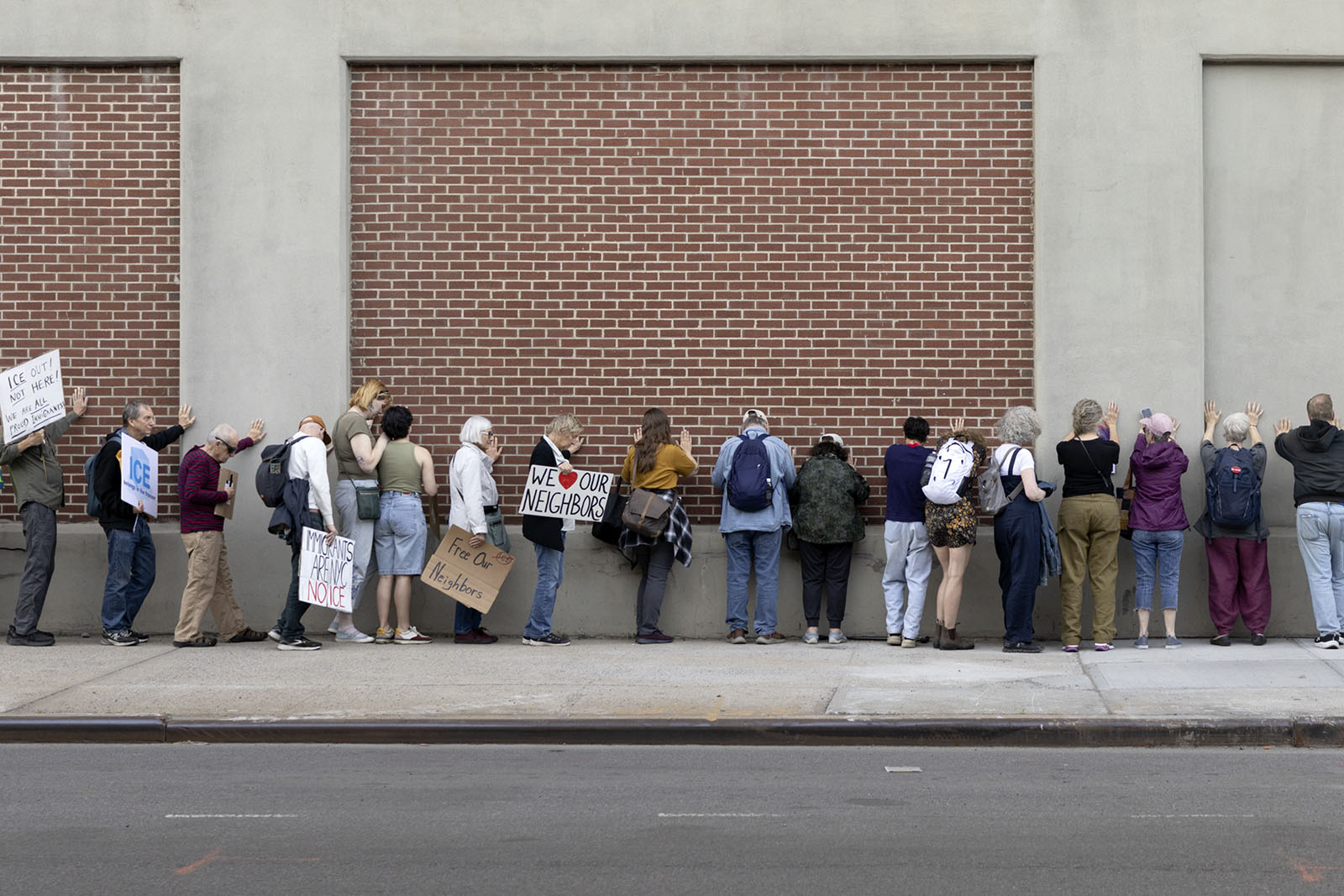
BROOKLYN, N.Y. (RNS) — On a recent Sunday, minutes before their afternoon service, members of Good Shepherd Lutheran Church gathered around a wooden table in the entrance of their Bay Ridge, Brooklyn, sanctuary for one of the congregation’s most sacred rituals: a potluck meal. Congregants filled their plates from aluminum trays with rice and beans and chicken stew, then took their seats for a meal that has, for a few years now, helped bind this tight-knit community together.
Among those attending was Silvia Feliz, who first walked through the doors four years ago, not for fellowship but for a food basket. The Dominican caregiver was new to the U.S., battling depression and searching for work. Now the vice president of the church council, Feliz helps run the church’s clothing donations and food pantry and sometimes cooks for the communal meals.
Good Shepherd’s unapologetic support for immigrants is what made her plant roots in the congregation, she said. The church, led by the Rev. Juan Carlos Ruiz, who emigrated from Mexico and became a U.S. citizen in 2001, has been built around the conviction that supporting and advocating for immigrants is inseparable from the Gospel.
“It’s something truly beautiful,” said Feliz in Spanish. “The priest preaches about love for others, and it’s not just that he preaches it; he actually practices it.”
For church members — most of whom are immigrants from Latin America, some without legal status in the U.S. — the commitment made by the congregation is inspiring. Every week, they prepare food baskets, operate a legal clinic and stand beside church members appearing in immigration courts at 26 Federal Plaza, a Lower Manhattan immigration court. They also hold weekly prayer vigils outside of a nearby U.S. Immigration and Customs Enforcement detention center.
And as the Trump administration steps up its mass deportation efforts — Immigration and Customs Enforcement rounded up 10,000 people over five days in July, while at least 10 people died during encounters with immigration officers within the last year — the church is innovating, coming up with new ways to protect congregants. One church member, for instance, is working on developing an encrypted app to connect volunteers and community members in need. As fear drives many immigrants away from public life, Good Shepherd offers a counter-story: an immigrant-majority church led by an immigrant, committed to providing care, protection and resistance.
Ruiz, or “Padre Juan,” as church members call him, is a recognizable figure in New York’s advocacy circles, with decades of experience advocating within and for immigrant communities. In January, Ruiz, 55, was among a dozen faith leaders invited to give a speech at Mayor Zohran Mamdani’s interfaith breakfast.
Andres Jimenez, a Good Shepherd member who emigrated from Colombia in the 1990s, said Ruiz’s deep ties within New York’s immigrant communities help sustain the church’s work.
“Having a faith leader with the community, it helps them; he guides them into resources,” he said. “The padre is someone they trust.”
Since Ruiz became Good Shepherd’s senior pastor in 2018, the congregation has become multiethnic and bilingual, drawing many immigrants from Central and Latin America. At least some of the change in membership is due to Ruiz’s longtime advocacy for immigrant communities across New York City and New Jersey. Last year, as ICE agents began routinely picking up immigrants appearing for immigration court hearings, Ruiz started going to the Federal Plaza’s immigration courts multiple times a week to accompany immigrants, sometimes advocating on their behalf before judges, according to Jimenez. At least ten church families have had at least one family member arrested by ICE, Ruiz said in an interview in April. The church has filed habeas corpus petitions to seek their release, but some were already transferred to out-of-state detention centers.
Religious institutions “have a spiritual power, they have moral power, and we do need to use that for the well-being of our communities,” said Ruiz. “We have a biblical prophetic tradition that tells us, when injustice is done to one of our brothers and sisters, that injustice is done to the whole body, to all of us.”
The church’s advocacy also reflects the commitments of its denomination, the Evangelical Lutheran Church of America (ELCA), a self-described “sanctuary church body.” Good Shepherd is also part of the New Sanctuary Movement, a coalition Ruiz co-founded in 2006 to build on the 1980s movement of churches that offered sanctuary to Central American migrants.
Ruiz’s commitment is also personal. He arrived in the U.S. at age 16 and overstayed a tourist visa to join his parents and siblings. He spent eight years without legal status, part of what he calls the “undocumented river of humanity.” He recalls the fear and constant vigilance during those years. “I do remember really being always looking over my shoulder,” he said.
Years later, after being ordained as a Catholic priest in the diocese of Paterson, New Jersey, Ruiz worked alongside Daniel Berrigan, a Jesuit priest, and his brother Philip Berrigan, a former Catholic priest; the brothers were both anti-Vietnam War activists who were incarcerated for their activism. While serving as a priest at many small New Jersey parishes, Ruiz then worked to address the needs of immigrant agricultural workers through the “Migrant Ministry,” a group of pastors who traveled between Parsippany, Sparta and Morristown to support the workers. There, Ruiz lived with Father Gustavo Gutiérrez, the Peruvian theologian once disgraced by the Vatican (but later partly rehabilitated by Pope Francis) for his focus on the “liberation of the oppressed” and social justice for the poor.
From those three men, the pastor said he learned to be an activist and what preaching is for. “You preach so that you can comfort the afflicted and afflict the comfortable,” he said. “And in that way, that’s how I preach.”
You preach so that you can comfort the afflicted and afflict the comfortable. And in that way, that’s how I preach.
Rev. Juan Carlos Ruiz
Following clashes with his supervisors at the Diocese of Paterson, who deemed him “too political,” according to Ruiz, he left the Catholic Church, converted to Lutheranism and eventually joined Good Shepherd.
At Good Shepherd, Ruiz has placed a major focus on the church’s immigrant ministry. Last year in June, after the Metropolitan Detention Center, a notorious Brooklyn federal prison known for poor living conditions, started housing ICE detainees following an agreement between the Federal Bureau of Prisons and ICE, Good Shepherd began a weekly prayer vigil outside the building. The interfaith gathering quickly attracted other clergy, congregants and immigrant rights activists.
On a recent Tuesday in May, a little after 6 p.m., nearly 30 people met in front of the MDC building, some holding “ICE Out of New York” and “Honk if you love democracy” signs, prompting encouragement from drivers who raced down the adjacent highway.
The hourlong gathering typically would end in a silent procession toward the penitentiary’s gates, where members sing and pray. But after offering prayers and reflection with Rabbi Stephanie Kolin of Congregation Beth Elohim, a Reform synagogue in Brooklyn, Ruiz broke the group’s routine. Inviting participants to lay their hands on the facility’s walls, the pastor urged them to reflect on the injustices happening inside.
“This place is visible rejection; it’s a sign of our soul, of our national soul,” he told the group, most of whom kept their eyes closed in silent prayer.
The vigils, like most actions led by the church, are made possible by immigrant members of the church, like Raul Ayala, a Good Shepherd member from Ecuador and musician who often plays at the vigils. At the end of one February vigil, Ayala stood across the prison’s gates to blow in a pingullo, a wooden flute instrument from Ecuador. For Ayala, the sound of the instrument played during equinox and solstice celebrations in Quechua culture is a symbol of resilience.
“There’s not a way to enter this building, and the only way that we can make presence is by sound and by presence,” Ayala said.
When asked about the vigils, a spokesperson for the Department of Homeland Security said the agency reminded “peaceful protestors and members of the media to exercise caution. Being near unlawful activities in the field does come with risks – though our officers take every reasonable precaution to mitigate dangers to those exercising their protected First Amendment rights. … The First Amendment protects speech and peaceful assembly – not rioting. DHS is taking reasonable and constitutional measures to uphold the rule of law and protect our officers.”
In recent months, as ICE operations have intensified and some immigrants have opted to stay home and avoid religious services, Good Shepherd, like many churches, has seen a decline in attendance. The church once counted 200 families, according to Ruiz. At a recent service, there were roughly 30 people.
“Because of the raids, because of ICE, people have stopped coming to the church. They’ve ceased attending,” said Feliz.
As a result, church members reinvented how they deliver services and conduct outreach. In January, the church’s food pantry, which serves nearly 100 people, went fully online. Instead of picking up food baskets at the church, volunteers connect with families via WhatsApp to deliver packages directly to their doors.
Still, the church worried that using apps might make members vulnerable to surveillance. Nearly a year ago, Jimenez, who is also a web developer, started developing the “Dignity Toolkit,” a mobile encrypted app that safely connects immigrant families and volunteers. It launched in January 2026. Developed through a partnership with New York for All, a local coalition that includes Good Shepherd, the app is being built on a local server so it won’t rely on cloud infrastructure provided by Amazon, Microsoft or Google. The tool connects unaccompanied minors with adults to help them navigate the immigration system and pairs families with translators for court and medical appointments, he said.
“How can we minimize that fear for people?” Jimenez said. “Living in fear is not easy. Living in fear, they cannot make good decisions, and that’s something that affects the whole community and the church.”
Several times a week, Eliana, a church member who asked to only be identified by her first name due to fear of ICE, journeys from Queens to Bay Ridge, an hour commute, to help out on the church’s legal clinic. Eliana, who emigrated from Colombia and received help from Ruiz for her immigration procedures, helps church members draft letters and personal statements for their applications. The young woman said she trained herself by watching Ruiz and other church members, as well as watching video explainers.
“I wanted to give back what they did with me to others,” she said in a recent interview in Spanish.
Feliz said she didn’t fear personal consequences for the church’s activism.
“I don’t know why; I just don’t feel scared.”
Aleja Hertzler-McCain contributed to this report.