One Place News
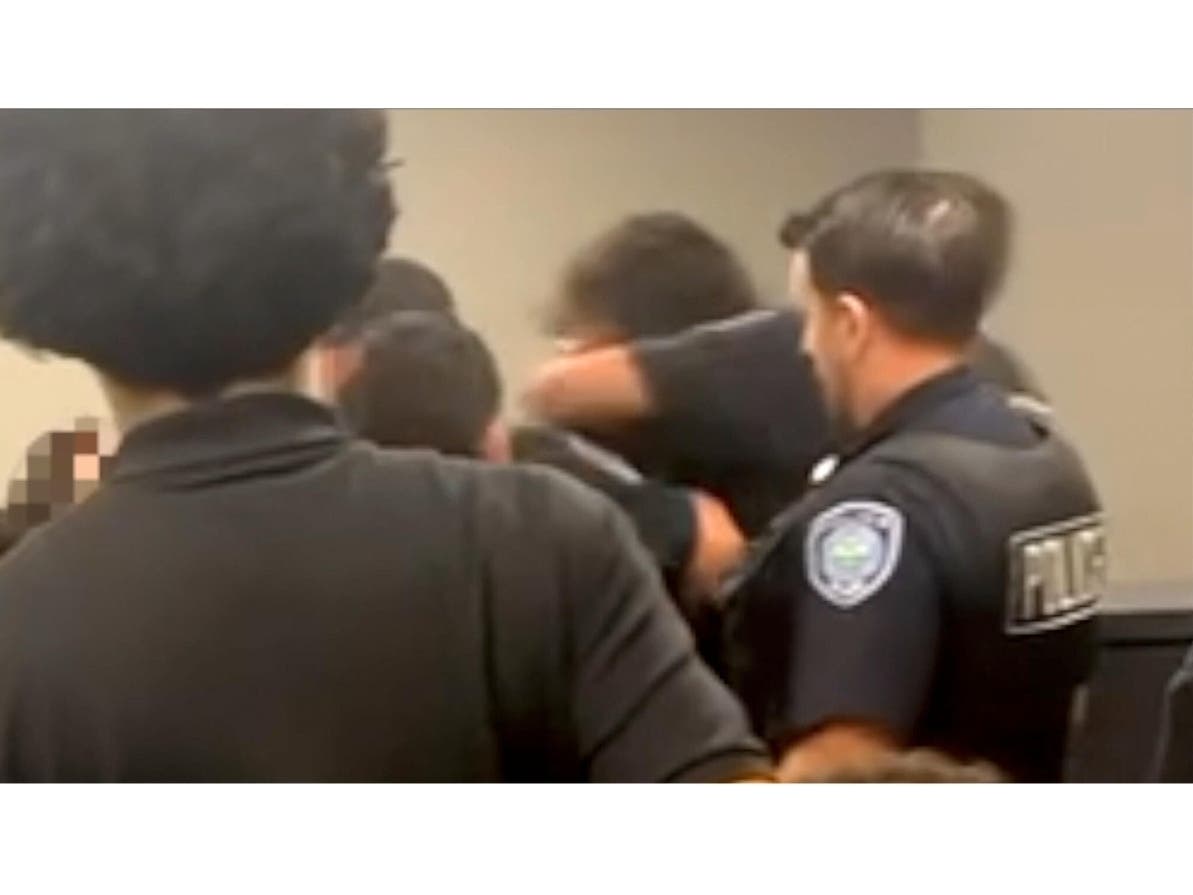
(RNS) — Six police officers removed a 14-year-old Muslim boy from a meeting of the Fire and Police Commission of Oak Lawn, Illinois, a close southwest suburb of Chicago, last month. Video taken at the meeting appears to show one of the officers applying a chokehold. Reportedly, in the course of removing him, “officers threw the boy into a counter at the rear of the room,” according to local news reports.
Criminal charges were brought subsequently against the boy’s mother after she “interfered with the officers” who used so much violence against her child. He attended the meeting with a group of Arab American activists who have regularly protested at village public meetings over alleged racist police misconduct.
All of this took place at an open public meeting of a municipal government in the United States. And, despite happening in a major media market, these outrageous events have raised scarcely a peep across a nation wearied and exhausted by government assaults against religious and racial minorities.
We should say, the boy was not innocent. He called Fire and Police Commission Board Chair Jim Baker a “jackass” after Baker mispronounced his name. Baker had the boy removed for his use of an “obscene” word, per local reporting, yet one so mild it can be printed here again— “jackass.” Still, the boy did not step away after being told he should. Readers can judge for themselves whether they think the force used by police was proportionate to what the boy did.
Good people can ask themselves how they would react if this happened to their child. We can wonder if there were other ways Mr. Baker might have handled an adolescent who has not matured enough yet to manage his anger when he was misnamed. My sense is that what happened was deeply disordered. It is a danger signal about who we all have become in this country.
I think these events in Oak Lawn are worth a look as the 25th anniversary of the Sept. 11 attacks arrives Friday. I grew up in Oak Lawn and still live nearby. I can remember when hundreds of people marched around a neighboring mosque, terrorizing local Muslims in the days following 9/11. One shouted “Kill the Arabs,” the Chicago Tribune reported, while others hurled insults at anyone who looked like they might be Arab. That largely forgotten event was shameful. But these recent events testify to how such shameful behavior continues a quarter-century later because, speaking plainly, the trouble with Oak Lawn is that it is so typical.
According to 2025 estimates from the U.S. Census, Oak Lawn is slightly less white than the rest of the United States. It is somewhat less Black. At 24%, Oak Lawn is more Latino than the U.S. overall (20%).
In all those cases though, the differences are not so great. Oak Lawn is not simply MAGA. In 2024, Kamala Harris carried more Oak Lawn precincts than Donald Trump. Like the whole United States, the village is complex. But once we look past race and party affiliation toward the religious and cultural landscape, things clarify a bit.
Oak Lawn was founded in 1882. The first Catholic church came to town in 1934. But like a lot of the near-in suburbs of Chicago, the population boom came after World War II. By the time I was born in the early 1970s, Oak Lawn was home to 60,000 people and five Catholic parishes.
Still today, Oak Lawn is defined by a boomer-era civic culture that is as flag-wavingly patriotic as the M4 Sherman tank parked as a war memorial on its main artery, where banners honoring local veterans line the street. And of course, the pervasiveness of its Roman Catholicism also defines Oak Lawn. That cultural intersection is where we need to pay attention.
When we look around the globe, it is not hard to see an unnerving pattern among patriotic white Catholics and Christians. In Austria, France, Hungary, Italy, the Netherlands, Poland, Slovakia, the United Kingdom and elsewhere, political leaders and candidates have rallied voters to defend Christianity against the perceived encroachments of Islam. And no matter how the Catholic Church and many other Christian churches have invited their members to see Muslims as neighbors and fellow believers we should “esteem,” many Catholics and other Christians have been difficult to persuade. Let us not forget, the outspokenly Christian U.S. secretary of defense defines himself as a “crusader.” Especially in places like Oak Lawn, where Muslims have become neighbors to patriotic Christians in greater numbers across recent decades, tensions have simmered and have sometimes boiled over.
That is where I return to on Sept. 11, whose memory we observe as Patriot Day. Consider the implications of that naming and what it says to those whose Christian faith is wrapped around their patriotism.
I was not in Oak Lawn on Sept. 11 myself. I was in Washington at a spot where I could see the first plumes of black smoke rise off the Pentagon, a building where I worked from 1996 to 1999. No one needs to explain the horror of that day to me. Yet, having been so near the event, “patriot” is not the word that comes first to my mind when I think about that day.
Sept. 11 was not an attack on patriotism. Those who hijacked the planes attacked pluralism, the idea that different sorts of people can and should live together in peace. And we Americans have done a poor job proving the attackers wrong about pluralism in the years since 2001 because it has become too easy for us to take for granted that the opposite of a patriot is a Muslim.
There are a lot of Muslim patriots. A 14-year-old boy who shows up at a public meeting to speak for his community is a patriot. But plenty of Muslim patriots like him also have had a hard time in the U.S. since the first Patriot Day, and too many have been assaulted or made miserable.
Oak Lawn is what the United States has become. Like the rest of the country, it is a place where, across 25 years, even good people drank the poison that eventually became MAGA’s racism and xenophobia. The problem is not isolated to any place or people here. It is rampant, and it is our shame.
This 25th Patriot Day comes months after the Operation Midway Blitz immigration enforcement happened in Illinois, and just as Operation Rotten Apple in New York ended. Los Angeles, Minneapolis and more American cities have felt the consequences of how much we have come to fear people who are not exactly like the prevailing, patriotic picture of Christian America. Our xenophobia has metastasized to the point where we even find it difficult to accept the presence of migrant Latinos who are Christian. Our cruelty has become casual, and its subjects are consistent.
What happened in Oak Lawn last month is one piece of a large data set of incidents across the past 25 years that tells a disheartening story about how too many of us fear an America that is changing. All together, they tell us that in too many ways, this anniversary finds the United States still unable to defend the American way that the Sept. 11 terrorists attacked.
(Steven P. Millies is a political theorist and professor of public theology and director of The Bernardin Center at Catholic Theological Union in Chicago. The views expressed in this commentary do not necessarily reflect those of Religion News Service.)