
David Ellison Will Get Control of CNN After All
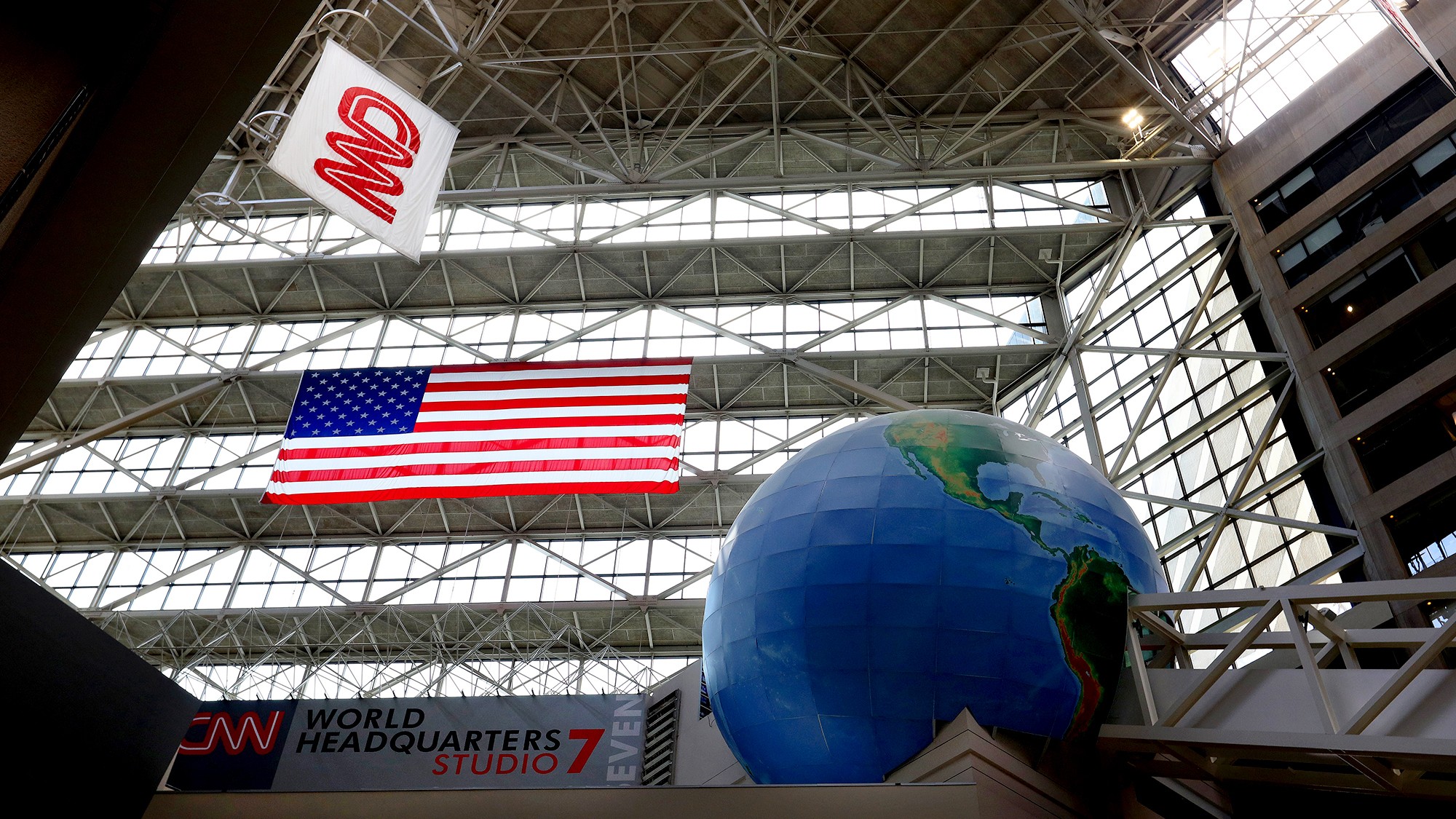
Eighteen months ago, David Ellison was mostly known as an ATM for Hollywood producers seeking to pad out budgets for dad-core flicks such as Jack Ryan: Shadow Recruit, Jack Reacher: Never Go Back, and Transformers: Rise of the Beasts. But now, thanks to a timely reallocation of his father’s money, he’s set to be one of the biggest news-media moguls in American history. Having already taken control of CBS News—with little to show for it audience-wise but plenty ideologically—he seems clear to add CNN to his roster of outlets.
His acquisition, through Paramount, of Warner Bros. Discovery has been held up by a lawsuit filed by blue-state attorneys general over antitrust questions. One reported goal of the AGs was to have Ellison sell CNN in order to close the deal, though California’s Rob Bonta labeled that speculation. But yesterday morning, those AGs appeared to give up their fight. As Benjamin Mullin, David McCabe, Shawn Hubler, and Laurel Rosenhall at The New York Times reported:
After weeks of on-again-off-again negotiations, Paramount and the states agreed to a number of concessions to complete the deal, according to the people, who spoke on condition of anonymity to discuss details not yet made public. The entertainment giant has agreed to establish a board of journalists to ensure the editorial independence of CNN and CBS News and committed to distributing 30 movies in theaters every year. The company also pledged to spend an additional $1.5 billion on film production over the next five years.
So although another major national news outlet will be under the control of a major Trump ally, at least there’ll be “a board of journalists to ensure the editorial independence”! (That this is happening while the president Ellison supports is banning all CNN reporters from the White House adds a tragicomic veneer to the story.)
If this particular move sounds familiar, that’s because such “boards” have been a part of other news-company acquisitions that have raised similar concerns about antitrust or editorial control. These boards’ effectiveness has been, to be generous, extremely limited. Two of the most prominent examples—both involving Rupert Murdoch—offer little reason for optimism.
[From the April 2025 issue: Growing up Murdoch]
The first began in 1981, when Murdoch wanted to purchase The Times of London and The Sunday Times. The editors of both papers were skeptical. In order to avoid an inquiry by Britain’s antitrust authority, Murdoch agreed to empower a set of “independent national directors” who would have to sign off on the firing or hiring of any top editor, and who would also resolve any major disputes between Murdoch and editors.
In practice, this did not work out. As the legendary editor Harold Evans put it in his 1983 book, Good Times, Bad Times:
[Murdoch had] guaranteed that the editors would have control of the political policy of their newspapers; that they would have freedom within fixed annual budgets; that the editors would not be subject to instruction from either the proprietor or management on the selection and balance of news and opinion; that instructions to journalists would be given only by their editor; and that any future sale of the titles would require the agreement of a majority of the independent national directors. In my year as editor of The Times, Murdoch broke all these guarantees. He put his point of view very simply to the home editor of The Times, Fred Emery, when he summoned him from holiday on 4 March to his office shortly before asking for my resignation: ‘I give instructions to my editors all round the world, why shouldn’t I in London?’
Evans lasted only a year under Murdoch’s ownership. A longer run was had by the conservative editor Andrew Neil, who edited The Sunday Times from 1983 to 1994. Giving parliamentary testimony in 2008, Neil said that the “independence” offered by these outside board members was not about real authority; it was about smoothing the path of an important news outlet into regime-friendly hands:
First of all, let us just remind ourselves. It was a conceit invented by John Biffen and the Thatcher Government to allow Mr. Murdoch to take over these papers in the first place, and it was put in place for that reason. It was not really put in place to protect the independence of the editors.
Neil, arguably the most prominent conservative British journalist of the past half century, was no fellow traveler of the left-wing Guardian, yet he contrasted that paper’s control by the Scott Trust with the kabuki theater of an “independent board”:
The Scott Trust is a perfectly legitimate way of running a newspaper and, as you can see from the success of The Guardian and its on-line success globally, it works. That works. It is entirely different from the strong proprietor who controls the shares and the business of that company appointing a couple of trustees as a fig-leaf.
The second example came in 2007, when Murdoch made an unsolicited offer to the Bancroft family to acquire Dow Jones and its flagship newspaper, The Wall Street Journal. Several family members were concerned about what Murdoch ownership might do to the newspaper’s quality, and as part of the eventual sale, Murdoch agreed to the appointment of a “Dow Jones Special Committee” that would, much like its London predecessor, have final say over the hiring and firing of top editors, as well as changes that could be construed as forcing an editor out.
With that guarantee in place, enough hesitant Bancrofts were persuaded to sell—though not everyone was on board. “Although I’m convinced that News Corp. offer is very generous in financial terms,” Dieter von Holtzbrinck, a Dow Jones director, wrote in his resignation letter, “I’m very worried that Dow Jones unique journalistic values will long-term strongly suffer after the proposed sale.” He added, “I do not believe that the ‘Special Committee’ can finally prevent Mr. Murdoch from doing what he wants to do, from acting his way.”
Barely four months after the transaction closed, he was proved right. Murdoch managed a nifty end run around the “special committee” and ousted the newsroom’s top editor, Marcus Brauchli. Murdoch didn’t fire Brauchli. Instead, he layered over him, naming the former Times of London editor Robert Thomson as publisher, but giving him direct oversight of the newsroom rather than the position’s usual business-side responsibilities. Brauchli, frozen out of major decisions in the newsroom he allegedly led, sent a note to staff saying he had “come to believe the new owners should have a managing editor of their choosing.” Brauchli was well compensated with a nice “consulting” gig for Dow Jones.
Because Brauchli had resigned rather than be fired, the approval of the special committee was not required. Murdoch informed its members as a fait accompli, telling one, “I have no doubt that The New York Times will make trouble with it for a day or two, but I’m not too bothered by it.” The committee later issued a statement in which members “expressed the view that learning of the Brauchli matter after the fact failed to meet the letter and the spirit of the agreement.” But alas, the committee “decided there was no practical way to ‘unresign’ Brauchli and start the process over.”
[David A. Graham: Hindsight is 2024]
The reporter Sarah Ellison (no relation to David), in her book on the Murdoch takeover of the Journal, described the special committee as “an artificial set of rules he would inevitably circumvent,” which seems dead-on.
Right now, we don’t know much about what a CNN (or CBS News) “independent editorial board” will look like. Bloomberg News reports that it “will be composed only of journalists, with no executives or shareholders allowed to join,” and that “the board will be required to have political balance.” The deal does not appear to have any sort of hard enforcement mechanism built in for any violations of the “the letter and the spirit” of the editorial independence agreement. (By contrast, it does include a $30 million penalty for each film Paramount promises to release to theaters but doesn’t.)
But let’s be blunt. No matter how well intentioned the members of these committees may be, if David Ellison wants to get around them, he will. The rules being put in place are an artificial set that a billionaire owner will inevitably circumvent. Such “independent” boards are PR gestures, not vehicles for editorial protection. As Andrew Neil said, they are tools to get a controversial deal across the finish line. And at that, they seem to have succeeded once again.
This post appears courtesy of Nieman Lab.
Source & Attribution
This One Place News story was acquired from theatlantic.com. OPN retains the source link and provenance for newsroom review.
Filed Under
Culture & Society