
As the US and China race on AI, the Vatican presses for global safeguards
Get RNS’ thoughtful, essential religion reporting every morning. Sign up for free!
VATICAN CITY (RNS) — On Friday (Sept. 25), Pope Leo XIV is scheduled to give a keynote address at UNESCO headquarters in Paris, marking the first papal visit to the United Nations Educational and Scientific Organization in more than four decades, and capping off “a day of reflection on artificial intelligence, education and peace,” according to the organization.
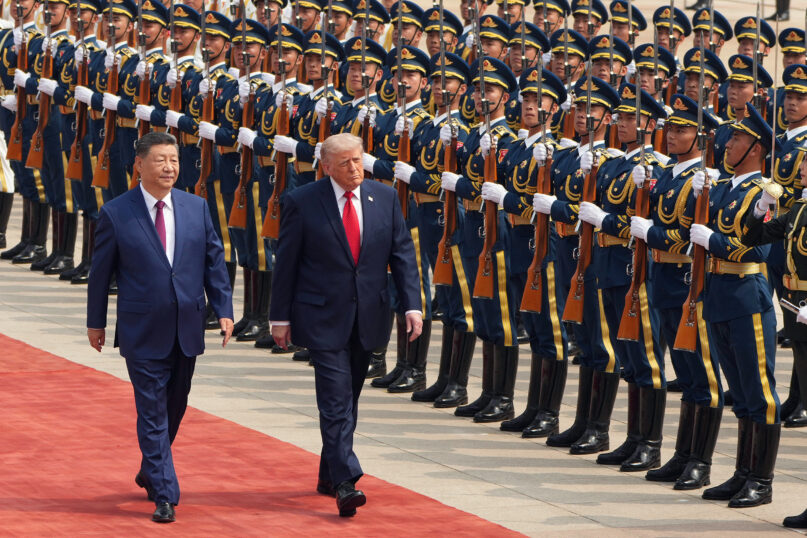
The pope’s visit to UNESCO comes on the heels of a Washington summit between Presidents Donald Trump and Xi Jinping on Thursday, in which the two are expected to discuss, among issues of trade, the potential for shared AI guardrails between the U.S. and China.
Looming over the Trump-Xi summit are recent escalating demands for AI regulation — including from the leaders of top AI companies, who are calling for a global slowdown on AI development amid revelations of rogue AI agents and increasingly dire predictions that include civilizational annihilation. While Xi has publicly endorsed international cooperation on AI safeguards, Trump has resisted, dismissing the catastrophic warnings as a “hoax.”
As the U.S. and China race for artificial intelligence supremacy, Pope Leo XIV has pressed both powers to accept international safeguards on the technology. Meanwhile, through formal diplomacy and a Catholic network reaching from Beijing and Washington to Silicon Valley and the Global South, the Vatican is quietly positioning itself as a moral convener in the AI debate and a potential bridge between the rival superpowers.
“Pope Leo could be instrumental in reviving the bilateral U.S.-China diplomatic engagement on AI safety,” said John-Clark Levin, an artificial intelligence researcher at Yorktown and advocate for greater Vatican involvement in AI governance.
In his May encyclical on AI and the digital revolution, “Magnifica Humanitas,” Pope Leo offered the church’s teachings on human dignity and the pursuit of the common good to tech entrepreneurs and world leaders, while calling for stronger regulation and oversight of AI companies and models.
On Friday, Leo will take his appeal for AI regulation to UNESCO’s 194 member states, of which China is one. U.S. representatives will also be present despite the country’s plan to withdraw at the end of 2026.
“The voice of the pope is a powerful ally,” for establishing international AI guardrails, said UNESCO spokesperson Matthieu Guével during a Sept. 7 press conference.
Though Vice President JD Vance once suggested Leo could help broker a U.S.- China pause in the AI arms race, calling it “one of the most profound and positive things” the pope could do for the world, Vance has since echoed Trump’s skepticism, questioning AI companies’ calls for regulation and urging them to police themselves.
But the pope’s formal address to UNESCO is only one of several recent Catholic diplomatic initiatives on AI.
On Monday, Archbishop Vincenzo Paglia, the former head of the Vatican’s think tank on life and bioethics, is speaking at the Gates Foundation’s Goalkeepers event on AI equity in New York City. In an August essay, Bill Gates said he was “fascinated” by Leo’s encyclical, and Paglia confirmed to Religion News Service that he had a two-hour private meeting with Bill Gates three months ago and plans to speak to him privately again during Monday’s event. Gates has already had meetings with President Trump and his team and said he hopes to meet Xi later this year. He also pledged $1 billion to combat AI inequality in the Global South, an important issue for Pope Leo.
On Sept. 16, roughly 30 bishops of the U.S. episcopal conference held a two-and-a-half-hour private meeting with seven AI experts representing four technology companies. Bishop Oscar Cantú of San Jose, who was recently appointed to lead the U.S. bishops’ AI task force, said the tech leaders raised concerns ranging from job losses to uncontrollable models and sought the Church’s support for regulation amid resistance from the Trump administration.
“The value system of the Church and of the White House are not in sync, particularly in this regard,” Cantú told RNS, adding that he hopes the White House will “think about not just the bottom line or our ego as Americans,” but the common good of society.
In August, Democratic Rep. Ro Khanna of California, whose district includes major AI companies, co-led a bipartisan congressional delegation to the Vatican to discuss AI ethics, human dignity and national security. And, last week, more than a dozen bishops went to Capitol Hill to urge lawmakers to adopt AI safeguards. Cantú did not participate in the visit but said legislators needed to feel the support of both the American church and the Vatican for “regulation and legislation that makes sense.”
“If anyone can,” Cantú said, “the Vatican is well poised” to bring Washington and Beijing into talks over shared AI safeguards. Cantú said, however, that he was unaware of any current dialogue on AI between the Holy See and the White House.
The Vatican may find Beijing more receptive than Washington to its calls for AI oversight. China already imposes extensive domestic controls on AI and has called publicly for international cooperation, while the Trump administration has resisted comprehensive regulation.
Relations between the Holy See and China have historically been fraught. But despite Chinese government officials viewing the election of an American-born pope with concern, Leo’s public disagreements with Trump have reassured Beijing that the new pontiff is not a pawn in the U.S. administration’s pocket, said Michel Chambon, a Catholic theologian and anthropologist whose book, “Making Christ Present in China” examines Christian communities in the country.
But Chambon cautioned that China “will mobilize the Holy See only if it helps Beijing achieve broader goals — for instance, in dealing with Trump.”
Direct Vatican mediation between Washington and Beijing may be “premature” to imagine, said Elisa Giunipero, a scholar of the Catholic Church in China. Nevertheless, she said, Beijing “certainly considers the Holy See a credible interlocutor” on international affairs.
Giunipero pointed to what she described as the surprisingly positive reception in China of “Magnifica Humanitas.” The Chinese and Vatican perspectives “seem to converge on the need to create global governance of AI,” she said, with the goal of establishing “a broadly shared framework of rules at the international level.”
At the World Artificial Intelligence Conference held in Shanghai this July, Xi said that “AI development should not be a solo performance by a single country, but a symphony of international cooperation.”
China’s desire to extend its influence in the Global South and the Holy See’s efforts to include developing nations in shaping AI’s future may offer another source of common ground. At the event, Xi called for more equitable access to AI technologies for the Global South and promised to provide AI access and training for developing countries.
“If serious U.S.-China mediation is not feasible yet, Pope Leo can still shape conditions for future bilateral dialogue by efforts to convene the Global South on this issue,” Levin said, adding that it could, “at the margins, shift the superpowers’ incentives toward coming to the table.”
A Vatican-sponsored conference in Rome in September connected institutions in the North and South — especially Latin America and the United States — around labor, technology, inequality and the environmental transition. Participants said the Vatican wants to be a partner in ensuring the voices of people in developing countries are not silenced.
Drawing from the encyclical, Leo told participants of the need for “regulating without stifling, and protecting without taking over,” urging unions and employers to take an active role.
“At this moment I hear the deafening silence of the poor,” said the Rev. Andrea Ciucci, chancellor of the Vatican’s Pontifical Academy for Life and a member of the AI commission created by Pope Leo, which held its third meeting last week and plans to meet every month.
Ciucci said the Holy See can play an important role from a diplomacy standpoint, but especially in contributing to the public debate surrounding AI through its official and unofficial channels. He did not exclude the possibility that the Holy See could become a key player in mediating discussions between China and the U.S. regarding AI.
Source & Attribution
This One Place News story was acquired from religionnews.com. OPN retains the source link and provenance for newsroom review.
Filed Under
Faith & Religion