
Even Where MAGA Won, MAGA Lost
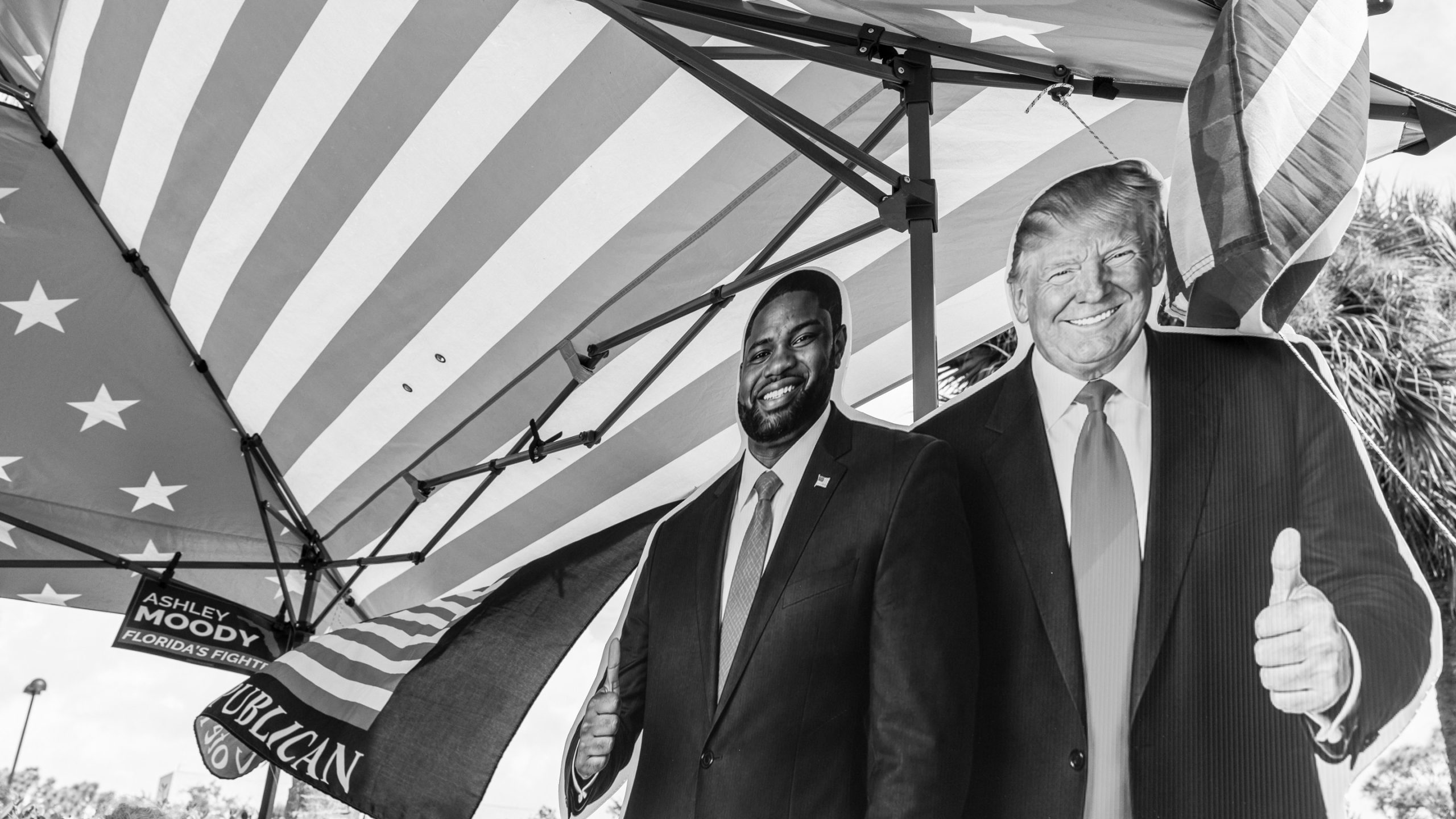
One of the biggest Republican wins in an otherwise-terrible midterm night for the GOP was the victory of the Trump-supporting Byron Donalds in Florida’s race for governor. Donalds will become the first Black governor of that state. If you could resurrect Jefferson Davis and tell him that the governor of Florida will be a Black Republican married to a white woman, he would crawl straight back into his coffin.
That this was MAGA’s big win in a night of defeats is remarkable, given the movement’s hostility toward diversity, and its nostalgia for an America where rigid race and gender hierarchies were enforced by the state. Even where Republicans won, in other words, President Trump’s racially exclusive conception of American citizenship lost. Trump could browbeat corporate America into eliminating DEI programs; he could threaten colleges to let in fewer students of color; he could direct the full power of the federal government toward deporting immigrants. But he could not will away the America that actually exists.
The America that emerges from the midterm elections is not the monochrome world of Madison Avenue ad campaigns from the 1950s. It is a diverse country, made up of many different kinds of people, all of whom are American. The victories of Keisha Lance Bottoms in Georgia, Aaron Ford in Nevada, and David Crowley in Wisconsin, in addition to that of Donalds, mean that there will be more Black governors than ever in U.S. history. In Texas, where Mexican Americans were subject to legalized forms of racial discrimination until the mid-20th century, Gina Hinojosa will become the first Hispanic governor. Xavier Becerra is the first Hispanic governor to be elected in California, and Deb Haaland will become New Mexico’s first Native American governor. Peggy Flanagan of Minnesota will become the first Native American woman elected to the U.S. Senate. And Abdul El-Sayed of Michigan will become the first Muslim U.S. senator.
This happened despite the president, and the many Republicans who followed his lead, trying to make the midterms about a familiar theme: the country being invaded by strange people who do not belong here, let alone in the halls of power.
President Trump and others called El-Sayed a “jihadist,” and Vice President Vance said he should “show a little gratitude to the country that gave him everything.” (Like Vance, El-Sayed was born here.) After El-Sayed won, he told Trump, “I know you struggled with my name. You can just go on and call me Senator.” Republicans fearmongered about “Sharia law” before losing every major statewide office in the Lone Star State. In Minnesota, candidates attacked Somalis, running spots about “Somali gangs” taking over. During a speech in Ohio, Trump went after the Minnesota Democrat Ilhan Omar: “She comes in from a country without laws, without police, without military, without—all they do is shoot each other.” He continued, “They come into the United States of America, and they tell us how to run our country. We’re not going to stand for it.”
Trump won in 2016 and in 2024 while leaning into this strategy of scapegoating ethnic and religious minorities, which convinced many politicians and media figures that the strategy was deviously effective, or at least that it didn’t turn too many people off. After all, in 2020 and 2024, Trump grew his coalition, gaining support among Black and Hispanic voters as well as white ones. But the strategy could not overcome the economic headwinds Trump himself created with tariffs and the arguably illegal, inarguably ill-advised war in Iran. Many voters in 2024 also believed that Trump would focus immigration enforcement on criminals, instead of on a violent and indiscriminate campaign that would involve schoolchildren and their families hiding in their homes and masked gunmen shooting Americans dead in the streets.
I am not going to make the same mistake as the Trump Republicans after 2024 did and declare a permanent realignment of the U.S. electorate toward my policy preferences. Economic mismanagement and the war were clearly the primary drivers of Democratic success. What these wins do say, however, is that the real America is not the “Real America” of conservative fan fiction inspired by the years 1945 to 1964. Real Americans are not just those whose ancestors came over on the Mayflower, or whose ancestors served in the Revolution or Civil War, or who describe themselves with pathetic euphemisms such as “Heritage American.” As Abraham Lincoln once said, newcomers who believe in the principle that “all men are created equal” have “a right to claim it as though they were blood of the blood, and flesh of the flesh, of the men who wrote that Declaration; and so they are.”
As soon as the returns made the extent of the bloodbath clear, MAGA personalities began blaming the nation’s diversity for Republicans’ losses. The conservative podcaster Benny Johnson posted, “In 1970, the White population in Texas was 89%. In 2000, it was 50%. Now it’s less than 39%. Demographics is destiny.” The Trump adviser Laura Loomer declared, “America was always intended to be a majority White country. Not a cesspool for third world minorities. America was founded as a Christian country. Not a Muslim country.”
[Idrees Kahloon: Why Republicans lost so big]
“Democrats imported millions of foreigners, handed them a bunch of free shit, and then registered them to vote,” the account of the influencer Chaya Raichik posted on X. “If we ever want to win again we need deportations and denaturalizations ramped up on steroids or our country will forever be lost to the communists.”
Contrary to Johnson, demographics is not destiny—if it was, Texas would have flipped a long time ago and Trump would not have won there by double digits in 2024. Millions of nonwhite Americans have conservative beliefs, and most of them would be happy to vote for Republicans who treated them as Americans instead of invaders. As for Loomer, not only was America explicitly not founded as a Christian country, but we also fought a civil war over whether it was a white country—and the side taken by Loomer lost. Raichik’s call for ethnic cleansing is grotesque, but it nonetheless illustrates how those on the extreme right see the problem, which is that there are Americans who are not white whose votes count as much as theirs. You cannot call for people to be exiled because of their ethnic background and expect them to vote for you.
In September, Trump said, “America does not belong to those who hate it. America belongs to those who love it.” But the way MAGA talks about the America that actually exists—as opposed to the one it imagines once existed—doesn’t sound like love at all. Whether or not Americans believe in multiculturalism, we are multicultural. One is an ideology; the other is a fact.
Source & Attribution
This One Place News story was acquired from theatlantic.com. OPN retains the source link and provenance for newsroom review.
Filed Under
Culture & Society • Economy & Finance • Politics & Law