
Modi Is Facing ‘A Million Mutinies’
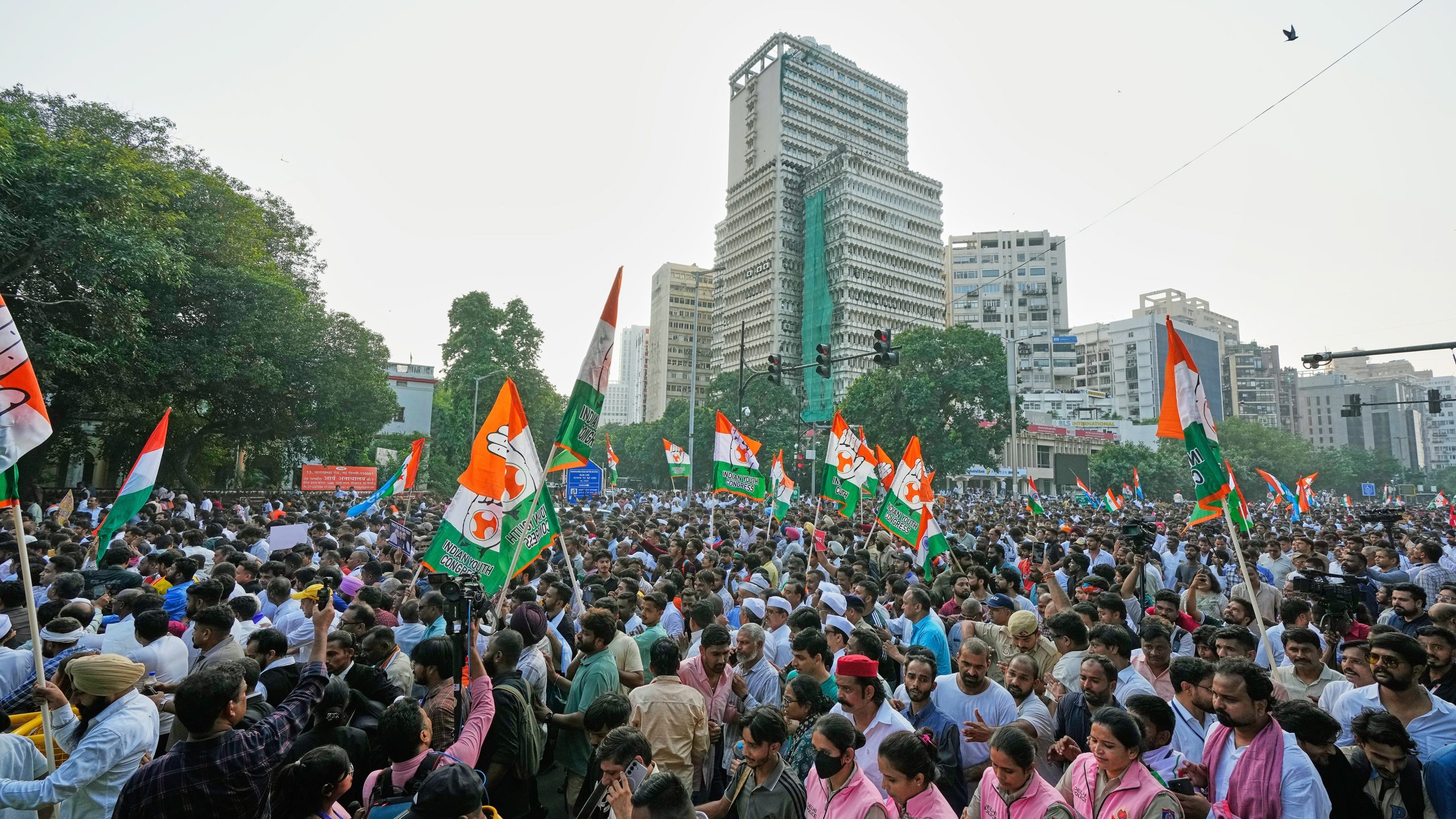
For more than a decade, Prime Minister Narendra Modi’s government has relied on fear to throttle dissent in India. It has jailed protesters, deployed a pliant media to vilify critics, and fanned the flames of communal violence. This year, that playbook appears to have lost its efficacy. Discontent has grown, and Modi’s power no longer seems unassailable.
The first signs of this change emerged over the summer. Tens of thousands of young people thronged Delhi to demand that India’s education minister resign. They had come of age in a country where public education was crumbling, economic growth favored the rich, and jobs were scarce. They had little patience for news channels perceived to be government mouthpieces—they even heckled several reporters out of their demonstrations.
The summer’s young demonstrators mounted posters and circulated cheeky memes and slogans that took direct aim at the prime minister. When police attacked one of their marches with pellet guns, tear gas, and shock batons, the violence stoked public indignation that swelled the movement’s ranks. Modi then tried to endear himself with the digital-age protesters: He implored them to stand down in an Instagram selfie video, and his colleagues from the Hindu-nationalist Bharatiya Janata Party delivered speeches peppered with youthful slang, such as delulu and clock it. These efforts just earned the BJP more mockery.
The police have used force against protesters before, but the effects were very different. In 2019, the BJP championed a discriminatory citizenship law; demonstrations erupted, and the police used brutal means to crush them, including abetting and even participating in communal violence. The following year, the government announced sweeping agricultural reforms. Farmers who protested that these favored giant corporations faced a violent crackdown. In neither case was the popular outrage as widespread as it was this summer. That is likely because those past protests were associated with the Sikh and Muslim communities, which the BJP and its supporters had effectively maligned, playing into and deepening long-standing prejudices.
By contrast, this summer, many of those demanding the education minister’s resignation came from privileged Hindu families—the very constituents that the prime minister and his party count on for support. The government therefore couldn’t target them with as heavy a hand. The movement culminated in the education minister’s ouster. Right-wing provocateurs and media outlets—aided, in several instances, by police officials and BJP supporters and politicians—singled out Muslim, female, and queer protesters for retaliation.
This fall saw the development of a new protest movement in the capital, centering on the denial of a fundamental democratic promise: the right to vote. Since 2025, millions of names have been struck from India’s voter rolls in a revision process that has raised many questions. At stake, Anjali Bhardwaj, an activist, told me, “is the very soul of India’s electoral democracy.”
Those agitating against the assault on the franchise repurposed some of the same rallying cries from the summer protests—for instance, “Jab Jab Modi darta hai, police ko aage karta hai,” or, “Whenever Modi feels the heat, he sends the police onto the streets.” And the government again turned to repression. Security forces detained thousands of people carrying out flash protests, beating many and confronting others with legal charges. But many citizens now see these tactics less as a show of strength than as an admission of fear. The new movement has not been extinguished, and opposition political parties have come out to show their support.
At the same time, other, mostly unrelated protests have erupted or continued in different parts of the country. Since January, workers in at least 10 states have staged a reported 275 strikes. In October alone, tribal residents from a village in Madhya Pradesh lay on mock funeral pyres to protest an $87 billion river-linking project that has displaced them; scores of protesters in Mumbai demanded accountability from a public university over allegations that a student who died by suicide faced caste discrimination there; and students at another public university, in Delhi, successfully agitated for the restoration of a long-defunct students’ union. In Arunachal Pradesh, protesters are resisting a mega-dam project that they say will submerge more than two dozen villages. All of these demonstrations have been met with major police pressure, much of it violent, and persisted in spite of it.
“A million mutinies are now finally coming to the fore,” Praveen Donthi, a senior analyst at the International Crisis Group, told me. Intimidating opposition members—“labeling people anti-national, anti-development, all that”—once worked to undermine such movements’ confidence, Donthi said. “That is not working now.”
The government has yet to recover from the blow that the summer protests dealt its image, according to Neha, the national president of the left-affiliated All India Students’ Association. (Neha goes by only their first name and uses they/them pronouns.) “The young people who have been part of these protests don’t really believe in the invincible aura of the prime minister at all,” Neha told me. “If anything, he has been acting as a wonderful source of memes and jokes and satire, and that has been the extent of his contribution to the young generation.”
This fall’s protest movement has its roots in an administrative process that began more than a year ago. In June 2025, just before contentious assembly elections in several states, India’s election commission announced that it would revise the country’s voter rolls. India has a process for this, called an Intensive Revision, and it has been done eight times in the past. But this Special Intensive Revision (as it was called) was different. The process was hurried and lacked transparency. Unlike past revisions, the SIR shrank the electorate, and not by a little: It struck 130 million names from the rolls.
Many of those deleted had died, moved to another constituency, were registered to multiple polling stations, or could not be found by enumerators. But the effects of the revision could not be explained solely by such cases. For example, the Sabar Institute, a public-policy-research organization, reports that about 70 percent of the 2.7 million voters deleted from electoral rolls in West Bengal after their cases were flagged for adjudication were Muslim, and more than half were women. In one constituency where Muslims made up 20 percent of the population, they accounted for 95 percent of the deletions, Sabir Ahamed, who co-leads the Sabar Institute, told me. A category called “logical discrepancies” excluded voters for inconsistencies in their names across different documents, or for arbitrary criteria such as an insufficient age gap between them and their parents.
“What followed was the greatest disruption of the electoral process India has ever seen—barring election boycotts and a rigged election in Kashmir in 1987,” the political scientist Gilles Verniers wrote in June. West Bengal held its state election shortly after the SIR concluded, and the BJP campaigned on the specter of so-called illegal infiltrators from Bangladesh. It won in a landslide.
People cut from the electoral rolls have not been disenfranchised only from voting. In West Bengal, the government also denied welfare entitlements to deleted voters, even though the supreme court had earlier clarified that the SIR was not a test of citizenship. And although a process for redress does exist, access to it is inequitable. In at least a few regions, a two-tier system allows enumerators to mark certain people as “VIPs” who can then sidestep the cumbersome process that those from less privileged backgrounds are forced to undergo to restore their name to the rolls.
Activists and journalists have raised questions about who decided to undertake this SIR with such haste and why. In the summer of 2025, Bhardwaj, the activist, filed a request for documents that could furnish these details under India’s Right to Information Act. In September, she received a note from the election commission indicating that it had not made the decision to undertake the SIR. But as far as she knew, the commission was the only body constitutionally empowered to do so. If it hadn’t chosen to revise the voter lists, then who had? “This raises a huge question on the constitutionality of the exercise and on the independence of the election commission itself,” she told me.
The SIR brought renewed scrutiny to a commission already dogged by allegations of partisanship in favor of the ruling BJP. Then, in a series of investigations published this fall, The Indian Express found that Gyanesh Kumar, the chief election commissioner, had made several SIR decisions unilaterally, in contravention of a requirement that the three-member body make all decisions by consensus. “Gyanesh, it’s done, bro,” became a popular refrain on social media, riffing on a viral tweet from a Bollywood star who had called on protesters to stand down over the summer. A loose coalition began to mobilize, including the Cockroach Janata Party—the pressure group that led the demonstrations in July—together with several left-wing student organizations, the Indian National Congress, and other opposition parties.
By early October, multiple organizations were calling for mass demonstrations to demand Kumar’s resignation and the withdrawal of the SIR. On October 10, when one such protest was to be held, central Delhi became a fortress, its streets lined with police barricades and patrolled by more than 40,000 police officers and paramilitaries. Hotels and guesthouses were directed to not take any fresh bookings; liquor stores were ordered shut. About 50 metro stations were closed and more than 200 trains were canceled, and internet service was suspended around Jantar Mantar, Delhi’s most famous protest site.
I walked around the area with a colleague that morning. The quiet was eerie. Loudspeakers on street corners played prerecorded announcements about the orders in place barring “unauthorized gatherings, public speeches, shouting of slogans.” The only people listening were journalists and security personnel.
We realized soon after that protesters trying to reach the site were being detained. At one point, we recorded the Delhi police dragging a young man into custody. A flank of officials obstructed our movement and insisted that we needed accreditation from the government press office, although our press cards were prominently displayed. Later that day, another police official in another part of central Delhi directed a group of his female colleagues to push me away when I asked him a question. He called journalists “reel makers” who were “only there to disrupt police work.”
The state had learned from its missteps in July. And so the police opted for a quieter strategy this time, picking up protesters before they could congregate and dragging them onto buses. My colleagues and I met several detainees who recounted being assaulted away from the public gaze, often in the vehicles that ferried them to distant holding centers, where they were kept for hours. More than 7,000 people were reportedly detained on October 10 alone. About two dozen journalists were detained that day; the number had nearly doubled by October 11. The pattern continued in the days that followed, as flash protests broke out across the city. Meanwhile authorities forbade the use of Jantar Mantar as a designated protest site. Leaders from the movement, including Neha, were kept in custody for periods ranging from one night to several days. Some were asked to sign documents that would effectively bar them from joining protests.
And yet, many citizens continued to show up daily. “I would not even, for a second, count this as the victory of a state. If anything, I would count it as the victory of the people outsmarting the police and the entire system,” Neha told me.
I talked with Naureen Sabba, a 26-year-old activist with the Revolutionary Workers’ Party of India who has participated in several protests since she moved to Delhi in 2023. The current movement, she acknowledged, was struggling to expand beyond committed activists and political workers. She pointed to two limiting factors: police dispersal and the loss of Jantar Mantar as a gathering place. “Common people, ordinary students, they are coming,” Sabba insisted. “However, they are coming in scattered groups, because the surveillance and repression of the state are so much that they are not even able to stand together in one place.”
[From the February 2025 issue: Narendra Modi’s populist facade is cracking]
Sabba conjectured that the state’s repression would ultimately backfire. “Think of a spring,” she said. “You can keep pressing it down, pushing it further and further. But there comes a point when, the moment you let go, it recoils with tremendous force. The harder you push it down, the stronger it bounces back.”
Donthi, of the International Crisis Group, told me that the protests have had an effect on the Modi government. “The SIR, the process, there is no doubt that it’s problematic, even in the minds of BJP supporters, which has led to a crisis of credibility for Indian democracy itself,” he said.
For the moment, however, the movement remains somewhat inchoate and largely confined to the capital. Ajay Gudavarthy, an associate professor of political science at Jawaharlal Nehru University, told me that he had recently traveled to the southern states of Telangana and Tamil Nadu and was struck by the lack of widespread outrage against the SIR. “Those who are in, they are not bothered; and those who are deleted—it’s become an administrative issue,” he said. The demonstrations risk being perceived as a conflict among political forces seeking power, Gudavarthy noted, unless opposition parties can link the SIR deletions to matters of social welfare.
I asked Ahamed, from the Sabar Institute, why West Bengal hadn’t seen widespread protests despite the scale of disenfranchisement there. Since the BJP came to power in that state, Islamophobic attacks have risen and the party’s critics have been intimidated into silence, he said. “Even I, after the SIR, couldn’t speak here. Whatever talks and speeches I am giving are outside Bengal. I have started censoring myself, despite being an educated, well-connected researcher.” Ahamed said this was because of his Muslim identity and the fact that the BJP was accusing deleted voters of being infiltrators who should be deported.
The issues at hand, Ahamed cautioned, are urgent. If the SIR is not reversed, the next general election, in 2029, might be a foregone conclusion: “We can say who will win.”
Source & Attribution
This One Place News story was acquired from theatlantic.com. OPN retains the source link and provenance for newsroom review.
Filed Under
Culture & Society • Economy & Finance • Politics & Law