
Explainability, Not Speed, Will Define the Next Military AI Race – Global Security Review
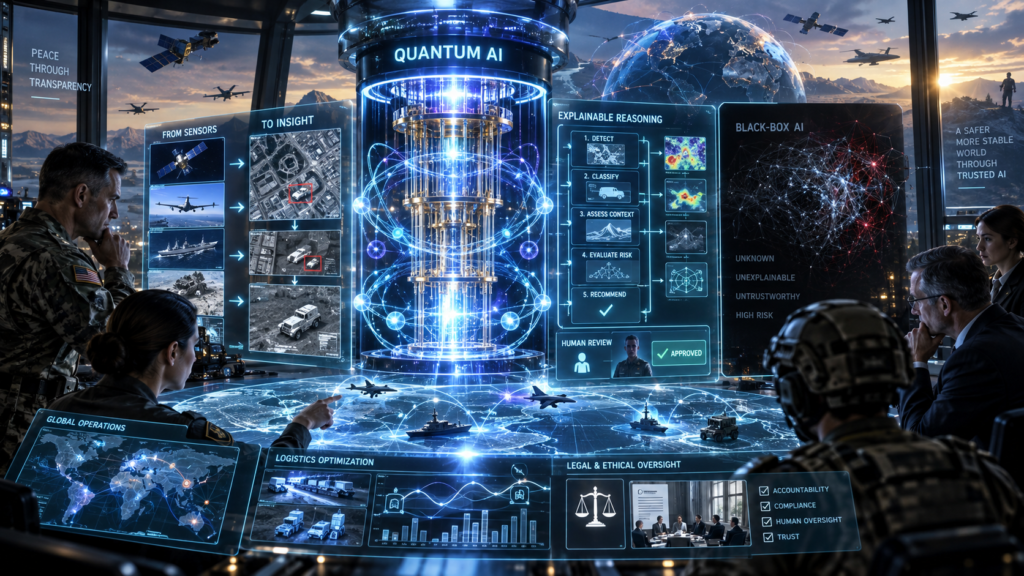
Explainability, Not Speed, Will Define the Next Military AI Race Global Security Review
A soldier who fires on a target must be able to reason “why” afterward. Similarly, a commander who authorizes a strike must be able to justify that decision to superiors, at times to lawyers, and possibly to the public. If an algorithm makes these decisions, how is the reasoning understood when it is not understood by the engineers who built it? Judging from how military technology has advanced, this is not hypothetical. It is the situation many militaries already face as artificial intelligence (AI) takes on a growing role in identifying threats, and even recommending or engaging targets. The usual conversation about military AI focuses on speed, power, and who can compute faster or strike first.
But a quieter, more important question emerges alongside it. Which systems can justify their decisions when lives, laws, and legitimacy are on the line? Quantum AI, an unlikely and still unproven contender, is being explored as a possible answer. Quantum computing provides a fundamentally different approach to processing information than classical computer methods. Rather than relying solely on classical computational methods, quantum computers exploit quantum mechanical phenomena such as superposition, entanglement, and interference to solve certain classes of problems more efficiently than conventional computers. Where Artificial intelligence is the set of processes that let computers recognize patterns and make predictions with limited human guidance.
Source & Attribution
This One Place News story was acquired from news.google.com. OPN retains the source link and provenance for newsroom review.
Filed Under
Military News