One Place News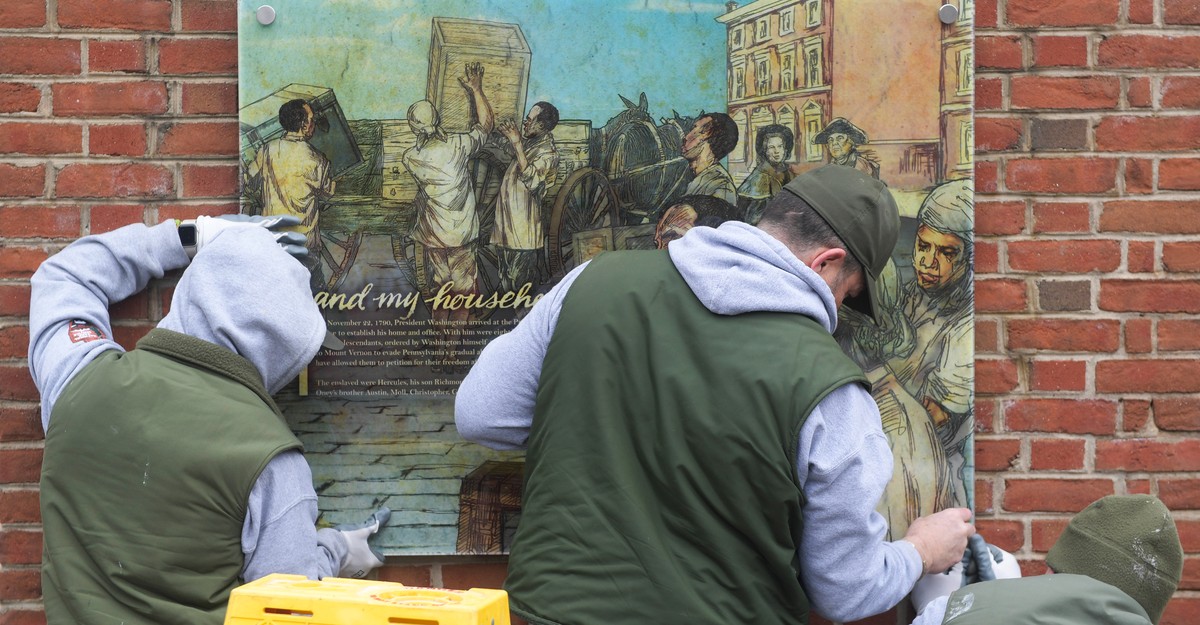
In 2010, the National Park Service installed an outdoor exhibit at the President’s House Site near Independence Hall in Philadelphia, which told the stories not just of George Washington but also of those he’d enslaved. One was Ona Judge, who escaped and evaded Washington’s yearslong effort to recapture her. Their names—Judge, Hercules Posey, Christopher Sheels, Austin, Richmond, Giles, Moll, Paris, and Joe—are still carved into a stone wall in huge letters.
In January, the Trump administration took that exhibit down, and last week, after months of legal wrangling, the NPS installed a new exhibit at the site, one that fundamentally changes the story visitors will find there. Where once the exhibit focused squarely on the individuals Washington enslaved, the new exhibit views Washington’s ties to slavery through the lens of his personal conscience, extensively highlighting his statements opposing slavery. In the sole panel now summarizing Washington’s participation, nearly every paragraph makes some mention of his ostensible antislavery views.
The new exhibit at the President’s House Site offers a profoundly misleading interpretation of Washington’s history with slavery, denying visitors an opportunity to contemplate the irreconcilable tensions between American slavery and American freedom. Rather than focus on the decades he spent actively enslaving other human beings—including while president in Philadelphia—the exhibit now uses Washington’s private statements questioning slavery and his posthumous emancipation of the people he enslaved to diminish the importance of the institution to his life. These revisions distort our history and deprive Americans from encountering history’s full complexity at the site where it happened.
The changes are part of a wider effort by the Trump administration to rewrite and sanitize American history following a March 2025 executive order targeting the Smithsonian and other federal history installations and a corresponding order from the U.S. Department of the Interior two months later. As a result, NPS staff have been ordered to change exhibits, publications, and other materials, particularly historical information that the administration views as insufficiently patriotic or disparaging toward prominent historical figures.
The revisions at the President’s House Site have drawn intense scrutiny, exemplifying both the aims and the limits of the broader effort. Even where the text acknowledges that Washington owed his status and livelihood to slavery and maneuvered to keep people in bondage, the interpretation focuses mostly on his “private doubts” about slavery and his private approval of efforts to gradually abolish it. Most notable, the new exhibit emphasizes the emancipation provisions of Washington’s last will and testament. “In death,” a panel explains, “George Washington committed his most public and personal anti-slavery act.” This is true and important, but it’s presented in a way that overshadows Washington’s lifetime of enslaving.
The Trump administration is hardly the first to find this selective editing of Washington’s legacy useful. For more than two centuries, highlighting Washington’s antislavery bona fides has functioned as a politically convenient rhetorical tool. Where Americans once invoked this interpretation of Washington to bring an end to slavery, conservatives are now reviving it in a way that denies the institution really mattered at all.
For the entirety of his adult life, George Washington enslaved other human beings. He bought and sold people, exploited their labor to build his substantial wealth, directed their punishment, and pursued those who attempted to escape. Over the last two decades of his life, however, Washington privately voiced his uneasiness, expressing an opposition to separating enslaved families and a wish to see Congress or state legislatures gradually end the institution. In his will, Washington directed that all of the 123 enslaved people he owned outright be emancipated following his and his wife’s deaths. (Martha Washington freed them early, about a year later, at the beginning of 1801; she died in 1802.) That group included a little fewer than half of the more than 300 enslaved at Mount Vernon at the time; the rest were owned by the estate of Martha Washington’s first husband, leaving Washington legally unable to free them.
When Washington died, in December 1799, some Americans immediately began shaping Washington’s legacy in a way that would support the cause of Black freedom. Two weeks after Washington’s death—and just one day after Henry Lee forever memorialized Washington as “first in the hearts of his countrymen”—Richard Allen, a free Black minister and a co-founder of the African Methodist Episcopal Church, delivered a eulogy. “We, my friends, have peculiar cause to bemoan our loss,” Allen told his congregation of Black Philadelphians. This was not only because of Washington’s singular contributions to the nation. Allen also claimed Washington supported Black freedom. “He whose wisdom the nations revered,” Allen said, “thought we had a right to liberty.”
Allen stood on firm ground. Remarkably, he was among the very first to mention publicly that Washington had freed the people he enslaved. Through this final act, Allen believed, Washington had redeemed himself: “He dared to do his duty, and wipe off the only stain with which man could ever reproach him,” Allen said. ”He ‘let the oppressed go free.’”
[Read: How America gave up on its own story]
As the antislavery movement gained momentum in the decades that followed, abolitionists used this same framing. In 1838, John Quincy Adams relayed Washington’s antislavery legacy to the Rhode Island Anti-Slavery Society and concluded that “George Washington was thus, in the broadest and most comprehensive sense of the word, an ABOLITIONIST.” Even William Lloyd Garrison—whose abolitionist newspaper The Liberator published blistering denunciations of Washington’s slaveholding—at times saw the rhetorical utility of touting Washington’s actions against slavery. In 1848, Garrison told a packed crowd in Boston’s Faneuil Hall that he had encountered a case of a man who was declared insane because he used his will to free his slaves. Garrison pointed dramatically to the portrait of Washington that flanked the stage and bellowed, “There! There is a man who was insane when he died! There stands George Washington, who by his will emancipated his slaves!”
In 1857, the Washington biographer and social-reform advocate Caroline Kirkland wrote that Washington believed slavery was “an evil so obvious” that the United States would soon abolish it. “On the whole, the testimony of Washington against slavery is clear and explicit enough, and no one can quote him as its apologist,” Kirkland wrote, “although we may regret that he had not time to turn his attention more decidedly and efficiently toward its abolition.”
Other abolitionists balked at this celebration of Washington’s antislavery credentials. In 1853, the abolitionist Parker Pillsbury mocked the reverence some had for Washington’s will. “I have heard a good deal said before of deathbed repentance,” Pillsbury said, “but I never heard it very highly extolled.” Instead, some abolitionists condemned Washington in speeches and newspapers, reminding audiences that he was “a slaveholder to the day of his death.” The abolitionist Charles Lenox Remond, for example, in 1858 even called Washington “a traitor to the cause of freedom.”
Yet for some abolitionists, the potential benefit of this intellectual sleight of hand was well worth it. Their selective invocations of Washington may have obscured his complicity, but some abolitionists truly believed doing so would help bring the horror of American slavery to an end. If George Washington saw fit to free the people he enslaved, the argument went, then what could be more American than ending slavery?
When war finally brought slavery to an end, this distorted view of Washington ceased to be of use as a political emblem. As much of the nation adopted the Lost Cause narrative about slavery following the end of the Civil War and Reconstruction, many white Americans saw no need to discuss Washington’s ties to slavery at all, preferring instead a heroic depiction of Washington, focused on his many contributions to the country, that could unify the fractured nation.
In the century that followed, however, some Americans still insisted on reckoning with Washington’s involvement in slavery. During both the Jim Crow era and the civil-rights movement, Black scholars and activists in particular emphasized Washington’s slaveholding to make clear the deep roots of modern racial injustices. Meanwhile, decades of new scholarship since the mid-20th century have revealed profound insights about the lives of enslaved people and the central role of slavery in American history, and the movement for racial reckoning in 2020 vaulted this knowledge to the front of public consciousness.
Whereas once Washington’s antislavery credentials were wielded to bring slavery to an end, today some conservatives highlight Washington’s ostensible opposition to slavery to deemphasize slavery’s foundational importance in American history. Against a growing insistence that slavery has profoundly shaped American society in ways the country has yet to fully reckon with, they now selectively highlight Washington’s purportedly antislavery views to wave slavery away as a momentary aberration in America’s glorious history of freedom.
The Trump administration articulated this logic clearly in 2021 in the report from the 1776 Commission, convened at the tail end of President Trump’s first term as a conservative rejoinder to The New York Times’ “1619 Project.” “The most common charge levelled against the founders, and hence against our country itself,” the report states, “is that they were hypocrites who didn’t believe their stated principles, and therefore the country they built rests on a lie.” It follows this with a plain assertion—“This charge is untrue”—and argues that it damages civic cohesion.
To counter these claims, the report leans on the antislavery Washington. “George Washington owned slaves,” the report states, “but came to detest the practice, and wished for ‘a plan adopted for the abolition of it.’” It continues: “By the end of his life, he freed all the slaves in his family estate,” ignoring the fact that the emancipation occurred after Washington’s death and applied to fewer than half of those who were enslaved at Mount Vernon. The report wields Washington’s purported opposition to slavery to assert that any study of slavery’s place in American history should focus on efforts to abolish it—a rejoinder of sorts to “The 1619 Project” and the 2020 demonstrations for racial justice, during which more Americans came to recognize the way slavery had fundamentally shaped the nation.
This take on Washington appears elsewhere too. Florida’s revised social-studies curriculum from 2023 includes Washington on a list of figures instrumental in ending slavery, and it ignores his role in perpetuating it. In the 1776 Curriculum, from the Christian, conservative Hillsdale College, the authors offer a similar (if slightly more nuanced) take on the matter.
The Trump administration has entirely ignored Washington’s ties to slavery in other contexts (such as in the fleet of mobile museums traveling around the country this year), but officials seemed to recognize that total erasure wasn’t tenable at the President’s House Site, given the focus of the former exhibit. Instead, the new exhibit dilutes the story of slavery by surrounding it with material that has little to do with the President’s House at all, such as biographies of individual Founders and the ins and outs of various constitutional structures. It frames information about slavery almost exclusively through the lens of antislavery progress.
[Read: Here come Trump’s ‘Freedom Trucks’]
Other panels still offer very brief biographies of the nine people Washington enslaved at the site, which used to be nearly the entirety of the exhibit; it actually includes them twice, seemingly in an effort to cover more space. One panel also describes the successful efforts of Ona Judge and Hercules Posey to escape from slavery. Yet even these panels are peppered with qualifications, for example: twice mentioning that Washington purchased tickets for enslaved people to visit the theater.
Where Washington is discussed directly, it’s mostly his opposition to slavery that comes through. Even Washington’s schemes to undermine Pennsylvania’s gradual-abolition laws—he periodically rotated the people he enslaved out of the state before the law would free them—are countered with some other antislavery action, such as his private statements hoping for abolition and his eventual emancipation of the people he enslaved, without ever interrogating that contradiction.
More broadly, although the statements in the new exhibit are individually factual, they’re put together in a way that’s fundamentally misleading. A few lines in Washington’s private correspondence and his posthumous emancipation orders are given far more weight than a lifetime of owning Black Americans as property—a misplaced emphasis that distorts the history and also robs his later act of emancipation of meaning.
In a statement after the NPS first removed the previous exhibit, the Department of Interior said, “The President has directed federal agencies to review interpretive materials to ensure accuracy, honesty, and alignment with shared national values.” Last week, following the completion of these changes, the department acknowledged “the evils of slavery including its injustices and hypocrisies.” It defended the new exhibit by saying, “These new panels are full of historical context.”
Yet, despite the administration’s ability to parrot the jargon of historians and museum professionals, the politically motivated revisions it has forced across the National Park Service and elsewhere are anathema to standards and ethics of those fields.
These losses are especially acute in Philadelphia. Nearly 175 years ago, Pillsbury, the abolitionist, lamented that Americans heaped praise on Washington while ignoring the enslaved people who made his life and achievements possible. “No glory has ever covered their names; no honor has ever been paid to their memory,” he said. “No monument commemorates their dismal toil.” The President’s House Site exhibit once corrected that imbalance. Not anymore.
Many Americans see this whitewashed, censored version of the nation’s past for what it is. Time and again, a majority of Americans express their desire to engage with a full and accurate American history. In Philadelphia, the Trump administration has had to use the power of the federal government to ensure they won’t get it.