One Place News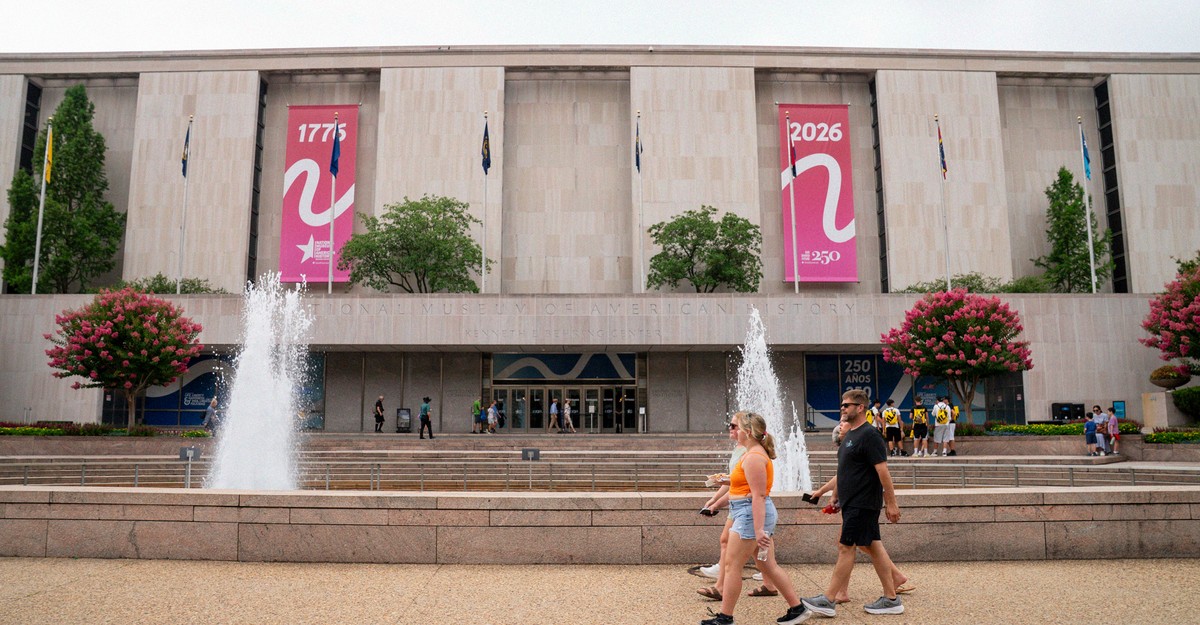
Incensed by the Smithsonian but lacking immediate power to do anything about it, Donald Trump has resorted to trolling the world’s largest museum complex from the sidewalk. In an executive order posted this afternoon, the president directed the Department of the Interior to place signs outside the National Museum of American History warning passersby about “ideological capture” and detailing the findings of his administration’s recent, quickly contested report on the museum. The order comes days after the museum’s director, Anthea Hartig, was grilled by lawmakers on Capitol Hill.
The warnings, the order says, will direct visitors to “locations and resources for accurate information” about American history and will notify them that exhibits “should be renovated consistent with the findings of the Report.” It asserts that the “current leadership of both the Smithsonian Institution and the Museum cannot be trusted to tell America’s story with honesty and gratitude.” Having determined, perhaps, that the museum’s 250-object exhibit “exploring the ideals of the Declaration of Independence” is not enough, Trump also ordered the Department of the Interior to mount its own temporary exhibits outside that will “appropriately honor the 56 signers” of the document.
To the White House, the order is probably meant to escalate its public-pressure campaign on the Smithsonian, which began with an executive order last spring calling to rid the institution of “improper ideology” and restore it “to its rightful place as a symbol of inspiration and American greatness.” In short, Trump feels that the museums are too negative about the country’s history and should be more patriotic, and the Smithsonian argues that its museums can be celebratory and present complex stories at the same time. Instead, the call to place trigger warnings outside the museum reflects the limitations of the Trump administration’s power in this instance, as well as a weakness in its campaign to seize control of the American story.
The Smithsonian occupies a strange place as a public-private partnership and “independent federal trust instrumentality” of the U.S. government. Partially funded by the federal government, the institution is governed by a board of regents, which does not have presidential appointees and can’t be purged in the way that the board of the Kennedy Center was. Although in some specific cases the Smithsonian has been treated as part of the executive branch and in others it has not, the institution is not an executive agency and not overseen by the president like the National Park Service is (NPS is managed by the Interior Department). That means the Smithsonian is also not susceptible to the type of mandated history scrubbing that NPS leadership has enforced at historic sites across the country.
Trump is directing Interior Secretary Doug Burgum in this new order because he cannot officially direct Hartig, and neither can he direct Smithsonian Secretary Lonnie Bunch, who reports to the board of regents. The signs will go on the NPS-controlled sidewalks and walkways because that’s where the White House can have a say.
The White House looks to even be aware of these limitations in the executive order, urging the heads of the Interior Department, the Office of Management and Budget, and the General Services Administration, as well as the assistant to the president for domestic policy to “identify and utilize any and all available authorities to promote the policy of this order.” This includes “any mechanisms available to encourage correction of the issues identified in the Report.” The naming of the OMB appears to nod to previous threats that the White House has made about hinging the Smithsonian’s apportioned funds on its compliance with Trump’s vision, which likely would be illegal.
In its July 4 report on the American-history museum, the White House argued, essentially, that the museum has been politicized and that it “no longer treats the American story as a shared national inheritance to be taught or celebrated, but as a political instrument to divide, dispirit, and discourage our citizens.” It criticizes what it calls “anti-White” advocacy and takes specific aim at museum representations of transgender Americans and undocumented immigrants, as well as exhibits featuring Filipino and Mexican Americans, describing as activism what many might simply see as mentions of people who exist in this country. The report repeatedly calls out museum staffers by name, and Hartig appears in more than a dozen images throughout the document. Speaking in one of the congressional hearings this week, Representative Melanie Stansbury, a New Mexico Democrat, called it “a political witch hunt.”
During those dizzying hearings, Hartig tried to defend her and her colleagues’ work. She told lawmakers that the museum is nonpartisan, and that it uses “historical evidence” and “competing perspectives” and acknowledges “enduring debates.” She said that the museum’s goal is to “preserve and document the evidence of American life in all of its breadth, so that the public can encounter the past and draw their own conclusions,” and that telling the full story of history “is a form of respect for the American people.” None of this, of course, stopped the accusations of activism or a GOP witness and even one lawmaker from calling for a cleaning-out of the institution’s leadership. The hearing was theater. The signs are too.
A kind of turf war has taken place across the National Mall this summer. The Great American State Fair, the signs plastered with Trump’s slogan “We are making D.C. Safe and Beautiful,” and the ever troubled Reflecting Pool—the president’s hand has been ubiquitous in America’s backyard. Still, these incoming signs will mark a new kind of outward hostility, falling somewhere closer to putting Trump’s name on the Kennedy Center. To publicly take aim at a beloved American institution could risk doing exactly what Trump accuses the Smithsonian of in the report: dividing.
But there’s something that the president, it seems, has not considered. Trump and his coterie love to talk about “freedom-loving” Americans, and those freedom-loving Americans don’t exactly love being told what to do. Some of them might even see these signs outside the museum and have all the more reason to walk right on in.