One Place News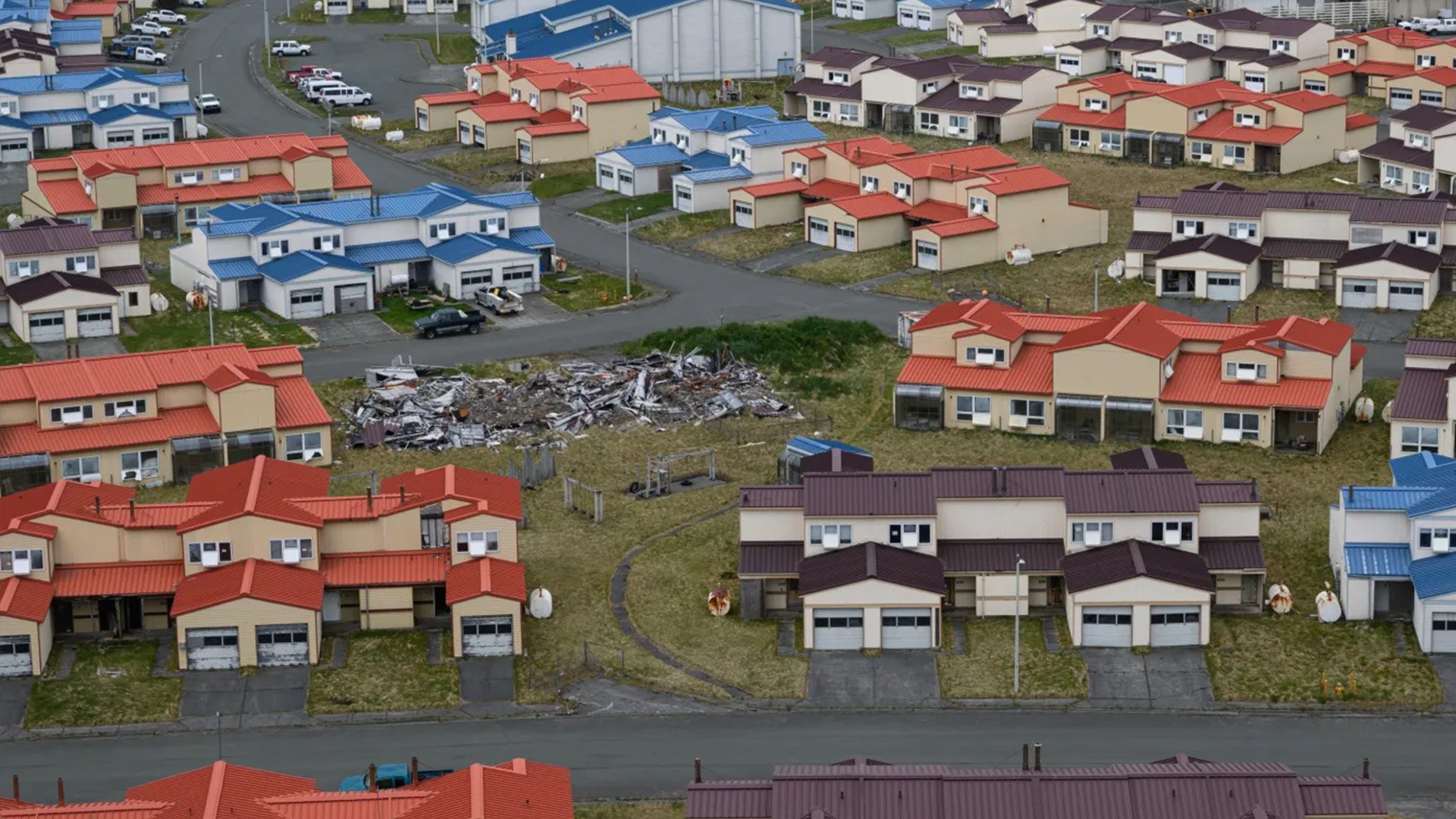
The mostly abandoned neighborhoods on Adak Island, Alaska, were once home to 5,000 Navy sailors and their families. But after 40 years as a supply depot, Naval Air Facility Adak closed in 1997, leaving scores of homes and buildings behind. Today, a small community of government workers and Alaska Native families have turned the streets and buildings of the former base into the town of Adak.
The island, far out on the Aleutian Island chain, is so isolated and decayed that Marines occasionally return to simulate hard-to-resupply expeditionary operations or urban chemical warfare among its abandoned buildings. The civilian population, now well below 100, can only reach the island on occasional civilian flights that land on the Navy’s forgotten runway.
But while nearly all of the 300-odd former Navy buildings in Adak are empty and many are collapsing, the U.S. government pays an Anchorage firm $340,000 per year to maintain internet access to them.
An investigation by the Anchorage Daily News and ProPublica published Monday found that an internet provider collects $340,000 every year to keep fairly slow “broadband” internet service active for the town now on the former Navy base.
“After the Navy shipped out, hurricane-force Aleutian winds pried homes apart,” wrote Kyle Hopkins for the Anchorage Daily News. “The worst of it is in a beachfront neighborhood called ‘Officer’s Country’ on old city maps. Bathroom mirrors and toilets and kitchen tables stand exposed to the rain in homes cleaved in half like dollhouses.”
But even Navy-built buildings now open to the elements with missing walls and roofs, reporters found, were listed on the internet provider’s roster.
The joint investigation was published as part of an ongoing series by Hopkins on internet access in remote Alaska. Adak was Hopkins’ first review of a community built around an abandoned military base.
Hopkins and a photographer flew to Adak, where many buildings on the former Navy base are uninhabitable, with collapsing walls and roofs, from years without repairs in the bitter weather of the Aleutian Islands. Hopkins visited every address on the old Navy base listed as receiving taxpayer-funded internet service.
But Hopkins reported that he found that nearly all residents use Starlink satellite internet. Blanketing the base, he reported not one customer for the tax-funded broadband.
The federal program, Hopkins reported, is paid for by the Universal Service Fund, a multi-billion-dollar effort administered by the Federal Communications Commission and funded as a small fee on nearly all consumer phone bills. The fund is intended to deliver internet to hard-to-reach rural customers.
Though the buildings on Adak were built by the Navy, the service has no current connection to the town or the pricey internet service.
Closed bases meet varying fates
Adak is one of scores of closed military installations that dot the country. Many have found new lives, like Naval Training Center Baldwin Park, Florida, and Lowry Air Force Base in Denver, Colorado, which are today mixed-use developments with thousands of homes, shopping and businesses. When Hurricane Andrew destroyed Homestead Air Force Base in 1992, a section was repurposed as a major racetrack (other parts were recommissioned as a reserve base in 2003).
Abandoned missile silos in the Midwest have been rebuilt as homes and museums — though some remain dangerously abandoned.
Top Stories This Week
Much of the town of Adak is based on jobs created by federal clean-up of the old base, along with other federal agencies that now oversee federal land on the otherwise uninhabited island.
But the town may have a military future. Alaska Sen. Dan Sullivan has led a campaign to move Navy assets to Alaska, which could include reoccupying Adak. Last summer, Navy Adm. Samuel Paparo called for a revival of the base. Forces there, he said, would provide U.S. forces a first line of defense against Russian aggression to “gain time and distance on any force capability that’s looking to penetrate,” Paparo said at a Senate Armed Services Committee hearing.
Though Adak would be a remote assignment, those sent to the cold, windy island would at least know they’d have internet access.
The post Abandoned Navy base costs taxpayers $340,000 a year in internet nobody uses appeared first on Task & Purpose.