One Place News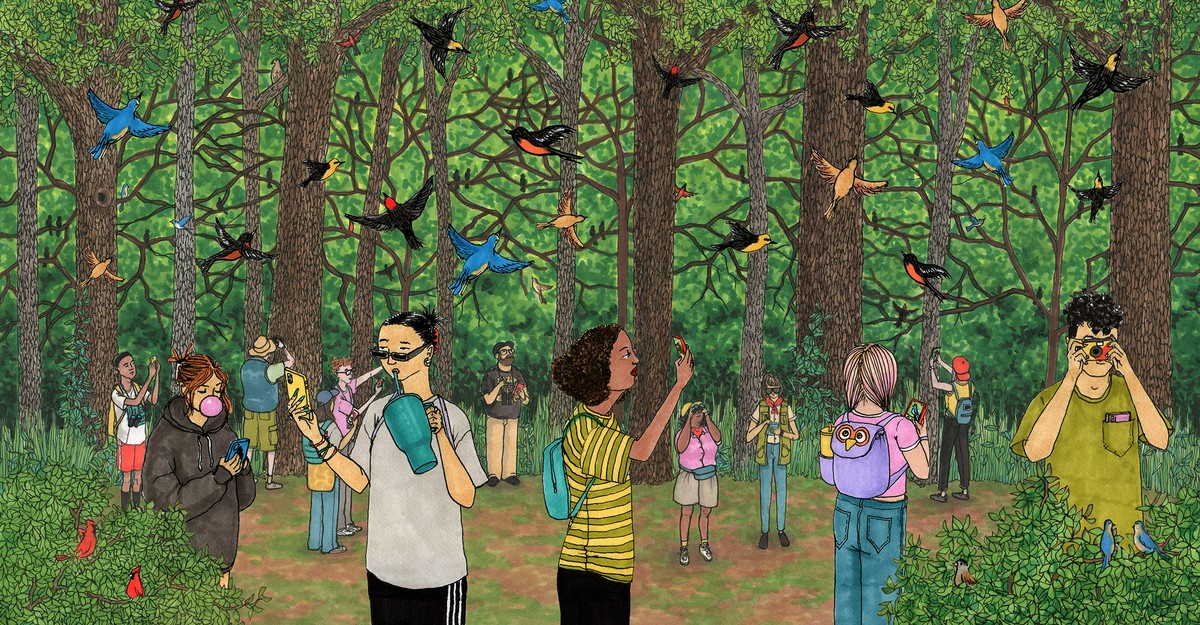
Not long before the sun rose on a Saturday in May, five men in their mid-20s were standing alongside an unassuming wetland in New Jersey, searching for birds. Ryan Zucker, a 23-year-old who could do an impressive impersonation of an eastern screech owl, had just taken a small branch to the eye, but still the group was exuberant.
Since midnight, they’d heard that owl, a common gallinule, and—after following some freight-rail tracks through the dark—the high-pitched, near-electronic trill of a sedge wren, the first recorded in Sussex County in 13 years. (A police officer had asked what exactly they thought they were doing on the tracks at 2 a.m., but took “We’re looking for birds” as answer enough.) In the previous 10 minutes, they had seen a sandhill crane raise its head above the reeds, watched a mallard chase an otter away from her ducklings, and heard a brown thrasher in the distance.
Each species put the five men one notch closer to being the repeat championship team in the World Series of Birding, a 24-hour contest to identify as many species as possible, by eye or ear, throughout New Jersey. The birds would start singing in earnest soon, and to cover the state before midnight came again, the guys needed to leave, now.
As one, the men—called ***mega (pronounced star-star-star-mega, or Team Mega if you can’t be bothered)—took off sprinting toward their van. William von Herff, a fast-talking 26-year-old originally from Canada, told me that he took up running ahead of his first World Series, in 2024. He needed to be sure he could race into a bog, then control his heart rate enough to sense the drumming of a ruffed grouse’s wings.
Birding has historically been the domain of the AARP crowd, but in the World Series, young people have an edge. And these days, birders in their 20s (and 30s and 40s) are showing up not just at birding competitions, but seemingly everywhere. Some of my friends who, like me, are in their early 30s now bring binoculars on vacation; so do a number of my sister’s friends, who are younger and cooler than mine. Young birding influencers are all over TikTok and Instagram. The National Audubon Society had 10 college chapters in 2019; today, it has 117. South by Southwest hosted its first bird lovers’ meetup last year and its first birding panel in March.
Andrew Marden, the 27-year-old who drove ***mega’s van, has been competing in the World Series since age 15, and he told me that only in the past few years have people his age started perking up when he mentions his hobby. Oh, that’s really cool, they might say. Some have even said they wanted to go birding too.
Virtually all of the 20 or so birders and bird-adjacent professionals I spoke with attributed the shift to two watershed events. The first is the coronavirus pandemic: At a moment when many Americans spent far too much time anxiously bouncing around their own home, birding represented a low-stress, low-screen, outdoor activity that could be done without travel.
The second is a revolution in birding tech. Birders have always used the newest tools available to them, whether vinyl records of bird calls, rare-bird hotlines, or push notifications. (***mega is lingo for an ultrarare species noted on eBird, a forum where birders report sightings.) But soon after the bird-identification app Merlin introduced Sound ID, a sort of Shazam for bird calls, in 2021, millions of people started using the app, including the 29-year-old Super Bowl champion Sam Darnold and the 33-year-old pop star Ariana Grande.
Merlin and similar tools have upended the culture of birding. Ten years ago, aspiring birders had little choice but to learn from the old-timers, who might be less than cool or less than welcoming. Jessica Wills, a 43-year-old birder who works in the restaurant industry in Tucson, Arizona, told me that older birders have sometimes walked up to her to explain things she already knows, or rudely corrected beginner birders when they make a mistaken ID. The apps have freed new birders to learn a good deal on their own. Instead of memorizing birds’ sounds and physical appearances, you can start a Merlin recording, see what songs it picks up, see what the birds singing them look like, and then try to locate them in your binoculars. And instead of staking out bird habitats for days on end in the hopes of seeing an elusive species, you can browse bird sightings on Discord or eBird. Several people I interviewed described birding as akin to Pokémon Go. (Really, Pokémon Go is a knockoff of birding.)
With or without an app, the basic activity is the same: You spend hours and hours standing around, straining your eyes and ears, and you get to know a lot about birds. If you’re really dedicated, you also get to know “habitats within the habitats, the very specific ways in which birds behave and when they’re active, and what sounds they might make, and what times of day are best, and what weather patterns are best for them,” Zucker told me in the van. Many of the birders I spoke with praised the benefits of such close attention to nature—María-Elena Montero, the president of the D.C. Bird Alliance, described birding as a practice, similar to yoga and meditation. Jax Quamme, a 33-year-old hearing-aid technician in Tucson who’d struggled with postpartum depression and then her brother’s unexpected death, told me that birding gave her the sense of purpose and “hits of dopamine” that she’d been lacking.
I also get a significant portion of my dopamine outdoors, but birding has always seemed to me like a mightily inefficient way to do so. Backpacking can get you sensational views along with the mental-health benefits of exercise. Skiing and cycling provide reliable thrills. Why would I spend countless hours studying a bird that may or may not choose to appear when I go looking for it? After ***mega heard the sedge wren at 2:30 a.m., we trudged back down the tracks and waited in the cold, rainy dark for marsh birds that mostly didn’t show. The only thrill was the latent possibility of an oncoming train. At one point, von Herff sat down and dozed off as we all stood by the tracks, and I began wondering what any of us were doing there.
But an hour and a canned espresso later, I understood. We’d arrived before dawn at the marsh under a light-polluted sky; I could just make out the hills behind it. And for the most part, we stood still, contemplating the faint landscape and the quiet around us, broken by the calls of frogs and, occasionally, a target bird. After a few minutes watching the hills’ dark reflections spread across the water, I noticed that a sense of calm and expansiveness—awe, even—had crept up on me.
In some ways, the young men of ***mega are like their peers who are more recent converts to birding. Older birders tend to have money and time to invest in regular bird-driven travel; these guys are more likely to be found at their local green spaces—Central Park for Zucker, D.C.’s Rock Creek Park for von Herff—amid work, school, and social commitments. They let tech into their sacred hobby: Marden has a life list of birds, 408 species so far, that his friends have shown him on FaceTime. (A previous generation might be scandalized by the list’s existence.) And whereas older birders have a reputation for being interested mostly in birds, the members of ***mega and others in their cohort tend to see the hobby as part of a broader commitment to conservation. Three of the five are studying or work full-time in green energy or environmental science; during the World Series, the team wasted precious seconds stopping the van so that Zucker could carry a wood turtle safely across an exurban road.
In other respects, the ***mega crew is a relic of an older model of birder. They’ve all been avid birders since childhood; most of them have a story about a relative who took them birding, or bought them binoculars, or left a field guide lying around to be devoured by a curious elementary schooler. Von Herff, Zucker, and Marden met as teenage birders, and Zucker and the two remaining team members—Benjamin Hack and David Benvent—knew one another at Cornell. (The school’s Lab of Ornithology is one of birding’s nerve centers and created both eBird and the Merlin app, and had factored heavily into Hack’s, Benvent’s, and Zucker’s decision to enroll.) Because they started birding so young, they all have longtime mentors several generations older than them.
Hack and von Herff had stayed with two of those mentors—Louise Zemaitis, 67, and Michael O’Brien, 61—at their home in Cape May the week before the World Series. Zemaitis and O’Brien are both bird guides and run birding summer camps for teenagers; O’Brien is also a co-author of an upcoming guide to North American birds, designed to be used alongside Merlin and eBird. Their yard is full of bird feeders and is apparently among the most reliable ruby-throated-hummingbird hangouts in New Jersey.
The first time ***mega’s route took the teammates past the house, they bickered over whether they had time to stop, and whether failing to do so would be too rude to bear. They pulled over, everyone yelled at one another while looking for hummingbirds out the window, and then Marden kept on driving to a nearby boardwalk, where they hoped to spot several crucial seabirds. But later, they stopped at Zemaitis and O’Brien’s house after all. (They still needed a hummingbird, Hack needed his overnight bag, and someone needed to pee.)
Zemaitis and O’Brien, who met at the 1994 World Series of Birding, are deeply invested in young birders. Many of their former campers, including most of ***mega, were competing in the World Series; they could recall who was friends with whom, and who grew up as part of the same birding clubs. They are enthusiastic about how birding has changed in their lifetime, and told me that the growing popularity of the hobby and the apps has meant that their campers arrive with more knowledge (and their own ideas about what birds they want to see). But Merlin alone can’t give you a fundamental understanding of ecology. Neither, I thought as I watched hummingbirds and a Baltimore oriole visit the feeders scattered through the yard, can it give you friends like Zemaitis and O’Brien.
Spending the day with ***mega, I was struck, too, by how its members cared for and respected one another even as they disagreed over their next move, or got frustrated when one of them couldn’t train their binoculars on a bird that everyone else had seen. Gen Z is notoriously lonely, and young men supposedly have it worst of all. But those narratives were difficult to reconcile with the guys’ mature, loving way of interacting. When I pressed the teammates on why they were birders and how that shared love had bonded them together, Hack, who had been stuck in the third row of the van with me for most of the day, told me the motivation was simple enough: “I think it’s just fun to do this with my friends.”
When I woke up in a Wildwood motel the morning after the World Series, ***mega was still waiting to find out if it had held on to its title. I decided to go for a walk, and before I left the room, I hesitated, as if on the precipice of a great personal choice. Then I grabbed my binoculars and my phone and set up a Merlin account before heading down to the beach. When I got the text from von Herff— “WE WON!!!”—I was standing in the surf, trying to figure out whether I was looking at a sanderling or a semipalmated sandpiper.