One Place News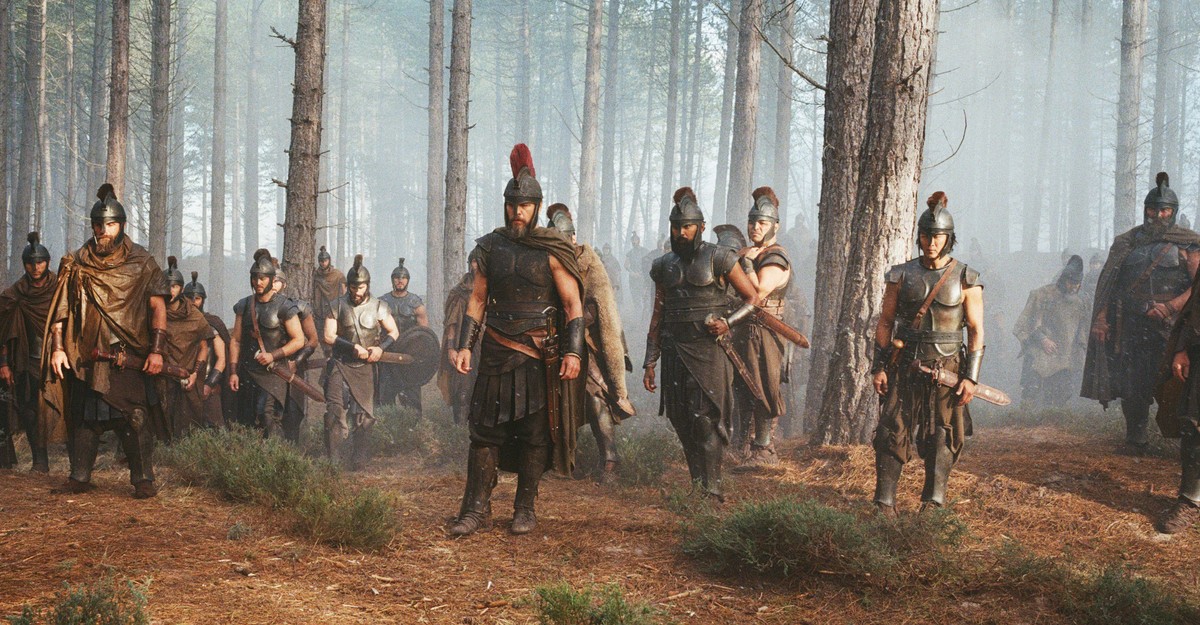
Emily Wilson’s celebrated translation of Homer’s The Odyssey sets aside the classic description of the epic poem’s hero, Odysseus, as a “man of twists and turns.” Instead, she goes for something more introspective: “Tell me about a complicated man,” it begins. That tweak perfectly reflects Christopher Nolan’s approach with The Odyssey, which is somehow Hollywood’s first proper adaptation of one of human history’s most enduring stories. His latest film contains many of the tale’s intricacies, its Greek gods and monsters, and its brutal, tragic sweep. But at its center is a person wondering whether he even deserves to return to the civilization that he fought so many years for.
As he has become fond of doing, Nolan delivers that rarest breed of blockbuster with The Odyssey—a visual extravaganza shot entirely in IMAX and best seen projected onto a mountain-size screen. Yet the movie manages to be a challenging, personal work, too, contending with the same anxieties about family and the crumbling edifices of modern society that power so much of Nolan’s filmography. He somehow finds idiosyncratic angles on well-trodden material, underlining Odysseus’s (played by Matt Damon) ache of yearning and loss without sacrificing the poem’s core sense of adventure. The result is a genuine pleasure to behold.
When Nolan first announced The Odyssey as his next project, I worried that the filmmaker’s love of practical effects and gritty in-camera realism might be his undoing. The story is, after all, reliant on walk-on appearances by mythological figures and heavy on fantastical creatures; even with his most outlandish films (such as his Batman trilogy and the dreamworld thriller Inception), Nolan has tried hard to stay grounded. The Odyssey certainly has the type of visual immediacy that he favors: The ship Odysseus navigates through the seas is battered by real waves, and the most fanciful moments are conjured with just the barest hint of CGI. The director imagines a land of antiquity that seems more inspired by UNESCO World Heritage Sites than by the director Ray Harryhausen’s colorful, special effects–laden Greek epics of yore; his vision is all simple stone temples and rough-hewn leather armor.
[Read: The absurd misunderstanding fueling the debate over The Odyssey]
The film is also infused with magic of a grim, earthy sort. The cyclops Polyphemus (Bill Irwin) looms over Odysseus and his soldiers through what feels like old-fashioned camera trickery; the pale, humanoid giant snatches them up and gobbles them whole. The witch Circe (Samantha Morton) somehow fluidly grabs people’s faces and stretches them, molding them into porcine snouts—a mechanical on-screen transformation unlike any I’ve seen in contemporary filmmaking. When Odysseus visits the land of the dead, undead shades crawl out of the volcanic soil, covered in mud and soot; perhaps that visual is the simplest way to render the moment, but Nolan knows how to make it blunt and spookily effective.
Odysseus’s journey unfurls in a similarly painstaking manner. Damon plays him as a taciturn yet commanding figure, respected rather than feared by his men. This Odysseus is less of a trickster and more of a thinker, however; he plots his moves quietly and is haunted by mistakes of the past. In typical fashion, Nolan dribbles out pieces of his protagonist’s story in flashback, saving the full retelling of Odysseus and the Ithacans’ sack of Troy for late in the film after teasing it in the beginning. Odysseus himself fills in many of the intervening gaps as memories that he shares with Calypso (Charlize Theron), the mysterious figure whose island he ends up stranded on.
Nolan, however, always has a reason for his temporal muddling. The writer-director is depicting Odysseus’s journey home not just as a travelogue riddled with grand setbacks, but also as a way for the hero to remember his sense of purpose after a decade of fighting dashed it to pieces. Odysseus and his army repeatedly cite “Zeus’s Law,” the ancient-Greek notion of hospitality, as they find themselves greeted by hostility and danger wherever they go. Are these men cursed by the gods, or is the world they had sought to conquer disintegrating around them?
[Read: Christopher Nolan on the promise and peril of technology]
That latter notion bubbles away in Ithaca, where Odysseus’s wife, Penelope (Anne Hathaway), guards his throne from a mob of greedy suitors seeking her hand in marriage; their goal is to wed Odysseus’s wife before his son, Telemachus (Tom Holland), comes of age. Hathaway plays Penelope as a proud, if wounded, bird, baffled at her husband’s absence even as many of his compatriots return; Holland, tamping down his Spider-Man chirpiness to tolerable levels, conveys how Telemachus’s essential goodness is still tinged with the arrogance of youth. The best characters on the Ithacan shores, though, are Eumaeus (John Leguizamo), Odysseus’s nearly blind swineherd who symbolizes the fading of honorable traditions, and the chief suitor, Antinous (Robert Pattinson), embodying the arrogance and greed eating away at the survivors after their victory.
Pattinson’s preening villainy is a crucial part of deepening the stakes. Nolan is emphasizing a loss of self and idealism in the shadow of war, giving The Odyssey some contemporary heft without any jarring didacticism. His previous movie, Oppenheimer, questioned whether the start of a new postwar world order had hastened the end for society; The Odyssey, meanwhile, is set in the aftermath of a great triumph and consumed by the notion of the dark ages that may well follow. Odysseus is flawed, sometimes impulsively proud, and haunted by his past failures—as well as generous and loving in a way that Nolan seems to want to celebrate. The filmmaker created a movie that does exactly that, keeping the necessary mythic scale but preserving the humanity at the center.
When you buy a book using a link on this page, we receive a commission. Thank you for supporting The Atlantic.