One Place News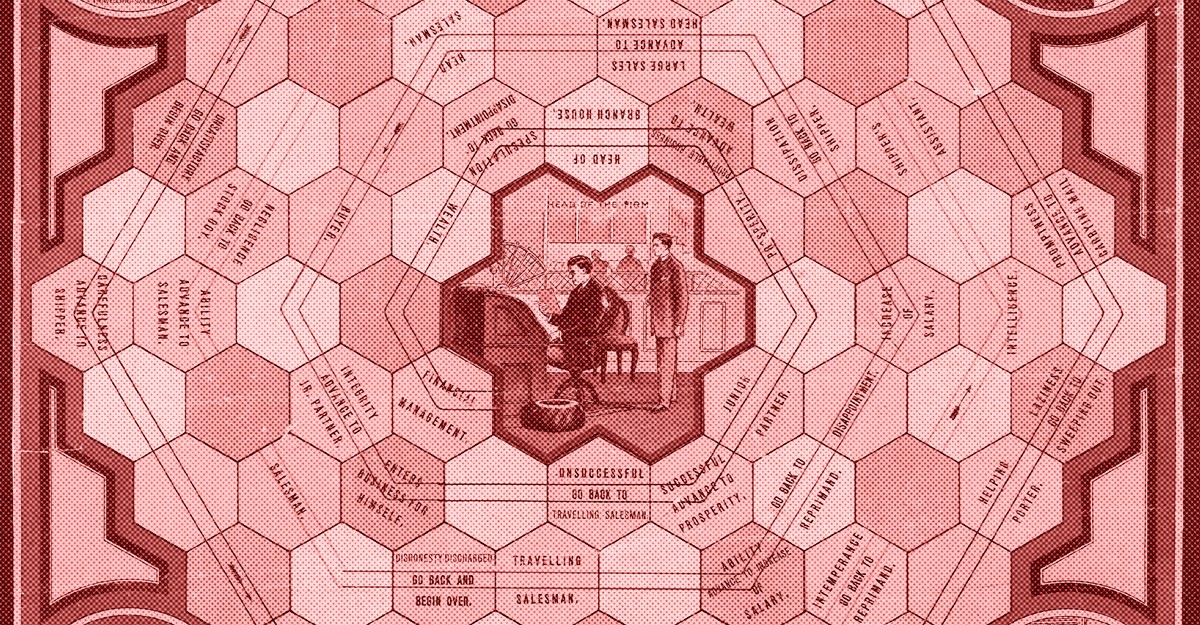
This is an edition of Time-Travel Thursdays, a journey through The Atlantic’s archives to contextualize the present. Sign up here.
One of the most gruesome murders in 19th-century America happened in a New York City office, just across the street from city hall. In 1841, Samuel Adams, a printer of no apparent relation to the famous Revolutionary, paid a visit to John Colt, the author of a popular bookkeeping manual and brother to a famous gunmaker. Adams had gone to see Colt about the $1.35 he believed he was due. In the argument that ensued, it’s not clear why Colt reached for a hatchet—he claimed self-defense—but he did, and he used it to bludgeon Adams to death. To hide the deed, Colt cleaned up the blood, stripped the corpse, and stuffed it into a large wooden crate in the room. The next day, he had the crate loaded onto a ship bound for New Orleans. The stinking body was soon discovered in the hold, and Colt was arrested not long after that.
Twelve years later, in 1853, Herman Melville was still thinking about the murder. Curiously, his sympathies rested with the killer—the man he called “the hapless Colt” in his great tale of office work and alienation, “Bartleby, the Scrivener.” The story’s narrator theorized that the crime would not have happened if the men had met anywhere but in an office. It was that setting, “entirely unhallowed by humanizing domestic associations,” that drove Colt to such “irritable desperation.”
What is it about the office? From its beginnings, it’s been a place of anxiety and conflict, if not usually of the murderous variety. It was, in Melville’s time, a novel space born out of the growing scale of capitalism. Industrial production, steam-powered transportation, and ever more trade required a new realm of work managing and tracking the massive volumes of information being produced. Young people, mostly men from the countryside, flooded into cities to meet the demand, and perhaps to make something of themselves. They kept accounts, tracked commodities, copied correspondence, and recorded legal documents. In the process, they complained a good deal about this tedious and odd kind of work, even as it became a pillar of modern economic life.
In the 19th century, “clerks” quickly became a sizable portion of the urban workforce (already the third-largest category of laborers in New York by 1855). Writing in The Atlantic in 1861, Thomas Wentworth Higginson explained the attendant shift in human labor concisely: “All hand-work is constantly being transmuted into brain-work.” In a world that had long equated labor with the physical act of making things, such a shift was seen as not terribly manly, and potentially dangerous to society as a whole. In an essay endorsing a robust program of “gymnastics” for clerks, Higginson lamented that these “dandies of the desk,” these “artisans of the brain,” would wither away, creating a nation of weaklings.
But the problem went beyond the body. Repetitive mental work in such unhallowed spaces also punished the mind and the soul. After sitting all day, Higginson said, the average clerk “leaves his place of business at nightfall with his head a mere furnace of red-hot brains and his body a pile of burnt-out cinders.” Not everyone went slowly insane under such circumstances, as Bartleby does in Melville’s story, but the experience was disorienting all the same. The misery of what Higginson described as “over-writing one’s self” was not just a literary idea; as the scholar Thomas Augst has shown, the diaries of this first generation of clerks record a similar sense of self-negation. “Everything is at its highest pitch of dullness. No life in anything, but all seems as inanimate as lifeless matter,” one entry states.
The inefficiencies of early office work drove developments in information technology and modern management practices. Adding machines, cash registers, mimeographs, punch cards, and eventually computers maximized productivity while creating stricter office systems and carefully prescribed processes. Beginning in the late 19th century, the office also produced a new gender division of labor, as more of the repetitive work—typing, filing, stenography—fell to a secretarial class of women with limited prospects for advancement.
The quiet struggles of the office never quite went away. The modern capitalist economy continued to expand, and the machines and systems developed to manage it all didn’t reduce the work: Generating and processing more information seemed to only generate more information to process. In Sinclair Lewis’s 1917 novel The Job, the heroine, Una, sees it all quite plainly. “She knew that the machines were supposed to save work,” Lewis wrote. “But she was aware that the girls worked just as hard and long and hopelessly after their introduction as before.”
Although many workers chafed against the confines of office life, demand for these jobs only grew. For men, what we now call white-collar work has become the route to social mobility, affluence, and a measure of status. For women, despite the exploitation and the very real limits on advancement they have faced, office work has offered them more financial independence and public standing than ever available before. Today, the white-collar workplace is often seen as the most reliable pathway to middle-class comfort and standing.
This model of progress was evident even in the games played at the time. In 1889, Parker Brothers released the board game Office Boy, which had a simple premise: You began on the margins, with one small act of initiative—Apply for Situation as Office Boy—and moved toward the center, Head of the Firm. Positive qualities—promptness, diligence, cheerfulness—sped up your ascent through the ranks; negative ones—laziness, dissipation, late mornings—slowed it down. The lesson was plain. Your future was in your hands, and with a little bit of luck and pluck and a good roll of the dice, you just might be the boss.
When you buy a book using a link in this newsletter, we receive a commission. Thank you for supporting The Atlantic.