One Place News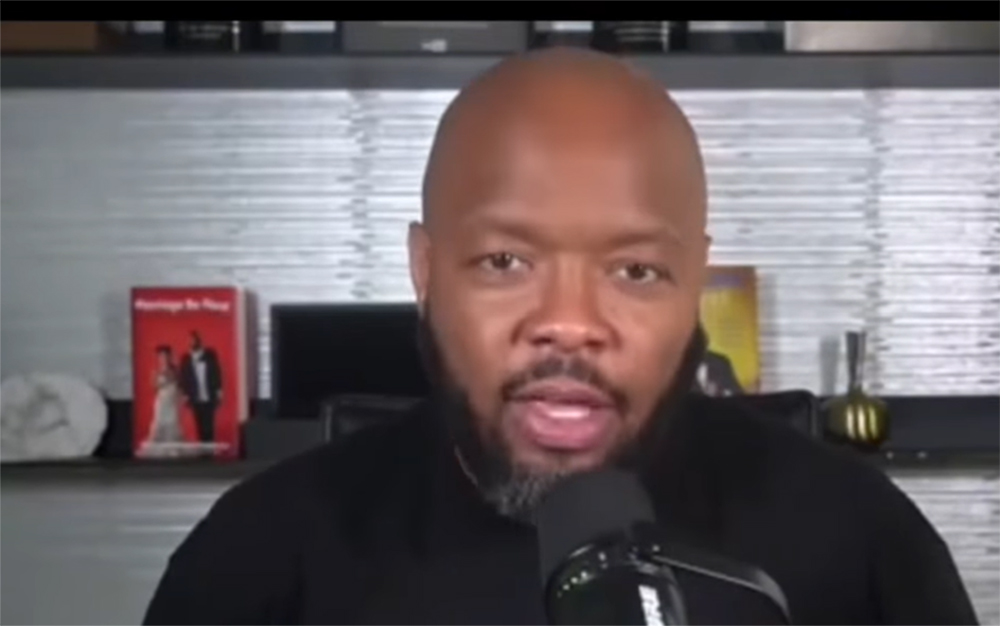
(RNS) — Christian comedian Kevin Fredericks, better known as KevOnStage, didn’t seem like he was trying to instigate another public debate about sexual ethics and Christian faithfulness in his comments during his podcast. But the discourse exploded anyway when a video randomly resurfaced, went viral and received apparent backlash, according to several Black progressive social media creators who chimed in.
When he yelled “I beat my meat” into the microphone during the podcast interview, he was explaining that his views on masturbation had changed and the strategy he employs to stay faithful to his wife on the road during his extensive touring schedule. But online, Black social media users are now using the name of KevOnStage to discuss masturbation and Christianity more broadly. It could be in part because Fredericks has been talked about on social media frequently for his apparent public deconstruction, through which he has also supported LGBTQ+ inclusion.
“This conversation about KevOnStage really isn’t about masturbation. It’s actually something much bigger than that,” explains Pastor Kristian A. Smith in an Instagram reel. “Kev is a threat to fundamentalist Christianity. He started off as a Christian comedian with a mostly Black Christian audience, and he was relatively socially conservative. … But he’s over here thinking critically out loud.”
Smith is right.
This latest controversy is not about faithfulness. It’s about fear that American Protestantism’s dirty little secret might be exposed: that we’ve been lied to at church for generations about what Jesus would call faithful Christian practice.
Every Sunday, Protestants fill the seats in countless sanctuaries and are preached long-held popular beliefs that lack basis in Christian Scripture, espouse doctrines Jesus never preached and that his earliest followers didn’t speak on or follow.
In Fredericks’ case, that doctrine in question is purity culture — a movement that became wildly popular in the 1990s, emphasizing sexual abstinence before marriage (especially for women). It discourages casual dating and ties a person’s moral worth to their sexual purity (e.g. doesn’t masturbate).
If a century from now archaeologists found an archive of the artifacts of that era of Christendom, they might conclude that sexual purity was the litmus test of faithful Christian practice, with the abundance of books on courtship like “I Kissed Dating Goodbye” or VHS footage of purity ring pledges and ceremonies. Entire books were written specifically as polemics against self-pleasure. Those archaeologists might conclude that purity culture was Christianity.
As someone who grew up in purity culture’s heyday, I was practically taught that. As a teenager and young adult, I was never haunted by Jesus’ actual words about his priorities, like about when we refuse to feed the hungry, clothe the unclothed and visit prisoners and the sick — all of whom are often cast into the shadows of society’s margins and forgotten. But I was wracked with debilitating shame and persistent anxiety about going to hell over something Jesus never said: that self-pleasure is a sin.
That discrepancy is a grave problem. Millions of Christians have been programmed to the point of nervous system-level discomfort to avoid cultural taboos as though divinely established, yet feel no such conviction about the things Jesus is recorded as saying are his priorities.
Though Fredericks is not a trained theologian, the backlash to his public deconstruction recalls the experience of many people who have received quality theological education. Theology students confront countless discrepancies between what we were taught in church and in seminary. We compare biblical stories to concrete sciences, compare English translations of the Bible to those same passages in their original languages and trace the historical origins of popular doctrines. In doing so, discrepancies abound. Sometimes that process is disorienting, disillusioning and even painful.
A seminarian studying this topic may find that the notion that masturbation is sin is rooted in the Catholic teaching that sexual activity is primarily for the purpose of procreation. It seems to have solidified in a letter from Pope Leo IX in 1054 that labeled masturbation as a mortal sin, among others, meaning it could bar a soul’s entry into heaven.
This teaching is not backed by any clear scriptural prohibition. And it stands in contrast to an entire biblical book, “Song of Songs,” that celebrates sex that doesn’t produce offspring — a tacit approval of sex for pleasure as legitimate sexual activity.
But that seminarian would likely know better than to pick that fight from the pulpit, lest they become a trending topic on Threads, or worse, lose their job. Perhaps the most painful part is discovering that the knowledge you’ve painfully acquired is of no value or interest to the congregations you might hope to serve once you earn your degree. In fact, by many, it is regarded as a threat.
“There’s an old saying in our profession: you can’t tell the sheep,” wrote Los Angeles-based pastor Aaron Van Voorhis. “… As a pastor of more than 20 years and a seminary graduate, I’ll let you in on a secret: you’re being lied to. … Imagine going to law school or medical school and finding out there are numerous facts about your field, that if made common knowledge, would seriously undermine your profession. That’s a moral crisis. And yet somehow this is acceptable in the church.”
That this is a moral crisis is no exaggeration. Our current battle against the form of authoritarianism we call Christian nationalism should be a lesson about the risks of allowing Christianity to become nothing more than church clothes for political agendas and social projects that are based on popular, debunked misinterpretations of Scripture or straight-up biblical fan fiction.
Conversely, the Christian church has been essential to freedom movements throughout history. It has provided essential resources and infrastructure these movements needed to sustain resistance to systemic oppression, in accordance with what Jesus said was one of the greatest commandments: love your neighbor as yourself.
When the church obsesses over purity codes never established by Jesus or his disciples, it creates a grand distraction with social and political consequences — a discrepancy many in the Fredericks debate are noting.
Pastor Smith, who named Fredericks’ public deconstruction as threatening to fundamentalists, continued in his Instagram reel to ask why conservative Christian commenters are concerned about a comedian’s private behavior but not about President Donald Trump having to pay a woman over $5 million because he was found liable of sexual abuse.
“Homelessness hit record highs in the last few years but y’all mad at KevOnStage,” writes Threads user Benjamin Faye (@heytherebenji), a popular voice on social justice issues.
“If black Christians had the same smoke for the white supremacist structures and anti-blackness that exist in the church, that they do for @kevonstage we would all be free,” wrote singer-songwriter Jaqueline Constance.
This discourse reveals that many people feel the social consequences of the Christian church’s misguided priorities. The answer here is not to instead frame Christianity through leftist politics, but to take faithful Christian practice seriously enough to scrutinize it — to discriminate between what can claim to be a legitimate branch of the root of Jesus’ teachings and what can’t. If American Protestants fail to do so, they risk irrelevance, or worse: further weaponization of their faith.
To be sure, Jesus did have something to say about sexual ethics but never made it the cornerstone of his teaching. Christians must find the moral courage to confront widely held erroneous beliefs, trusting that the truth of their tradition will survive investigation.
As one Southeastern University theology professor told my class often, “A faith that can’t be tested can’t be trusted.”