One Place News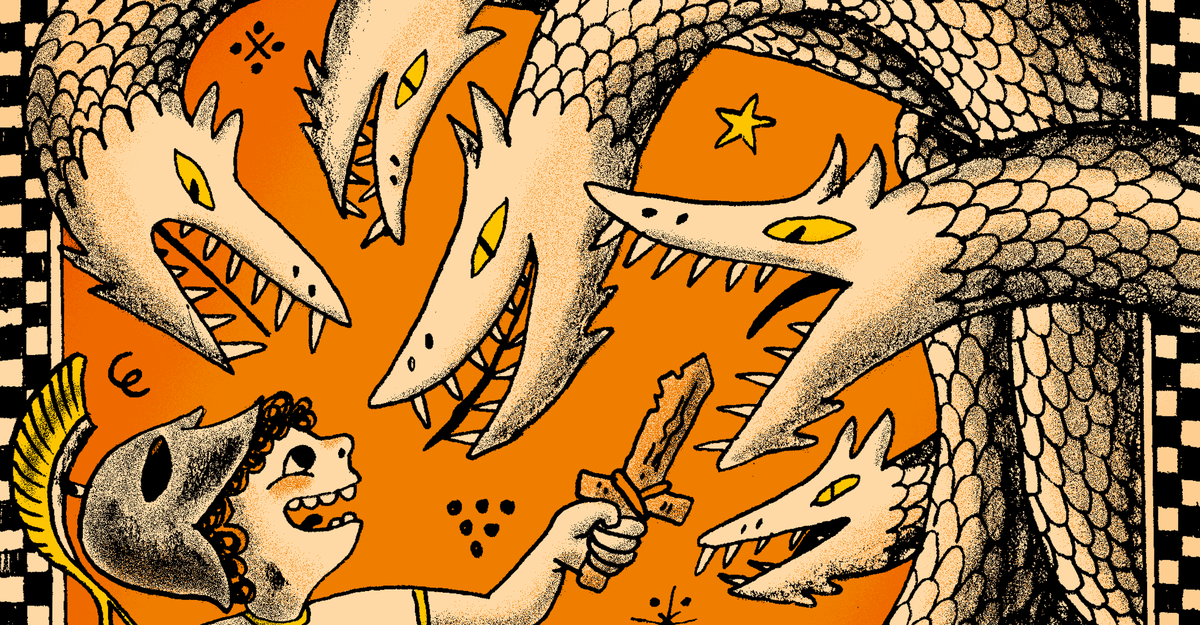
In Book 12 of Homer’s Odyssey, a band of war-weary sailors is navigating home when a narrow strait appears on the horizon. The ship, captained by their king, Odysseus, is blocked on one side by a high cliff where a six-headed monster named Scylla is waiting to devour those who pass beneath. On the other side lies a whirlpool called Charybdis that could swallow the ship whole. Odysseus orders his men to row on. Scylla pounces, snatching members of the crew between her jaws. As she consumes them, Homer writes, they shriek, stretching out their arms in “horrifying death-throes.”
It’s a gruesome scene, one of many in this confusing, archaic poem composed some 3,000 years ago. One night this winter, hearing Scylla’s tale read aloud to him for the first time, my 3-year-old son, bundled in his pajamas before bedtime, had a request.
“Read it again!” he said.
The Odyssey is not, strictly speaking, a children’s book. The poem’s structure can confound even an adult reader. It does not open with “Once upon a time,” but rather in medias res, as a committee of gods discusses a war that the author expects you to know about already. By the time the story gets to Odysseus’s plight—Homer assumes you’ve heard of him, too—his journey unravels like a Quentin Tarantino film: It starts near the end and then shifts back and forth in time. Some parts of the plot are also not especially kid-appropriate. Characters trip on drugs. A giant’s eye gets poked out with a red-hot stake. Odysseus is unfaithful to his wife. Goodnight Moon this is not.
Nevertheless, I have spent the past several months reading The Odyssey to my toddler. Part of my motivation is high-minded. Homer’s fingerprints are all over other epic tales: Classic characters who owe a debt to Odysseus include Dorothy on the yellow-brick road, Huck Finn floating on a raft, and Bilbo outsmarting Smaug in Middle-earth. This poem “is the ur-text,” Christopher Nolan, who directed the film adaptation of The Odyssey that is coming out this week, told The New York Times recently. Why not start with the source material? But also, I’m doing this because, some questionable content aside, The Odyssey is a great yarn. My son is young, but he’s not too young to appreciate bloody battles, man-eating monsters, and a side quest to hell.
[From the December 2017 issue: ]The Odyssey and the other
I eased in gently at first. Before reading the full epic, I introduced my son to the story of the Trojan War with picture books produced for children, including The Adventures of Odysseus. The illustrations showed him fleets of Greek ships sailing for Troy to recover Helen, and men being transformed into livestock. They taught him that a Cyclops has only one eye and that Sirens are alluring but dangerous.
When he seemed ready for the real thing, I chose the 2025 translation by Daniel Mendelsohn, who teaches a Homer seminar at Bard College. His language is luscious, full of detail, and lots of fun. (He describes Charybdis, for example, as being “like a seething cauldron / That bubbles up to the brim when it’s set on a roaring fire.”) When I read it aloud, my voice falls into a rolling cadence that propels the story forward. This is by design: Mendelsohn aims to replicate Homer’s original meter, which makes his version ideal for performance.
Mendelsohn also retains Homer’s repetitious epithets for characters that some modern translations—written for the silent reader of the 21st century—have slimmed down. We hear many times that Penelope is a “clear-thinking woman,” and that Athena is the goddess “of the bright owl-eyes.” When read aloud, the repeated descriptors serve as reminders to the listener of who each character is and the role they play. Which is especially helpful when that listener is someone who still takes afternoon naps.
The first time I opened the 549-page volume with my son, I read the first line using the most Homeric voice I could muster.
“Tell me the tale of a man, Muse—”
“Daddy, what’s a Muse?” he asked.
I explained that a Muse was a goddess who loved literature and art. “They help the storyteller recite the poem,” I said.
“What’s a goddess?” he asked.
“It’s a god who is a girl,” I said. “You know, like Mommy.”
He nodded, his eyes narrowing slightly.
“Keep reading,” he said.
I did as ordered, spending several minutes getting through the first seven lines. I told him of Odysseus’s “roundabout ways”—“What’s roundabout?”—and the sacking of “Troy’s hallowed keep”—“What’s hallowed?” I wondered if I’d made a mistake. At the current rate, I worried we might never finish the first book, let alone the entire poem. Then I read line 8, which tells of how Odyseuss’s men succumbed to their desperate hunger and ate the prized cattle of the sun god, Hyperion:
“Fools that they were, like children, who devoured the sun god Hyperion’s—”
“Cows!” my son interjected.
He knew the story. The prep had paid off.
We continued to read into the summer, line by painstaking line. Sometimes he’s refused to listen, thrusting a well-worn children’s book into my hands instead. I’ve also censored the story here and there: When things got a little too steamy inside the lairs of Calypso and Circe, I skipped ahead. As we approach the end of the epic, I’ll save a horrific scene where Odysseus orders the execution of a group of women whom his family keeps as slaves for another time. Despite these challenges, The Odyssey has been a constant in our lives that has brought us closer together. One day, when he fell ill with a stomach bug, he pulled out the book and crawled into my lap. For him, The Odyssey was a comfort read.
With a bit of prompting, my son has been able to notice some of the ways The Odyssey echoes in other beloved stories. In Book 5, Poseidon sends a storm that shatters the boat that Odysseus was sailing in, alone. Ino, a sea goddess, takes pity on Odysseus. She lends him a magical veil that keeps him from drowning and tells him to “use those hands to swim.”
“Ino is telling Odysseus, ‘Just keep swimming!’” I said.
“Like Dory in Finding Nemo!” he said.
“Exactly!”
Finding Nemo can, in fact, be seen as a modern children’s reinterpretation of Homer’s poem. The hero’s name, Nemo, is the Latin word for “no one”—which is what Odysseus calls himself as he attempts to escape the Cyclops.
Later on in Book 5, as Odysseus tries to survive in the ocean, he wails out a prayer for salvation: “Have pity on me, Lord.” His prayer is heard. The waves stop rolling and the storm ceases.
I asked my son, “Can you think of anyone else who was lost at sea and prayed for God to save him?”
He looked down, thinking.
I offered a hint. “Maybe someone who was swallowed by a fish?”
“Jonah!” he said.
I’ve loved helping him make these connections: As he gets older, I hope he’ll take solace in knowing that the newer stories he enjoys today are connected in a chain of humanity stretching back thousands of years. I have always found that link to the past reassuring.
[Read: The phrase I texted my kids 133 times]
For now, though, I’m delighting in how The Odyssey has unlocked my son’s imagination—something that the other, more kid-friendly books we’ve read together haven’t been able to accomplish.
The weekend after we read about Scylla, I took my son for a walk along a nearby river that passes through steep banks with cliffs above. At one point, he stopped and squinted toward a crevice high in the rock. “That’s where Scylla lives,” he announced. He lifted a stick and a stone from the ground: his sword and shield. “I’m Odysseus,” he shouted, and sprang up the bank. “Let’s get her!” A few months later, he used life-size chess pieces at an outdoor brewery to reenact the sacking of Troy. After finishing the battle with the help of a knight—the Trojan horse, he explained—he shoved a bishop standing in for Paris and wrapped his arms around the queen, who represented Helen. “I’m Menelaus,” he said, the name rolling off his tongue thanks to all the times he’s heard me read it to him. “Paris stole my wife.”
The world around him has become a stage filled with heroes, gods, and fantastical creatures. As he grows older, he’ll learn that plenty of those exist in the real world, too. Stories—especially myths—can give children context for the truth of life ahead. They can help children understand that they aren’t the first people in the world to face hardship or overcome obstacles. Others have come before, stood up to the monsters, and thrived. And so can they.
When you buy a book using a link on this page, we receive a commission. Thank you for supporting The Atlantic.