One Place News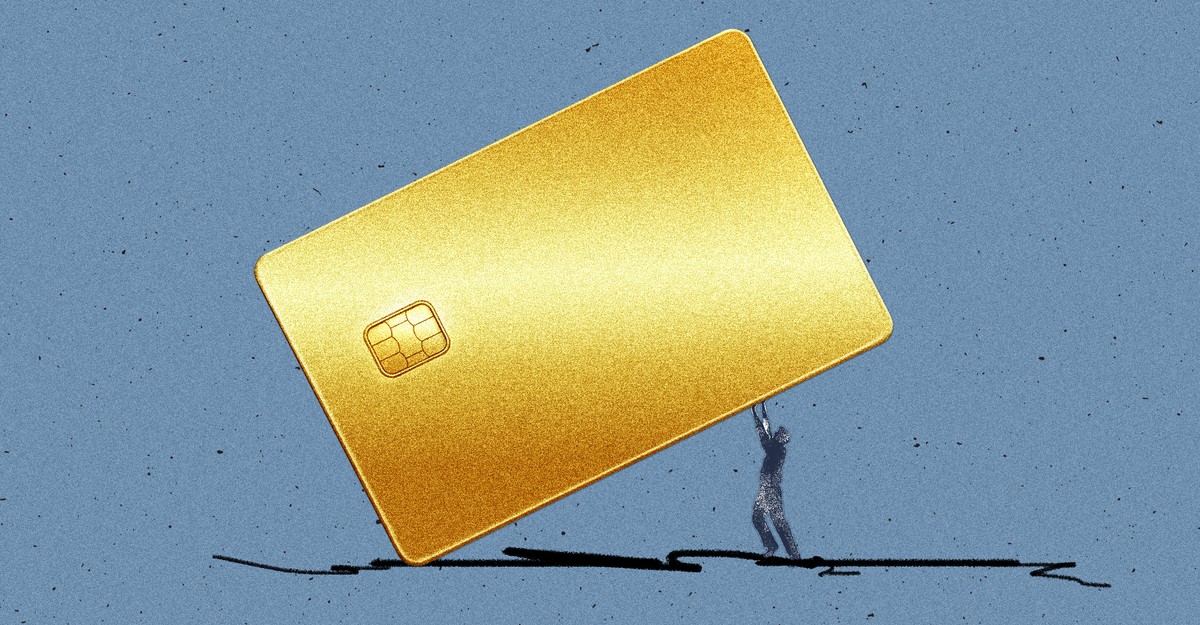
Physical credit cards should be a thing of the past. Over the past few years, touchless services such as Apple Pay have driven a boom in the digital-payment industry: Digital wallets now account for about half of global online purchases and one-third of point-of-sale payments. You would think that credit-card companies might abandon investing in cards that weigh down your wallet—but you’d be wrong.
Take, for example, the Platinum Card from Robinhood, introduced in March. Coated in 99.9 percent pure platinum, it weighs 27 grams, or more than half the weight of an average golf ball. “If you throw it on a dinner table, it’s gonna make a ‘clang,’” Deepak Rao, a senior vice president at Robinhood, told me. The Platinum Card is just the latest addition to an ever-growing heap of lavish cards that speak to America’s appetite for flashy, metallic, and loud ways to pay.
American Express last year released a mirrored card so reflective that one card holder I spoke with told me that she uses it whenever she needs to touch up her lip liner in a fix. A similarly mirrored credit card made by the fintech company Bilt comes with its very own polishing cloth. Apple, meanwhile, provides a cleaning guide for its titanium card that recommends avoiding “abrasive objects.” Revolut, an online bank, offers a steel credit card that comes in a range of colors, including lavender, space gray, and rose gold. And JPMorgan Chase’s cards come in boxes that are themselves so intricate and high-quality that Brian Dean, a finance influencer, told me he keeps one on display on his shelf.
In 2022, the journalist Amanda Mull wrote in The Atlantic that metal payment cards were on the path to becoming luxury accessories. Today, that transformation seems complete. Opulent cards, marketed for years as status symbols, have been embraced by an entire commercial ecosystem of banks and fintechs trying to one-up each other, eager consumers, and influencers extolling cards’ virtues and ranking their weights with microscales.
Institutions are now designing cards with virality in mind: Some cards omit names and numbers so they can be filmed more easily, and others are proudly marketed by grammage. A card’s weight informs its so-called plunk factor, akin to the leather grade of a handbag or the sparkle of a diamond. Lewis Rubovitz, the chief strategy and marketing officer at CompoSecure, the leading manufacturer of metal cards in the United States, told me that most providers want their credit cards to be “heavy, heavy, and heavy.”
Such weight doesn’t come cheap: Industry experts told me that plastic cards cost issuers about $1.50 each to buy from manufacturers, whereas metal cards run companies about $15 on average. That price can surge into the hundreds or even thousands of dollars if those cards are made of metals like palladium, platinum, or gold. As cards get fancier, they typically become heavier. Whereas a plastic card weighs approximately five grams, cards made with stainless steel—the most popular material for metal cards—can weigh more than two or three times as much. A solid-gold card can weigh up to 36 grams, the equivalent of three AAA batteries.
Barclays makes a card plated in 24-karat gold, an inactive version of which is listed on eBay for $199. Robinhood-card holders can upgrade the company’s steel Gold Card to a version made entirely of 10-karat gold. Those cards can cost thousands of dollars to produce, depending on gold prices, according to Rao. American Express, meanwhile, has twice released limited-edition runs of cards made from melted-down Boeing aircraft, and Revolut coated a recent release in titanium of the grade used in an Audi F1 race car.
It’s all starting to get more than a little absurd. Leanne Fremar, JPMorgan Chase’s global chief brand officer, told me that the company has experimented both with different ways to incorporate metal into its cards, such as manufacturing versions with a metal core or veneer, and with finish techniques that make cards textured, ombré, or polished. Some efforts are years in the making. Robert Myrsater, the head of design at Bilt, told me he had dreamed of making a credit card with a reflective, chromelike finish since 2021, but he ran into a serious issue ahead of the January release of Bilt’s mirrored Palladium Card: It retained finger smudges. He tested out numerous layering treatments before finally just including the microfiber cloth that owners can use to keep the card looking fresh.
If your credit-card company doesn’t offer metal versions, third-party vendors have stepped in to do the job for them. Metal-CreditCard.com will “upgrade” plastic credit cards by extracting their chips and placing them into steel cards. Engraven Card, another company that turns plastic cards into metal, finds particular success in custom designs that make explicit references to wealth. “I’ve upgraded welfare EBT cards to say Millionaires Club,” Travis Jean, Engraven Card’s founder, told me.
The metal-card industry’s sales pitch is that a credit card’s weight carries genuine social currency. Online videos rank the various sounds metal cards make, ranging from “mid” to “like a flex,” when they’re plunked down on a table. “That matters to people: how it feels when it goes down at that restaurant bill,” Jessica Ling, the executive vice president of global advertising at American Express, told me. Metal-CreditCard.com’s founder, Vincent Torres, told me something similar: “The plunk factor of dropping a full metal card on the table, it changes people’s perspective of just who you are.” (Torres recently wrote a book titled How a Metal Credit Card Transformed My Life.)
The message appears to be working. Spencer Johnson, a YouTuber whose unboxings of cards have amassed hundreds of thousands of views, told me that videos on metal credit cards are “high-dopamine content.” Viewers “want a little taste of that just by watching somebody else open theirs, even if it’s not attainable for them,” he said. Rachel Tyers, another credit-card influencer, first made it big on Instagram when she posted a video explaining how to apply for the mirrored card from American Express. The video has 3.6 million views, and she’s since made videos of herself using scales to compare the weight of credit cards and testing which are scratch-resistant or show fingerprints.
Whether you really should be investing any of your sense of meaning and self worth into a three-inch slab of metal is, of course, a question all its own. But card sellers are tapping into a surge of interest in luxury goods. Demand for metal credit cards is on the rise alongside that for high-end jewelry, expensive homes, and premium airplane seats. Several people I spoke with speculated that the ubiquity of digital payment has only helped credit cards stake out new territory in the realm of the physically ostentatious. “It is a much more dramatic gesture to be at a table with a bunch of friends, and you’re plunking down a metal card over beeping your phone into the payment system,” Clint Henderson, a managing editor at The Points Guy, told me. Digital-payment services might be more convenient, but they can’t be held, flashed, or thrown down on a restaurant table. They certainly won’t score well on a drop test.
And so, the designs keep coming. Cards that light up, are made entirely of glass, and even contain jewels have already been manufactured for clients by CompoSecure. Revolut is hoping to soon bring its Ultra Card, which arrives encased in a transparent picture frame, to the United States. As for Robinhood, Rao has an idea for how to outdo his past products: a card in Vantablack, one of the world’s blackest coatings. “It’s going to be epic, but I haven’t figured out how to do it yet,” he told me.