One Place News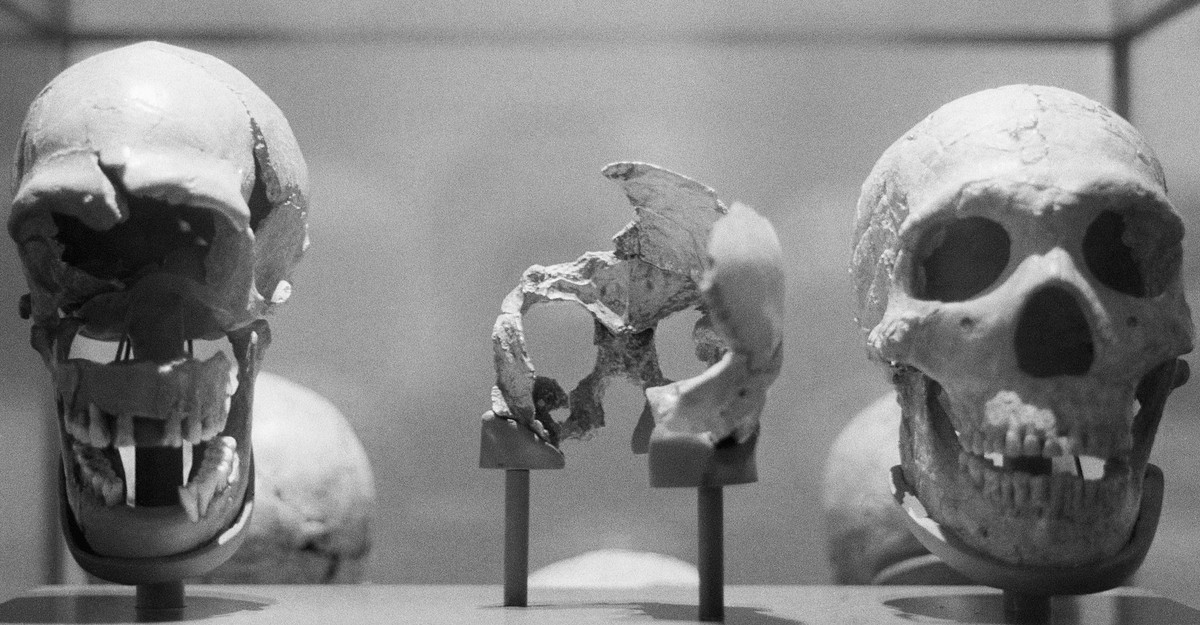
Some 50,000 years ago, modern humans wandered into Ice Age Europe. The continent was new to us Homo sapiens, but not for beings of our general kind. Neanderthals and their ancestors had been living among Eurasia’s glaciers for ages, and in ways that would have struck us as familiar. Evidence suggests that they may have strung eagle talons together into necklaces and stained their bodily ornaments with pigments. They tended fires, cooked food, and maybe even made their own glue. On sandstone cave walls, they etched wavy lines, dots, and other geometric designs.
After first contact, under social circumstances that we cannot possibly imagine, modern humans and Neanderthals had children together; around the same time, in Asia, our species also procreated with another species, the Denisovans. Scientists know this because they have sequenced DNA from Neanderthal and Denisovan remains, and they can see fragments of their code in our genomes to this day. Now we are learning that still more of these fusions of blood and culture may have shaped our lineage. Last week, a team of researchers from UC Berkeley and Johns Hopkins University published new evidence in Science suggesting that two “ghost” ancestors haunt our family tree—not Neanderthals or Denisovans, but some other hominin populations.
DNA analysis is only one of the techniques that scientists have been using to cast narrow shafts of light into the dark abyss that is the human past. Researchers from several disciplines have been collecting and reinterpreting ever smaller traces of our forebears to reimagine how they lived, what they made, and what family secrets they might still be hiding.
The ghost-ancestors paper is the most recent example. The team from UC Berkeley and Hopkins analyzed some very odd sequences of DNA in the human genome, which were discovered 20 years ago. These don’t match up with those of any ancient hominin species that have already been sequenced, and their origins have been mysterious. But now we have some suspects. One of the strange sequences appears to come from a hominin who mated with us before we ventured out of Africa. The other may come from the great wanderer Homo erectus, who left Africa nearly 2 million years ago and ranged across Asia. Homo erectus may never have encountered Homo sapiens directly, but the researchers suspect that the hominin interbred with the Denisovans before the Denisovans interbred with us. Either way, all of these people—if it is right to call them people—played a role in our species’ story of becoming, yet we are only now learning the nature of that connection.
All year, scientists from different fields have been making revisions to the human-origin story. In January, one team announced that they’d found handheld wooden tools along an ancient lakeshore in present-day Greece—a refuge between glaciers where hominins of some kind butchered elephants about 430,000 years ago. These are surely not the first wooden tools ever to be made, but they are the most ancient that we’ve managed to find—and they were used during the Stone Age. That name—“Stone Age”—is misleading. It reveals more about the limits of archeology than about the material culture of the people who lived through the period, who may not have thought of themselves as being defined by stone tools at all. We perceive them that way only because their knapped axes of flint and obsidian are likelier to have survived to the present day than the digging sticks that our forebears smoothed and sharpened.
[Read: When did humans first start wearing clothes?]
Beyond stone and wood, these lakeside elephant butchers likely put all kinds of natural materials to clever use. They may have employed woven twine to sew animal hides together, but we wouldn’t know it, because twine unravels into thin, disintegrating filaments, and bacteria rapidly remove hides from the world. Wood tends to rot away too. In this location, the tools had the good geological fortune to be buried quickly under mud.
Stone tools have themselves been reinterpreted. Researchers recently detected traces of poison on an ancient set of quartz arrowheads that were dug up in 1985. The weapons were found in a South African rock shelter that was used by modern humans 60,000 years ago—tens of thousands of years earlier than what had been regarded as the oldest confirmed human use of poison. The ancient South African archers retrieved the neurotoxin from a plant bulb that grows as large as a honeydew melon and dabbed it onto the cold stone of their arrowheads, knowing that it would slow down any animal that they pierced. Some scientists are now calling for a reappraisal of other ancient arrowheads to see whether they too had been sheathed in poison by people whose ingenuity had previously been underestimated by science.
Piecing together the history of our species in this way is tedious work, because the evidence is so fragmentary. The Earth’s violent, self-renewing processes erase so much. During the planet’s cold spells, its glaciers steamroll from the poles toward the equator, grinding and scraping whole landmasses clean. In its warmer, middle zones, jungles can sprout up within decades, covering human ruins in a thick and devouring layer of green.
Scientists have recently learned that the Amazon rainforest has been concealing millennia-old earthworks on an enormous scale. A team of international researchers spent weeks flying lidar-equipped planes back and forth over a swath of Amazonia. Their laser scans revealed nearly 400 immense structures that were previously unknown to science. From the sky, they saw that these systems of raised banks and deep ditches formed geometrically precise circles, octagons, and squares, and were linked to one another by remarkably straight roads. The earthworks were built 1,200 to 2,500 years ago by the Aquiry civilization. Having surveyed only one small portion of Aquiry territory, the researchers suspect that tens of thousands more of these structures may be waiting silently under the region’s trees.
One hundred thousand years from now, the Aquiry ruins might vanish altogether, and in Earth time, 100,000 years is nothing. In 10 million years, even the skyscrapers and continent-sprawling infrastructure of our own civilization will be crushed into sedimentary layers. Nearly everything that we have created will be reduced to trace elements and isotopes, but for a few specimens lucky enough to be fossilized. For all of the other details of our world to persist in human memory, science would need to get better, or civilization itself would need to keep existing, and telling its own story, from now until then.