One Place News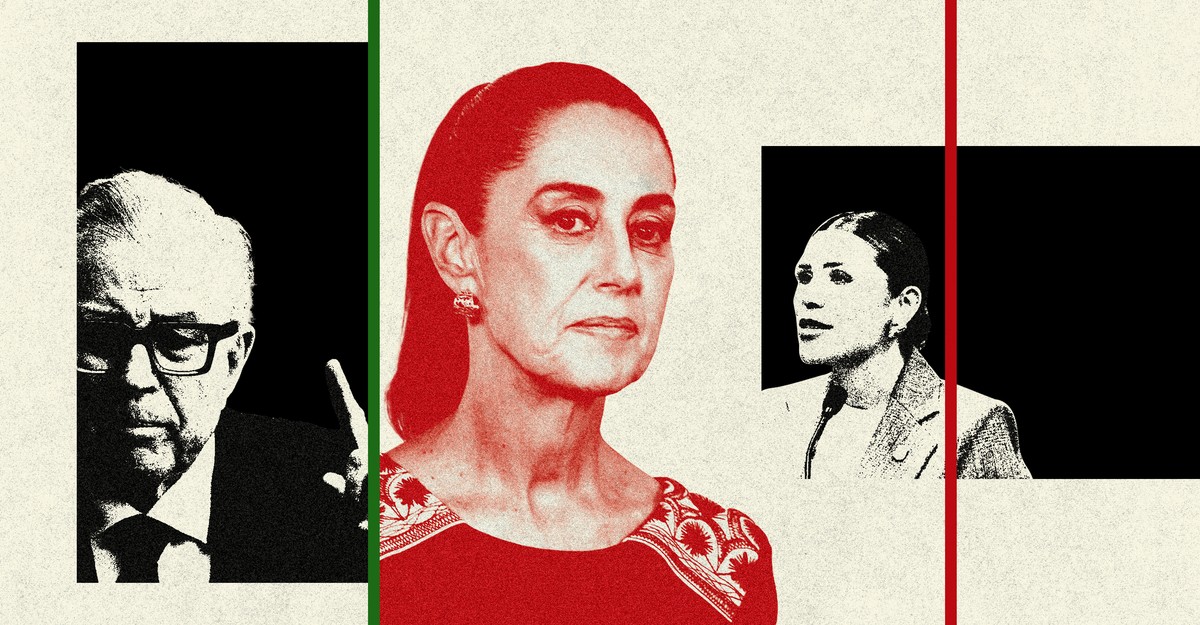
The governor of Baja California is a 40-year-old attorney and former big-city mayor named Marina del Pilar. Her state, which includes the megacity of Tijuana, is a magnet for American tourists, and also for narcotics cartels. As a politician of some experience, she is presumably unfazed by the sorts of challenges that come with governing a volatile section of her volatile country.
And yet, in what has quickly become a very famous recording of a phone call that leaked last week, she has difficulty masking her shock about an unusual predicament. “Are they saying they want to extradite me?” she asks her interlocutor, who is apparently an intermediary for the FBI. The “they” in question is the United States government. Almost immediately, her tone becomes more businesslike, and she makes a not-so-cryptic offer: “Can’t they tell me what they want me to talk about? I might know or hear a lot of security-related things.”
In other words, the governor of the strategically important border state of Baja California was just caught on tape offering to become an FBI informant. The remarkable thing here is that she would not be the first; the list of current and former Mexican officials and drug traffickers who have offered to cooperate with the U.S. government is now lengthy.
The phone exchange, released by the Mexican journalist Héctor de Mauleón, seemed almost too Narcos to be real, until del Pilar confirmed its authenticity. Her predecessor had arranged the phone call, she said, after the U.S. revoked her visa last year. As more recordings leaked in recent days, the country was transfixed. Columnists theorized about what del Pilar might know that she would be willing to trade for more favorable treatment. The Americans seemed to want her testimony for a bigger case—but who was their target?
In order to fully grasp why politicians like del Pilar are considering cooperating with U.S. investigators, it is vital to keep in mind the current, overwhelming Mexican reality, which is that the country’s leaders believe that President Trump will intensify America’s intervention in Mexico. Their gravest concern—a plausible one—is that Trump will launch military strikes against the country.
Since his second term began, Trump has periodically threatened military action inside Mexico, alluding to air strikes or operations that would “take out the cartels.” Mexican officials have repeatedly rejected the possibility. “There will be no invasion of Mexico,” President Claudia Sheinbaum said last year. But quietly, Mexican officials have discussed what it would mean if they were attacked by their neighbor and largest trading partner. Would it be a special-forces operation, like the one that seized former Venezuelan President Nicolás Maduro? A drone strike on a fentanyl lab? Some Mexican officials are reading books about the Mexican-American War, searching for historical precedent.
Because the threat of military intervention is so dramatic, not enough attention has been paid to a type of intervention that is already taking place, one that could pave the way for strikes. In a break with long-standing precedent, American prosecutors have used informants to pursue members of the Mexican government, apparently “moving up the food chain,” as one U.S. official described it to me. Del Pilar has become the most famous example of such cooperation. The State Department canceled her U.S. visa last year while law-enforcement agencies investigated her and her then-husband. In the leaked audio recordings, the supposed FBI representatives refer to “sanctions” and “charges” against her, though no charges have been filed. Del Pilar makes clear that she is willing to offer information gleaned from state security meetings in order to avoid being extradited. She says vaguely that what she hears in those meetings “isn’t what I hear elsewhere,” possibly referring to sensitive information that might help investigators. On Sunday, del Pilar released a video saying she was merely trying to find ways to reinstate her canceled visa. I messaged her spokesperson to ask about this, but she didn’t respond. The FBI has also declined to comment.
Several former Mexican officials facing U.S. charges have turned themselves in, apparently agreeing to cooperate with authorities to reduce their sentences. Dozens of newly extradited drug traffickers, too, are believed to be cooperating. Their accounts appear to have allowed U.S. investigators to build cases against members of Sheinbaum’s Morena political party. At least four have been indicted. Many more have had their visas revoked.
It’s a high-risk escalation in the Trump administration’s fight against narco corruption—and possibly also a pretext for a unilateral attack. Trump could use evidence of the government’s links to organized crime in an attempt to justify using force in Mexico. This week, the Trump-appointed head of the Drug Enforcement Administration, Terry Cole, gave a speech describing “the deadly connection between cartel networks and the Mexican government.”
“They are one in the same,” he said.
The most senior member of Sheinbaum’s party to face charges is Ruben Rocha Moya, the governor of Sinaloa. He was indicted in April for alleged drug trafficking. Prosecutors have accused him of supporting a faction of the Sinaloa cartel, which in turn used kidnappings, intimidation, and ballot theft to help Morena candidates win elections. Sheinbaum has defended him, claiming that the indictment lacks evidence.
“An action of that magnitude has no precedent in the history of our bilateral relationship,” Sheinbaum said at a political rally in May, referring to the DOJ’s request for the arrest, for extradition purposes, of 10 Mexican citizens. “Is this a genuine, legitimate interest in helping Mexico? Is it a genuine commitment to combating organized crime? Or are we witnessing segments of the U.S. far right using our country to position themselves ahead of their 2026 elections?”
Ironically, it was Sheinbaum’s cooperation with the United States that helped bolster the American caseload. As Trump threatened to invade Mexico, her administration last year quietly increased its security ties to Washington, an apparent peace offering aimed at deterring an attack as well as an effort by Sheinbaum to rein in organized crime. The Mexican government extradited or transferred more than 100 alleged criminals to the United States from February 2025 to January 2026—many times the previous flow. Then, in February, the Mexican military killed Nemesio Oseguera Cervantes, known as “El Mencho,” partially based on U.S. intelligence.
Many of the newly extradited Mexicans—facing the possibility of life in prison—have become cooperating witnesses in exchange for the possibility of reduced sentences, according to current and former U.S. officials. El Mencho, meanwhile, left behind ledgers documenting bribes and payments, according to one U.S. official, which could be used as evidence. And now del Pilar and other Mexican officials, threatened with yet another round of extraditions and canceled U.S. visas, are apparently talking to U.S. law enforcement. If those cases advance, and Mexican officials offer damning information about their colleagues, it could lead to another cascade of indictments.
“That’s the challenge for Sheinbaum. Once you uncork the bottle, there’s no controlling what comes out,” Robert Patterson, the former acting administrator of the DEA, told me. “And a credible investigation doesn’t pick and choose who it touches or who it holds to account.”
[Read: Claudia Sheinbaum’s impossible dilemma]
For years, even as the United States pursued Mexico’s most famous drug kingpins, investigators observed an unofficial red line: The Justice Department did not indict senior sitting officials or politicians. Those cases could shatter diplomatic relations. U.S. officials complained privately about pervasive corruption in Mexico, but they never attempted to extradite the worst offenders while they were still in office.
Even when prosecutors charged former Mexican officials, the response could be explosive. Months after arresting former Defense Minister Salvador Cienfuegos in 2020 on drug-trafficking charges during a visit to Los Angeles, the United States bowed to political pressure and returned him to Mexico. He continues to live as a free man. It was a lesson in the way U.S. prosecutorial goals could be flattened by Mexican politics.
Yet Rocha’s indictment and the pressure on del Pilar suggest a radical change. The United States is now willing to pursue members of the ruling party, in spite of the rift it might cause. It’s a strategy that has confused many current and former U.S. officials, particularly given the unlikelihood that Rocha will ever be extradited. He has temporarily resigned from his post but has denied the charges against him. “I’m scratching my head on what the goal is here,” said one former narcotics prosecutor.
The most frightening scenario to many officials on both sides of the border is that the United States might use Rocha’s case as a pretext to strike Mexico. They point to what happened after Maduro was indicted on drug charges. Mexico, of course, is not Venezuela. It is the United States’ biggest trading partner, the largest democracy in the Spanish-speaking world, home to some 1.5 million U.S. citizens, and visited by approximately 40 million every year. The fallout from any unilateral U.S. action would hit both sides of the border.
And yet, for the first time in more than a century, the United States is not backing away. Last week, the State Department designated two lesser-known drug cartels—the Juárez Cartel and Los Viagras—as “foreign terrorist organizations” and “specially designated global terrorists.” Some within the Trump administration believe that those designations would offer some kind of legal authority for an attack, though international-law experts largely differ.
As the U.S. has shifted its legal strategy in Mexico, the cartel landscape, too, has changed dramatically. Nearly all of the drug kingpins of the past two decades are in prison or dead. Most famously, El Chapo is sitting in a maximum-security prison in Colorado. El Mencho was killed by the Mexican military. Ismael Zambada García, “El Mayo,” was—bewilderingly—delivered to U.S. authorities on a New Mexico airstrip in 2024 by one of El Chapo’s sons, Joaquín Guzmán López, who apparently hoped to earn favorable treatment from U.S. prosecutors. Another son, Ovidio Guzmán López, is also cooperating after being extradited in 2023.
[Read: The incredible story of the cartel Olympics]
The campaign against cartel leaders has been so successful that, even if the United States wanted to decapitate a drug-trafficking organization, it’s unclear whom they would target. “For an administration that thrives on publicity, if the goal is to make a big splash by taking out someone who is a big household name, that well is running very dry,” Adam Isaacson, the director of the defense-oversight program at the Washington Office on Latin America, told me.
Some experts had been concerned that the absence of kingpins could lead to a power vacuum and a spike in violence. That hasn’t happened. Homicides in Mexico fell by nearly half from September 2024 to May 2026.
With the pressure on its government rising, Mexico has begun to make its own demands of the United States. Last week, Sheinbaum said that she would request criminal charges in the cases of Mexican citizens killed by ICE. The week before, she demanded clarity about the U.S. role in the surrender of Joaquín Guzmán López in New Mexico. And her administration reminded the Americans of another grievance: Since January 1, 2018, Mexico has requested the extradition of 269 alleged criminals whose cases have yet to be approved by the United States.
After years of deriding Mexican inaction on security, the United States appears to have found a willing partner. Now it risks forfeiting that cooperation. On Monday, as if to demonstrate what could be lost, Mexican authorities arrested Janero Van DeMario Garrett, allegedly a member of the Sinaloa cartel. “The arrest was made possible thanks to mechanisms of international cooperation and the exchange of information with the DEA,” Mexico’s security minister wrote on X.
The alleged criminal, it turned out, was a U.S. citizen.