One Place News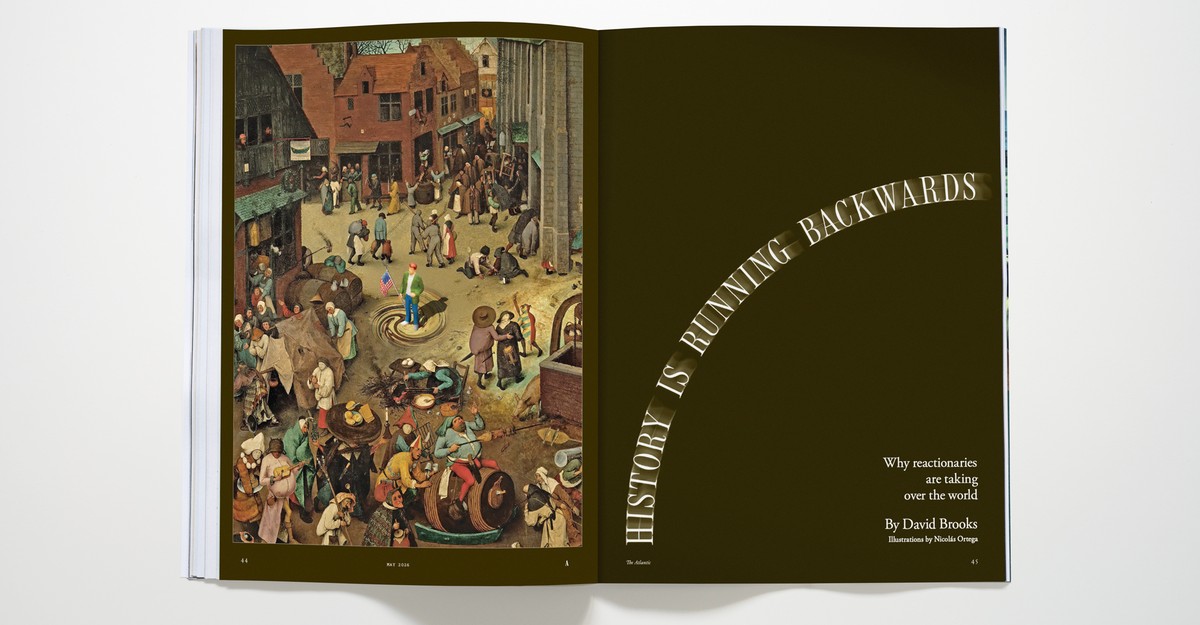
History Is Running Backwards
In the May issue, David Brooks considered why reactionaries are taking over the world.
“History Is Running Backwards” is a provocative article. But I think David Brooks errs in framing traditionalism and modernity as an either/or, when in fact they exist in a both/and context. One can be both a traditionalist and a modernist simultaneously. The key, as Brooks notes, is that “a well-adjusted life consists of daring explorations from a secure base.” Would that we all were so blessed to have that!
Judy D. Cottrell
Eugene, Ore.
In dividing humanity into two neat psychological types—stability-seeking traditionalists and novelty-seeking progressives—Brooks misses an essential point: Psychology doesn’t exist in a vacuum; it constantly interacts with changing social factors. People who not long ago may have readily switched jobs and moved cities are now more likely to stay in place because of the scarcity of new positions and lack of affordable housing. Their psychology didn’t change—their circumstances did. Our ancestors who ventured out of Africa 1.9 million years ago were likely seeking their next meal, not the thrill of adventure. These days, people are liable to deny science and seek safety in traditional institutions because the grandest creation of modern technology—artificial intelligence—threatens everything about our way of life. Debates should focus not on psychological insecurity but on the technological, economic, and political decisions that are fostering material uncertainty and pushing people to cling to a much safer past.
Allen Frances, M.D.
Carmel, Calif.
The fact that the traditionalists whom Brooks discusses cannot even agree on when humanity’s “fall” occurred should raise doubts about their ideology. What they are constructing is less history than creation myth: As in the story of Adam and Eve, the fall occurs when people begin thinking for themselves. History and science teach us that there never was an Eden of perfect human harmony. Civilization was built painfully, and by most measurable standards, life today is far better than it was in the past.
The key to understanding the traditionalists is analyzing not the past they claim to describe but the present in which their appeals are gaining traction. Their movement has emerged as society has granted more rights to previously marginalized groups. Beneath the traditionalists’ arguments lies a recurring sentiment: My group once had the authority to define how society should function, and now it no longer does. If only people would stop questioning inherited traditions and defer once again to established authority, as defined by my group, then society could recover its lost harmony.
Brooks suggests that cultivating a sense of “rootedness” might help blunt the traditionalists’ appeal. But many Americans do not see themselves reflected in what passes for American tradition. Our society does not make it easy for them to feel “rooted”—they do not see people like themselves in the literature or history they study. We need to develop broader narratives that tell the country’s whole story. That in turn can cultivate a broader sense of belonging. The humanities do need revival, as Brooks argues. But they should not be organized around a myth of decline. They should be grounded instead in the founding principles that all people are created equal and possess inalienable rights. The continuing struggle to realize those ideals could provide the shared civic story in which all Americans might find roots.
Thomas M. Thurston
Rosarito, Mexico
Everything Is Free and Nothing Matters
In the May issue, Noah Hawley described what he saw at Jeff Bezos’s Campfire retreat.
F. Scott Fitzgerald once wrote, “Let me tell you about the very rich. They are different from you and me.” Ernest Hemingway, in “The Snows of Kilimanjaro,” issued a reply, writing, “Yes. They have more money.” I returned to their exchange while reading Noah Hawley’s essay about his time at Jeff Bezos’s retreat. Hawley demonstrates that Fitzgerald was indeed correct—and not merely in the way Hemingway considered. Bezos, Elon Musk, Mark Zuckerberg, and their peers are so wealthy that they cannot spend all of their money in their lifetime. They really are free from consequences.
Neil Ravin
Hampton, N.H.
Billionaires are certainly having a moment—they’re more powerful than ever. But Noah Hawley’s assertion that they are living consequence-free lives is false. After Elon Musk criticized Donald Trump’s “big, beautiful bill,” the president was clearly displeased, and a rift emerged between the two titans. But it was short-lived: Trump had the power to damage Musk’s business interests by canceling his lucrative contracts with the federal government. Political leaders still have the power to rein in billionaires—if only they’re brave enough to try.
Ken Taub
Saint James, N.Y.
I Found It: The Best Free Restaurant Bread in America
In the May issue, Caity Weaver wrote a “fun article for people to read.”
When I received my print edition and saw that the cover story was about America’s “best free bread,” I was a little grumpy. The world is in chaos, democracy is withering, and this was the best The Atlantic could do? But because the story was on the cover, I sat down and read it. Turns out the answer was “Yes!” Caity Weaver’s article is an amazing novella. Her style is witty and brilliant, light and insightful. The article is a masterful piece of journalism and a true delight to read, even with its wrenching moments. Thank you for featuring something that pushed the chaos and gloom to the back of my mind for an hour.
Stacey Wells
Oakland, Calif.
In the midst of a particularly taxing, soul-sucking, and bleak week, “I Found It: The Best Free Restaurant Bread in America” made me smile and laugh and remember that there are still lovely things to discover about the world. I’m very sorry for Weaver’s loss. I’m sure her parents would be proud that her articles have brought much joy to the world, and made a random computer programmer in Las Vegas not want to have a tantrum in the conference room.
Evan Appel
Las Vegas, Nev.
Behind the Cover
In this month’s cover story, “Confessions of a Token Black Professor,” Tyler Austin Harper recounts his decision to leave a tenure-track assistant professorship at Bates College, in Maine. One of the few Black faculty members, Harper came to find the college’s performative commitment to social justice suffocating, and ultimately hypocritical. On the cover, the outline of a lone figure walks away, set against the Bates seal.
— Paul Spella, Senior Art Director
Corrections
“Never Call Retreat” (July) misstated the name of the labor organization that repurposed “Battle Hymn of the Republic” into “Solidarity Forever.” It was the Industrial Workers of the World, not the International Workers of the World.
“How Britain Became as Poor as Mississippi” (July) stated that the economic gaps between London and other British cities are comparable to that between cities in West and East Germany. In fact, the economic gap between southeastern England, where London sits, and the rest of Britain is comparable to that between West and East Germany.
“So You Want a Coat of Arms” (July) gave the incorrect impression that Kate Middleton directly received her own coat of arms. The arms were granted to her father ahead of her royal wedding.
This article appears in the September 2026 print edition with the headline “The Commons.”