One Place News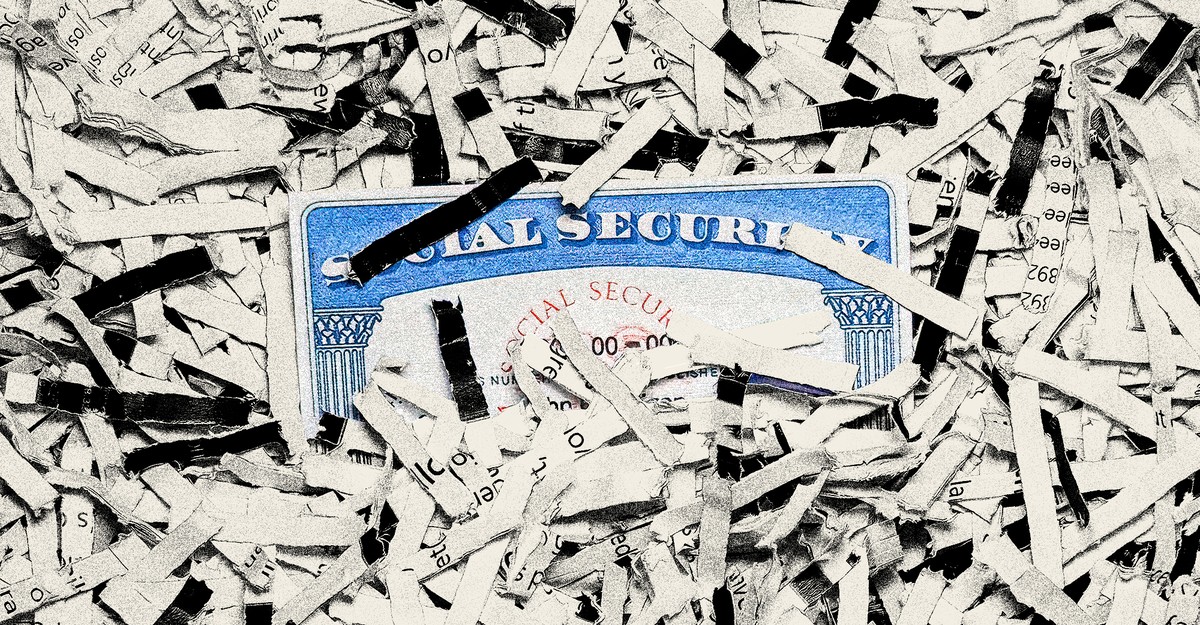
Americans have been hearing about the looming demise of Social Security for decades. The number of old people receiving benefits has been increasing much more quickly than the number of working-age adults whose taxes pay for those checks. Yet politicians have let the problem fester for so long that the public could be forgiven for thinking that the crisis would never actually arrive.
But it’s arriving. For the past 16 years, Social Security has paid out more than it has taken in. This has required dipping into its trust fund, built up over the decades when the Baby Boomers were in their peak earning years. That fund is on track to run out by 2032. When it does, benefits will have to be cut by an expected 22 percent across the board to line up with the tax revenue that funds them.
Pretty soon, politicians won’t be able to kick this can down the road anymore. Senators elected this November will be in office in 2032. So will the next president. They will have no choice but to come up with a way to save the federal government’s largest and most popular program, lest they be blamed for its partial collapse. The available solutions are politically tricky but not particularly mysterious. They involve raising taxes, increasing the national debt, and cutting benefits, or some mix of the three. Even if our leaders settle on a way to keep Social Security solvent, however, they are unlikely to address the deeper problem underlying the budgetary one: A program designed to reduce poverty has morphed into a transfer of wealth to the richest members of our society.
In 1935, when the Social Security Act was signed into law, the average person entering the workforce could be expected to die at about 65 years old. Those who lived past that age tended to be too disabled to work, leaving them reliant on their children, if not a local charity or poorhouse. Social Security was designed to ameliorate this problem by levying a tax on workers and their employers, and paying benefits to the elderly roughly in proportion to how much they earned during their career. When the checks first went out, in 1940, the average recipient received $22.60 a month, or about $550 in today’s dollars. Such payments did not require too much sacrifice—just a 1 percent tax on the first $3,000 of a person’s earnings, matched by their employer—because there were many times more workers than there were beneficiaries.
The program ballooned over time. Congress voted repeatedly to expand benefits faster than inflation. But the biggest changes weren’t purposeful. Because benefits are proportional to what a retiree earned during their working years, America’s increasing salaries necessarily made the program grow. So did rising life expectancy. The average 65-year-old now has about 20 years left to live, up from 13 years in 1940. Meanwhile, the pool of workers paying into the system has not kept pace. Fertility rates have fallen, and fewer babies mean fewer workers in the future. The number of workers for each beneficiary has gone down 24 percent since 1990, as more and more is being asked of a smaller share of the population.
[Idrees Kahloon: An oligarchy of old people]
The unfortunate fact is that Social Security was never guaranteed to work forever. The tax formula is simple: Each worker, along with their employer, pays 6 percent of their income, up to $184,500. The benefit formula is not. The Social Security Administration takes your highest-earning 35 years of work and calculates your average monthly earnings from those years, adjusted upward for subsequent growth in average wages. A progressive formula determines how much of that you’ll be paid monthly: Assuming that you elect to start receiving benefits at age 67, you’ll get 90 percent of the first $1,300, 32 percent of the next $6,500, and 15 percent of the remaining.
The benefit side of the equation and the tax side of the equation do not add up to the same number. Thanks to the wage adjustment and long life expectancies, most people receive substantially more money than they paid in. In the aggregate, revenues have lagged behind benefits. “There’s no reason those formulas would be compatible with each other,” Andrew Biggs, a former deputy commissioner of the Social Security Administration, told me. The only reason they ever were was that America used to have enough workers to support its population of retirees.
Preventing the program’s insolvency is a math problem that involves tweaking the tax side, the benefit side, or both, until they equal each other. This is not conceptually difficult. Steven Kull, a political psychologist at the University of Maryland, runs a poll every so often in which he shows participants the possible reforms, telling them how much each change closes the funding gap. “The biggest theme is that people solve the problem,” Kull told me, with “majorities taking steps that eliminate most or all of the shortfall.” Respondents tend to be confused as to why their elected leaders haven’t fixed the issue. “The common answer is, That wasn’t that hard. What’s all the fuss about?”
The problem is not that the math is difficult, but that every possible move comes with downsides. “Social Security reform is ultimately about breaking promises,” Biggs said. Either you raise taxes above the rate that people are used to, or you cut benefits for people who were counting on them. Historically, Democrats have preferred the former path, proposing to raise taxes on the well-off to pay for the program’s shortfall while leaving benefits alone. Republicans have traditionally wanted to shrink the program—although typically in a somewhat progressive manner. After President George W. Bush’s unpopular privatization push failed, for example, he proposed a slow flattening of the program by making the benefit formula less generous for all but the bottom 30 percent of recipients.
The Democratic approach has always been more politically popular. Donald Trump was the first Republican to accept that fact. In 2015, as he marched to the Republican nomination, he promised not to touch Social Security, breaking with GOP orthodoxy and thrilling the base. Ever since, the Republican discussion on saving the program has had a distinctly muted tone. A March 2024 white paper by the Republican Study Committee—a caucus that includes most House Republicans—proposed raising the retirement age and “gradually moving towards a flat benefit.” Neither Trump nor Speaker of the House Mike Johnson commented on the proposal. Project 2025, produced by the Heritage Foundation, was more shrewd. The 900-page document contained advice for the future administration on how to properly regulate the shrinking population of greater sage grouse, but it contained no guidance on Social Security.
Democratic plans still revolve around raising taxes while keeping benefits constant or even increasing them. But they now tend to include a feature designed to keep the party’s upper-middle-class base happy: the “doughnut hole.” Many of the current Democratic plans uncap the payroll tax, but typically only for earnings above $400,000, meaning that dollars earned between $185,000 and $400,000 would go untaxed, and everyone who makes less than $185,000 would pay the highest payroll tax rate of all.
Representative John Larson, a Connecticut Democrat, has introduced many Social Security–reform plans over his 14 terms in Congress. “I personally don’t think that there should be a doughnut hole,” he told me. But, he explained, “during the presidential campaign, Biden said that we should lift the cap over $400,000.” Larson came to understand why. “Every town hall I go to, I say, ‘Raise your hand if you’re making more than $400,000,’ and I’ve yet to have a hand go up.” As Democrats have become the party of the pretty-well-off, they have more and more voters who make more than $185,000 but less than $400,000.
The doughnut hole is one weakness, but every plan has its shortcomings. Last month, Senator Elizabeth Warren, a Democrat, and Senator Bernie Moreno, a Republican, announced a proposal to uncap the payroll tax entirely. Their idea gets points for bipartisanship, but it would close just two-thirds of the shortfall, at most, if implemented. Within three years, benefits would again exceed revenues.
A few plans get the math to work out with sufficiently large tax hikes. Proposals by Larson and Senators Bernie Sanders and Sheldon Whitehouse would uncap the payroll tax (with a doughnut hole) and raise taxes on investment income. These are large tax increases: A wealthy self-employed couple making $800,000—imagine married doctors in private practice—would face a marginal federal tax rate of more than 50 percent.
Perhaps the biggest problem with these plans is not the new taxes—it’s what the new taxes pay for. Conceived as an anti-poverty program, Social Security today pays out most of its benefits not to the poor but to the middle class and the rich. The bottom 20 percent of older Americans receive just 7 percent of the total benefits. The economics of old age have changed a lot since the 1930s. The prices of assets—homes and stocks—have soared. As a result of these trends, the elderly are now America’s wealthiest age group, living without children in homes that are on average roomier than everyone else’s. No longer are most of them financially dependent on their children; if anything, their descendants are more likely to ask them for help.
[Jessica Riedl: The elixir of the payroll-tax cap and other social security myths]
If the public craves a trillion-dollar tax increase on the well-off, there are better ways to spend the money. The federal government already spends about six times as much for each elderly adult as it does each child, even though children and their parents are more than twice as likely to be poor. Uncapping the payroll tax would not close the Social Security shortfall, but it would provide enough money to pay an allowance of $4,500 a child to every family in the country every year. Reforming Social Security by cutting benefits for rich people and raising them for poor people would make the most financial sense and return the program to its roots. President Franklin D. Roosevelt designed Social Security for the elderly not because they were uniquely deserving but because, as he put it in his signing address, they were so “poverty-ridden.” But that scenario—flattening Social Security and focusing future generosity on the young—doesn’t seem particularly likely. Social Security’s popularity comes from its universality, and if well-off people see their benefits reduced, the program could lose some of its widespread appeal. As I reported this story, many wonks recited to me the old political adage, “Programs for the poor make poor programs.”
Indeed, most voters, when faced with the choice, prefer tax increases to benefit cuts. A poll last year by the National Academy of Social Insurance, a network of social-safety-net researchers, showed that the three most popular reform options were slightly different ways to uncap the payroll tax. The next most popular was an increase in benefits. Even raising the payroll-tax rate on everyone by one percentage point ranked above cutting benefits only for the rich. “Broad-based bipartisan majorities say that they’d even be willing to chip in a little bit more themselves,” Rebecca Vallas, the head of NASI, told me, “if that’s what it takes to prevent benefit cuts.”
A social safety net that so heavily favors the old and rich over the needy and young is probably not what most Americans would design if they were starting from scratch, but it’s what we have. The likeliest outcome of whatever Congress comes up with in the next six years is that same dynamic, only more so.