One Place News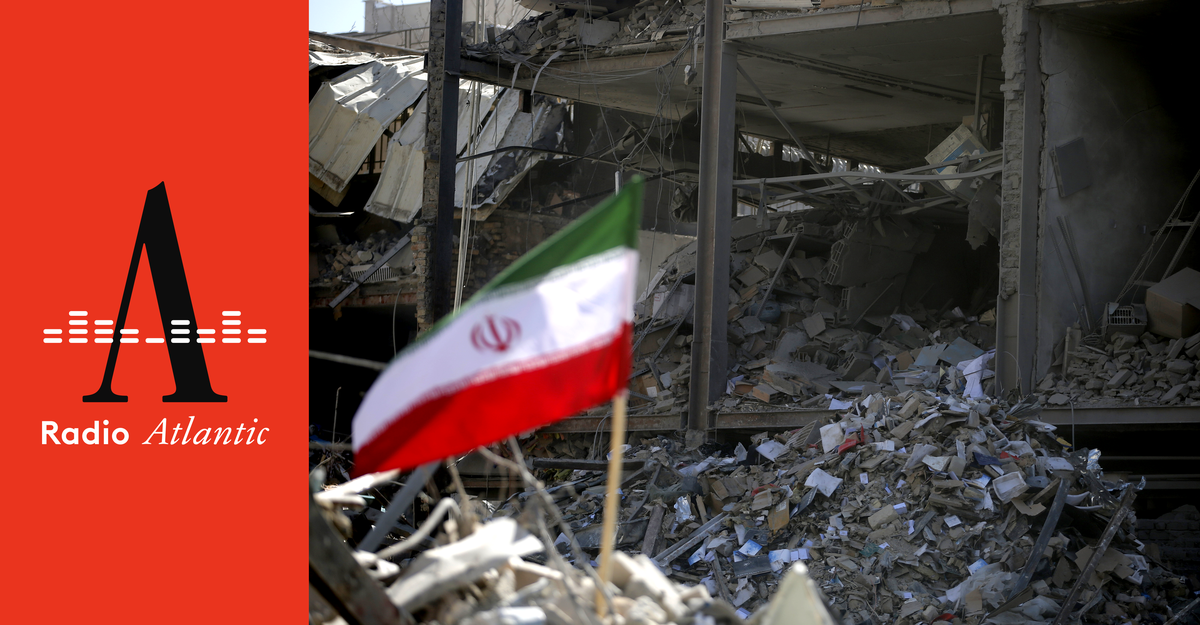
Subscribe here: Apple Podcasts | Spotify | YouTube | Overcast | Pocket Casts
Following the U.S.’s war with Iran can give you whiplash. One day, it’s nearing a resolution; the next, the nations have resumed missile strikes on each other’s military installations, and Iran on Gulf States caught in the destructive web of this conflict. By the time President Trump declared, on Friday, that a cease-fire with Iran was over, the United States had already hit more than 140 targets in the preceding days—his words did not make policy; they were simply an articulation of reality.
Though the president has said he would not enter any “forever wars,” America seems to find itself headed toward one. Is there a way out? My colleagues Tom Nichols and Nancy Youssef, who cover the military and diplomacy for The Atlantic, joined me on Radio Atlantic to discuss the conflict that is beginning to feel more like a permanent condition.
The following is a transcript of the episode:
[Music]
Tom Nichols: If you want to know whether countries are at war, ask them if they think they’re at war. The Iranians would say they’re definitely at war, and it’s not over. And every time the United States tries to establish some new condition that they think would indicate peace, the Iranians go out of their way to say, we don’t accept that condition. We’re not at peace.
Adam Harris: The conflict between the U.S. and Iran intensified—over the last several days. The United States Central Command says it’s struck at least 300 Iranian targets—including drone storage sites, air defense systems, and military speed boats—Iran retaliated by, once again, closing the Strait of Hormuz and there are reports of strikes from Iran in Jordan and Oman.
The fighting marks yet another breakdown of a flimsy cease-fire agreement.
This is Radio Atlantic. I’m Adam Harris, and today we need to think about the escalating war with Iran.
In June, Congress passed a symbolic measure directing the president to end the use of U.S. armed forces in Iran. But even with a more binding rebuke of the unauthorized conflict, it will be difficult to disentangle from the problems created after several months of fighting. Iran now knows it can control the Strait of Hormuz; and that its simmering hostilities with Gulf States will not end just because the U.S. leaves.
During his campaign President Trump frequently campaigned on the idea that, under his administration, there would be no more “forever wars.”
And, more recently, he said that this conflict would be over quickly.
President Trump: Anything that happens is just going to happen very fast. We’re not, we’re not looking for long-term.
So why are we still at war with Iran? And will we ever be able to get out of it?
With me to discuss all of this are my colleagues, Atlantic staff writers Tom Nichols and Nancy Youssef.
Let’s get to questions.
Tom, welcome to the show.
Nichols: Thank you. Thanks for having me.
Harris: Nancy, thanks for being here. So Nancy, I want to start with you. The escalation this weekend indicates that the U.S. may have turned a more turbulent corner with Iran. Is the memorandum of understanding between the two nations as to end the conflict functionally dead at this point?
Nancy Youssef: Well, they’re trying to both come up with a military solution and a diplomatic one, but maybe not the cease-fire one. So kind of. I think the predicament that the United States finds itself in is that it wants the Strait of Hormuz to operate as it did before the war began, which was free and open to international shipping, and at the same time not return to major combat operations. And I don’t think both of those can exist. Because the Iranians believe that they should hold on to the leverage that they’ve gained through the war over the Strait of Hormuz and now see it as a key national security element. The memorandum of understanding is relevant in that if you look at paragraph five of that memorandum of understanding, it asks the Iranians to secure safe passage of the strait during the 60-day period. But the language is so vague that I think they are understanding it as we’re going to decide what ships go through, under what conditions.
Whereas the United States seemed to interpret it as a free and open passage. And so that is at the heart of the conflict. So the memorandum of understanding is both in trouble and a key reason for the point we are at right now.
Harris: Yeah. And the point we are at right now, right, as the president noted on social media a couple of times last week, the cease-fire is over. Tom, heading into the weekend, we saw that a couple of different times, and then we saw several bombings kind of between both sides. So the cease-fire, right—I’m air-quoting here—has never necessarily been a cease-fire, right? We don’t feel closer to peace, necessarily. This isn’t an all-out war. How might you characterize where we are, militarily? Like, where are we in this war with Iran?
Nichols: Well, I think your point about a cease-fire is a good one, but no one ceased firing. So where are we? Well, we’re in the situation where the United States embarked on a war of choice. It went badly. The United States asked for a time-out of some kind. The Iranians, more or less, agreed to that on their terms. But each time the United States tries to indicate that the conflict is over, which to us, I think, which the Americans at this point means the strait is open, and we’re going to talk about nuclear stuff, the Iranians say, No, the conflict is not over until you accept our terms. And this is why I’ve been arguing over and over again that the United States lost this conflict.
Because the Iranians are the ones setting the terms. The Iranians, I think, would say, Yes, this war is over any time you admit that basically the Strait of Hormuz now belongs to Iran. Of course, the Iranians also want this rebuilding fund, hundreds of billions of dollars that they want everybody to contribute to, to rebuild Iran after all of this American and Israeli damage. And they’re not going to let go of that either, and as Nancy just said, the United States does not understand the memorandum of understanding that way. But I don’t think the MOU, just like the cease-fire, was ever really in effect. It was was a fig leaf. It was a way of trying to calm the markets. You notice that the president—speaking of the markets, the president seems to get pretty riled up on Friday afternoons and then announces that, you know, by Sunday or Monday, things have calmed down. This is almost like a weekend war. And so I think that’s where we’re at. We’re in a slow-motion kind of punch-up where we’re not at peace.
The Iranians, I think, would say, If you want to know whether countries are at war, ask them if they think they’re at war. The Iranians would say they’re definitely at war, and it’s not over. And every time the United States tries to establish some new condition that they think would indicate peace, the Iranians go out of their way to say, We don’t accept that condition. We’re not at peace.
Youssef: Adam, could I jump in? Because Tom made such great points, and I wanted to just add one to it. In terms of military options, there are very few before the United States if it doesn’t want to go back to major combat operations, which in and of itself doesn’t guarantee an outcome. I think you’re seeing a strategy that you could describe as sort of controlled escalation, that the U.S. aim now is to strike the things that Iran uses to control shipping through the strait—their fast boats, their drones, their missile capability—and sort of pick away at that such that Iran has fewer assets to do that with, to hold the strait with. The challenge is, I don’t think that’s a tenable position, because at some point I think the Iranians will decide they would rather go back to war and force the U.S. hand than to continue having this erosion of their capabilities. I think for the Iranians it will eventually become a war by another name at this rate. And that’s what you’re seeing in these strikes. If you look at the pattern of them, they are targeting the very things that the Iranians are using to control the strait. They’re not using big, sophisticated equipment. They’re using small, fast boats, $30,000 drones to intimidate the ships such that they decide it’s not worth the risk to go through.
Harris: There are all of these other partners in the region, right? Thinking of the other Gulf States, that are absorbing a lot of the physical, economic brunt of this war in the region. I know Oman and Iran were negotiating over the weekend. Is there anything that the Gulf States can do to help with the negotiations? Is there anything that they can do, Nancy or Tom?
Youssef: Well, I think they’re actually key because they are bearing the brunt of the Iranian response. We saw this again over the weekend. When the Iranians strike back, they are striking the Gulf nations, notably ones that have created basing or allowed for U.S. basing in their countries. And so for them, they are putting a lot of pressure on the United States to reach some sort of resolution such that they don’t keep having to be the recipient of the Iranian frustration with U.S. actions. But the Gulf States are also in a very tough space because in terms of security partners, we have been, the United States, their key security partner, and there are few options for them to look at in terms of alternatives. They need that waterway for their own economies. And so I think for them the idea of having to pay the Iranians some sort of fee or tax to keep their economies alive is quite jarring given that they’ve paid hundreds of millions, if not billions of dollars in air-defense capability to protect themselves from Iranian strikes.
Nichols: Well, I mean, let me put on my old Naval War College hat here for a moment and ask: What can anyone do? There is a huge asymmetry of interests here. For the United States, this has devolved into ego and face-saving because the president is angry. For Iran, this is existential. This is about regime survival and what kind of power Iran will be in the Gulf. So when you look at these options, what can the Gulf States do? What can the United States do? First of all, no one has the ability to control any territory in Iran. That’s a huge mismatch here strategically. The United States can inflict all kinds of pain. At some point you’ve bombed everything so many times that the Iranians have made it clear: Fine—we’re willing to take more punishment. If that’s what it takes, we’ll take another beating. But we’re not gonna fall. We’re not gonna stop harassing shipping in the Gulf. And Nancy raised an important point here. You don’t actually have to militarily go toe to toe in the strait. All you have to do is make it so uncertain and so expensive for shipping in the Gulf. That’s all they need to establish. And that is for Iran. That’s not hard to do.
So what are the American options? Are we going to land forces along the Iranian coast? Are we going to seize Kharg Island with boots on the ground? No. I mean, maybe the president—I would never say never with somebody like Donald Trump, but the number of casualties involved would be prohibitive. And now they’re in the box that I can tell you that every U.S. war game that’s ever been run about this for like 40 years always ends with, where the decision makers go, Well, now what do we do? And when the president says no one’s ever done this before, that’s right. There’s a reason for that.
Harris: Yeah. You know, Nancy, Tom makes a really good point there, that we’re in this sort of box and say, What do we do now? How does the U.S. disentangle from this, right? The president has historically said that he was not going to start any sort of “forever wars,” but it feels like we have lurched into that, right? What would it take to disentangle from this conflict?
Youssef: I think ultimately it’s making a choice. Well, look, diplomacy is the ultimate answer, right? That there is no clear military solution to this because, as Tom noted, while the U.S. has the capability, does it—is it willing to pay the cost of casualties, high costs, uncertain outcome all before a midterm election in November for a war that has proven to be unpopular amongst not only Democrats but the president’s base?
And so I think ultimately it becomes a diplomatic solution in which the United States has to come up with some acceptable outcome in which there’s an agreement about how the Strait of Hormuz operates going forward and what is an acceptable outcome. I think the U.S. position right now is we have to have a free and open one. And I’m not sure that that can be achieved at this point given what the Iranians now see as a key part of their national security. And so I think it becomes a long diplomatic engagement that has to happen. You know, remember that when the United States was last negotiating with Iran for the [Joint Comprehensive Plan of Action], the Iran nuclear agreement, it took 20 months to reach an agreement on one of the four issues we’re now talking about, just on their nuclear capability. We’re now talking about trying to reach an agreement on nuclear capability, proxy, sanctions, and the Strait of Hormuz.
Nichols: Can I add one comment about what the word disentangle should mean, though?
Harris: Yes, well, I also—I want to to get that, but I also kind of want to complicate it a little bit because disentangling also includes the nations that we’re, we haven’t necessarily mentioned explicitly here, which is Israel, right? Where the last time we saw in in June the president saying, We don’t want Israel to fire on Lebanon anymore. Bibi, don’t fire on Lebanon, and he did it anyway, right? It emphasizes the point that you made a little bit earlier about the control that the president has over this, if any—how does America’s ability to disentangle, and what we mean by disentangle, like, how does that relationship with Israel affect that ability?
Nichols: Yeah, I mean, that’s part of the problem. And I feel like we’re talking here about disentangling, conscious uncoupling or something. But if we mean by disentangle the status quo ante, we just get back to the strait being open for everybody and everything’s fine and it’s where it was, we’re not going to get that. I think that is now out of reach, perhaps for a very long time. If by disentangle, we mean that the president and his advisers say, Listen, calm the markets, bring home some of the forces that we’ve deployed there, push all this off the pages to the kind of diplomacy Nancy’s talking about, then you’re accepting a few things. You’re accepting, first of all, that basically the strait now is going to be jointly administered by Iran and Oman. And that’s just the way it is. That’s what happens when you lose a war. And you can try and negotiate your way out of that.
A kind of version of that is you accept that, you leave a force there to say, We will inflict some pain on Iran every time Iran inflicts pain on anybody else around here. And just now you’re committed. It’s not a forever war, but now you’re kind of doing imperial waterway policing for years to come, which I think is where we’re going to end up for a while. And this third problem that you just raised, Adam, is: Do we turn to the Israelis and say, Look, we screwed this up. You screwed it up. This is just how it is?
And you know me and my gangster movies—I feel like this is a Pauly-from-Goodfellas moment, where you say to the Israelis, If you keep attacking Lebanon, now I got to turn my back on you. Because the Iranians are trying to get us to admit that we actually have a leash on the Israelis, which is something that would be great for them to be able to portray to their people.
So, you know, the Israelis, there’s going to be, if again, if disentangle means get to some kind of keep all this quiet, let the markets function, stay, keep it away from the midterms, then yeah, there’s going to be distance between the United States and the Israelis because every time the Israelis talk about Hezbollah, the president’s going to say, I don’t want to hear about it. And that is, all of these are—I should just add, everything I just said is a bad outcome, but I don’t see any good outcome here. You’re not getting—you’re not going to get what the president wants, which is everything being just like it was last winter.
Harris: You mentioned the midterms, and I wanted to ask about Congress here because back in June, Congress voted on a war-powers resolution that was symbolic at best, but it directed the president to end the war in Iran. I guess my question is, what, if anything, could a Congress do to end this conflict now?
Youssef: So I think Congress’s oversight role in U.S. conflicts has changed and devolved since the post–World War II era, and we continue to see that pattern. We don’t call it a war; we call it major combat operations. We declare cease-fires that may or may not be true 60 days in so that you don’t have to get additional authorization from Congress. I think ultimately the role that Congress would have is in funding and how they fund the department.
You know, the Defense Department’s now asking for a $1.5 trillion budget. $1.5 trillion—that’s more than the GDP of 160-some nations. And that’s after this conflict. And the reason that I’m pointing out the funding is that is something that Congress controls. And it says something about how we approach U.S. threats to this country when every problem is treated as a nail that can only be hit by the Pentagon hammer, then we’re treating these problems as all military ones. And I think the budget reflects if that is how Congress still feels about it. And so there is a lot to be done in terms of how we authorize war and ultimately whether Congress is going to speak in a bipartisan way about its authorities to have the say in terms of when U.S. military forces are deployed.
Harris: And one last question for both of you. It’s Monday. As you report this week: Nancy, I’m gonna go to you first. What do you want to know by Friday? What questions do you still have?
Youssef: I think it’s the one actually that Tom raised. Is this the strategy going forward—of, sort of, controlled escalation, some would call “mow the lawn” strategy? And at what point do the Iranians see that as a threat in and of itself and respond? And what does the U.S. do in response? It feels to me not tenable in the long term. The other thing I’m interested in is how the Iranians are responding. It was striking to me, during the ayatollah’s funeral, to see millions of people out on the street. To me, that created potential pressure on the regime to kind of keep fighting back, or gave them a sense of sort of more backing than they had before this war to do things. And so I want to better understand that. And then thirdly, what the Omani government, what the Qatari government is able to do to sort of reach some sort of agreement, because I think this is now beyond just military. We have to think of it in conjunction with diplomacy and how those two work together.
Harris: And Tom, same question to you.
Nichols: Well, my question is, are we actually ever going to hit anything that matters enough to the Iranians that they would change their mind about negotiation or bend? I think the president’s threats have been a depreciating asset that over and over and over again, says, This time we’re going to hit the thing that really brings them to their knees. And we never do. So I guess I would just say a week from now, are we still in the same situation? Or have we found something we think is the thing that brings this conflict back to some sort of negotiated resolution? I’m pessimistic about that. But that’s pretty much what I’d be looking for at this point.
Harris: Well, Tom, Nancy, there will be a lot to keep our eyes on in the days and weeks ahead. Thank you so much for taking the time to help us better understand it.
Youssef: Thank you.
Nichols: Thank you.
Harris: That’s all for today’s show.