One Place News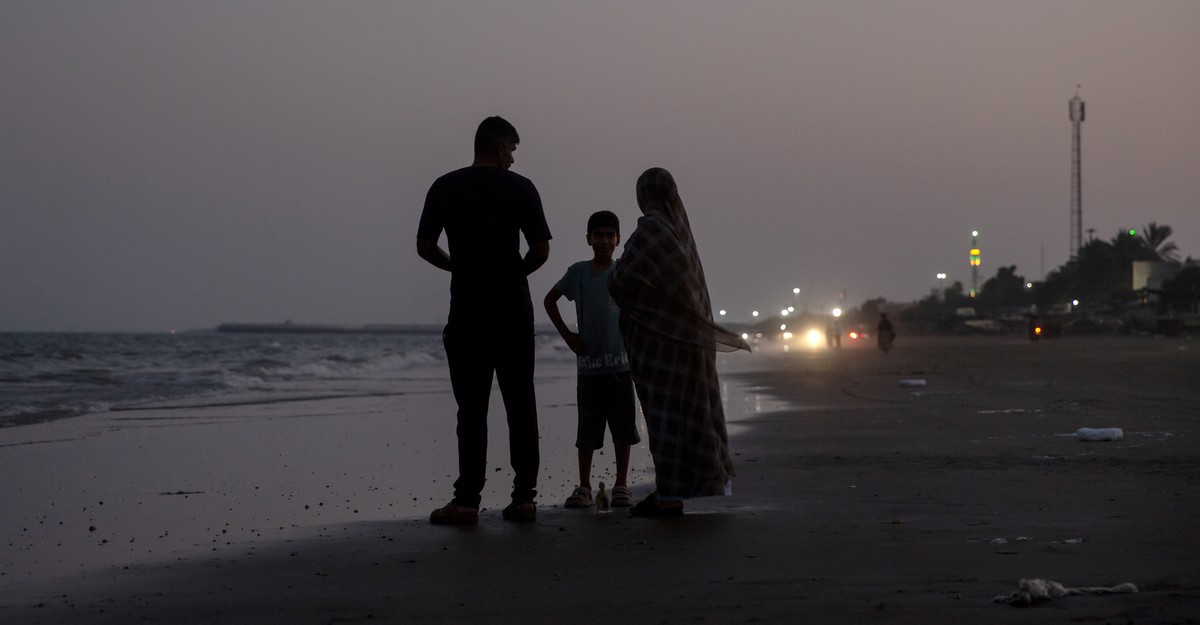
An adviser to Iran’s negotiating team recently said that Tehran should ready itself for years of “neither war, nor peace.” The phrase has become popular among Iranian political analysts trying to make sense of an ostensibly ambiguous situation: The conflict is supposedly over, but Iran’s military keeps striking ships and U.S. allies in the Persian Gulf, and the United States keeps bombing Iran.
The people of Bandar Abbas, a port city of about half a million on Iran’s southern coast, do not find this to be an ambiguous situation at all. “For days, we haven’t been able to sleep due to constant explosions,” a 45-year-old resident, whom I will call Omid, told me (all of the Iranians in this article asked for their name to be withheld for their safety). “Is it only called war if they hit Tehran?”
Dozens of U.S. strikes in the past two weeks have hit the 1,120-mile Iranian coastline, as well as islands in the Persian Gulf, and they have killed more than 30 civilians, according to official Iranian sources. Bandar Abbas has sustained particular damage, but the strikes have also landed on targets all the way from Mahshahr in the southwest, near the Iraq border, to Chabahar in the southeast, near the Pakistan border.
[Read: Trump has only terrible choices with Iran]
The seaboard where Iran meets the Persian Gulf and the Gulf of Oman is target-rich because it contains so much military and civilian infrastructure. Omid lives about a mile from port facilities that were hit last week. “It was like a storm,” he said. “The whole house shook. I dropped the kids on the ground and covered them with my body.”
In many southern Iranian cities, electricity has been cut, sometimes for hours on end, on summer days when temperatures can reach 130 degrees. And the attacks aren’t limited to the shore. On Tuesday, a strike on an army base in southeastern Iran killed seven soldiers, five of whom were young conscripts. The base is about 200 miles inland.
The Iranian regime has plenty to answer for in this return to hostilities. The terms of the memorandum of understanding that it reached with the United States on June 17 seemed to favor Tehran but, determined to reassert its control over the Strait of Hormuz, Iran launched recurrent attacks on passing ships, eventually leading to the war’s resumption.
An ultra-hard-line faction within the ruling establishment, largely outnumbered and out of favor, disapproved of the deal with the United States and had pushed for Iran to continue fighting. This group is now widely blamed for the war’s renewal. On Wednesday, an editorial in the centrist newspaper Jomhuri-ye Eslami attacked “those who shamelessly violated the dignity of Iran’s negotiators,” saying that “they normalize hostility to rationality.” The newspaper accused the ultra-hard-liners of speaking from comfort in Tehran and rhetorically called for them to be sent to the war-stricken areas in the south “to see how people suffer there.”
A petition online calling for ultra-hard-liners to be sent to the south has gathered more than 60,000 signatures. It singles out Saeed Jalili, thought to be the sole member of the national-security council who didn’t vote to approve the memorandum of understanding, as well as commentators on Iran’s state TV, which is controlled by the ultra-hard-liners (Jalili’s brother Vahid is its vice chair).
Addressing this faction, which purports to defend Lebanese Shia from Israeli aggression, an Iranian veteran of the Iran-Iraq War posted on X: “I wish you had as much zeal for southern Iran as you have for southern Lebanon.” The veteran’s profile includes a picture of Ayatollah Ruhollah Khomeini, the founder of the Islamic Republic, signaling that he is not an outright opponent of the regime.
There is a subtext to this poster’s admonition. During the Iran-Iraq War of 1980–88, which Khomeini prolonged for several years after repelling the Iraqi invasion, a disproportionate burden fell on Iranians in the southwestern and western provinces. The region recovered only slowly and suffered economically as well as physically. Now the Iranian south may again suffer from an ill-advised prolongation of a war that disproportionally hurts southerners.
Attacks on the coast have destroyed civilian and commercial boats used for fishing or trade. These can be very costly to replace. Alireza, a college student in a small town in the province of Hormuzgan, told me that before the war, his father had earned as much 250 million Iranian rials a month (about $140) doing construction work in Bandar Abbas. Since the strikes began, his pay has dwindled to about half that. “Nobody wants to build now, and building material is expensive,” Alireza said.
“I don’t know why they call it ‘tensions,’” Alireza said about the official rhetoric around the conflict. “This is war. I don’t know why they say, ‘They hit the south!’ No, they hit Iran.”
[Read: The forever negotiation]
Iranian students are right now preparing for the Konkur, a high-stakes university-entrance exam, held in August, that all but determines their professional future. “At night we study under the sound of missiles,” Narges, an 18-year-old who will sit for the exam in Chabahar, told me. “And in the mornings we go to school with explosions around us.”
This destruction comes at a time when more Iranians than ever have strong, positive associations with the country’s south. The coast has become a recreational destination in recent years. Domestic tourists had come to appreciate its hummocky beaches, quaint islands, and rich maritime culture, not to mention its easygoing ambience. New eco-lodges and resorts had mushroomed. Last year, a vacation complex on Hormuz Island won a top global architecture award. Now popular islands such as Kish and Qeshm lie in rubble. Many Iranians have observed the destruction with horror.
Aware of this, government officials are scrambling to pay lip service to their love of the south. On X, President Masoud Pezeshkian hailed the region as a “symbol of anti-colonial resistance” and pledged to stand by its residents. “Iran’s south is the beating heart of this land,” his spokesperson posted. Other officials have made similar gestures.
But the southerners I spoke with wanted an end to the war, not paeans to their region’s virtues.
“Looks like both sides have an interest in war,” Narges said. “But for us, it only means stress and lack of sleep, water, and electricity.”