One Place News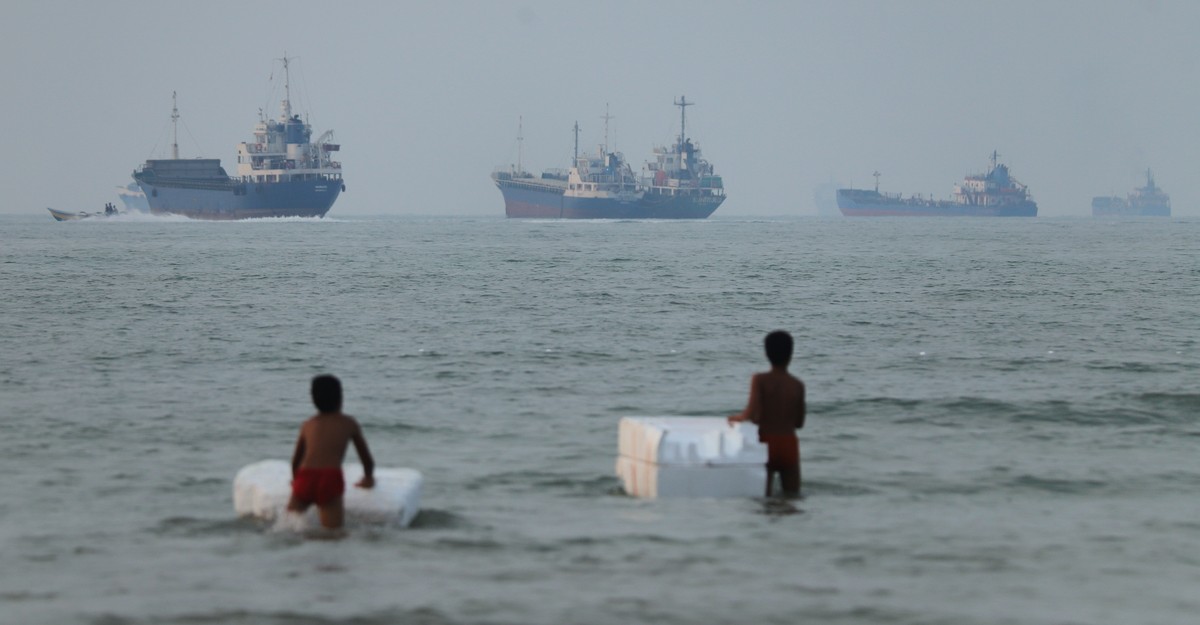
This is an edition of The Atlantic Daily, a newsletter that guides you through the biggest stories of the day, helps you discover new ideas, and recommends the best in culture. Sign up for it here.
Yesterday, President Trump wrote on Truth Social that the United States would become the “GUARDIAN OF THE HORMUZ STRAIT,” blockading Iranian ports and ensuring the safe passage of non-Iranian vessels. And in the spirit of “FAIRNESS,” he added, the U.S. would charge vessels a fee for the trouble.
Then, this morning, an amendment: Trump disposed of the fee idea while still indicating that he intends to assert control of the strait and resume the blockade. Now, Trump says, the Gulf states will be making “the Trade and Investment Deals” with the U.S. as a form of compensation. But the particulars of those deals (and of which states will participate) remain unclear.
Today marked the fourth consecutive day of strikes across Iran. The cease-fire has disintegrated—Trump formally notified Congress yesterday that the war has resumed—and negotiations have collapsed. If American forces do try to reassert power in the strait, they’ll face a difficult path. Iran is still clamping down on ship traffic, and recent violent clashes in the waterway have once again dramatically reduced the number of vessels entering and exiting the Persian Gulf. The United States’ ability to exert control in the strait could depend on its ability to erode the system of dominance that Iran has established in recent months.
Dominance in the Persian Gulf has never been clear-cut. In the early 16th century, Portuguese mariners brought their cartaz system of permits to the Strait of Hormuz, overseeing the waterway for more than a century. In 1622, the joint forces of Persia and England’s East India Company seized it. The Strait of Hormuz is now broadly understood as an international zone, and yet portions of the waterway remain contested. Its narrowest stretch is just 21 miles wide—meaning that, according to a United Nations convention, it is entirely within the territorial waters of Iran and nearby Oman. Neither Iran nor the U.S. are party to the UN treaty, but the U.S. nevertheless recognizes it as international law, Michael Poznansky, a nonresident senior fellow at the Brookings Institution, told me.
The U.S. has assumed some responsibility for the Strait of Hormuz in the past. Defense of the Persian Gulf was at the core of the Carter Doctrine—Jimmy Carter’s attempt, in 1980, to respond to the Soviet Union’s invasion of Afghanistan. Iran periodically attacked foreign vessels in the strait during the Iran-Iraq War of the ’80s; in 1987, the U.S. Navy launched Operation Earnest Will, escorting Kuwaiti tankers through the strait for more than a year. During that war, the Iranian regime threatened to fully close off the strait but decided against it, realizing that the damage to its own economy would be too great. Iran has repeated this threat over the past two decades, but it never actually followed through until February, in retaliation for the U.S. and Israeli strikes on its land and the assassination of Supreme Leader Ali Khamenei.
Despite the persistent threat of Iranian interference in the strait over the past half century, its leadership was never guaranteed to be able to enforce an effective blockade. But what remains of Iran’s military, decimated by months of war, has still proved capable of maintaining the transit restrictions that the regime announced in the spring. The persistent threat of mines, and of its nimble boats that can harass or attack other vessels, has kept ship traffic to a minimum; the number of crossings on Sunday was the lowest it had been in a month.
Past efforts to break Iran’s stranglehold over the course of this war have failed. In May, American forces began escorting some vessels through the strait as part of an initiative called Project Freedom; it ended after just two days, in part because Saudi Arabia declined to let the U.S. use its military bases and airspace. European allies could provide support for potential U.S. missions in the Gulf, as they did during Operation Earnest Will, but Trump has now eroded many of those relationships.
Given Iran’s demonstrated ability to influence ship traffic, the project of ensuring freedom of navigation in the strait might require a permanent U.S. effort, Ray Takeyh, a senior fellow for Middle East studies at the Council on Foreign Relations, told me. This could end up being cumbersome and dangerous, Takeyh explained, given the military assets involved in escort missions and the inevitability of Iranian interference. And even then, ship traffic may not return to prewar levels.
Trump’s social-media posts over the past couple of days have gestured at the desire for a strong and continued American presence in the strait—a profound shift on the part of a president who spent years decrying the country’s role as “the policemen of the world.” He may soon come to realize that policing the strait does not always mean controlling it.
Related:
Here are three new stories from The Atlantic:
- The shooter in Maine was a new ICE recruit.
- Trump’s anti-growth agenda
- Marco Rubio’s disappearing Signal chat
Today’s News
- ICE has temporarily halted most traffic-stop arrests nationwide after two fatal shootings involving immigration officers in Houston and Maine have prompted growing scrutiny of ICE’s use of force and response to the incidents.
- E. Jean Carroll has received more than $5 million from Donald Trump after a federal court released the funds awarded to her when a jury found him liable in 2023 for sexually abusing and defaming her. The payment came after the Supreme Court declined to hear Trump’s appeal earlier this month and despite his attorneys’ effort to block the disbursement.
- Mahmoud Khalil, the former Columbia University graduate student facing the possibility of deportation, has filed a lawsuit against Trump-administration officials, the Heritage Foundation, and pro-Israel advocacy groups, alleging that they conspired to target him and other pro-Palestinian activists in violation of their constitutional rights.
Evening Read
Punctuation: A Generational Divide
By Judith Shulevitz
I was a novice editor, he was an experienced writer, and the first article he turned in revealed a virtuosic command of comma placement. He opened with long, slow clauses; picked up speed with shorter ones; withheld all commas for a gloriously terse thesis statement; and then, crash! A mass-casualty pileup of appositive phrases. Grammarians, I married him.
Now our son is the family authority on punctuation. His expertise lies in using it in texts and on social media, where commas and periods go to die. Semicolons too, decades after Kurt Vonnegut tried to banish them. “First rule: Do not use semicolons,” he pronounced in 2005. “All they do is show you’ve been to college.” Exclamation points and emoji reign supreme. (Does an emoji count as punctuation or rate as a paralinguistic element—that is, a relative of a wink or an eye roll? My son shrugs.) Online punctuation is for torquing emotion, he told me, not for making yourself clear: “The ultimate goal is not efficiency but maximum attention.”
More From The Atlantic
- The bizarre partnership between the U.S. and Venezuela
- Generative AI is an engineering disaster.
- The see-no-evil Supreme Court
- Yair Lapid on American loneliness
- The unintended consequences of genetic tests
- A free-speech meltdown
Culture Break
Watch. Ferris Bueller’s Day Off, which just turned 40, has avoided a midlife crisis for good reason: It’s a timeless portrait of popularity and truthiness, Megan Garber argues.
Explore. There’s one key tactic professional that athletes use to deal with extreme heat—and it’s helpful advice for the rest of us, Nancy Walecki reports.
Rafaela Jinich contributed to this newsletter.
When you buy a book using a link in this newsletter, we receive a commission. Thank you for supporting The Atlantic.