One Place News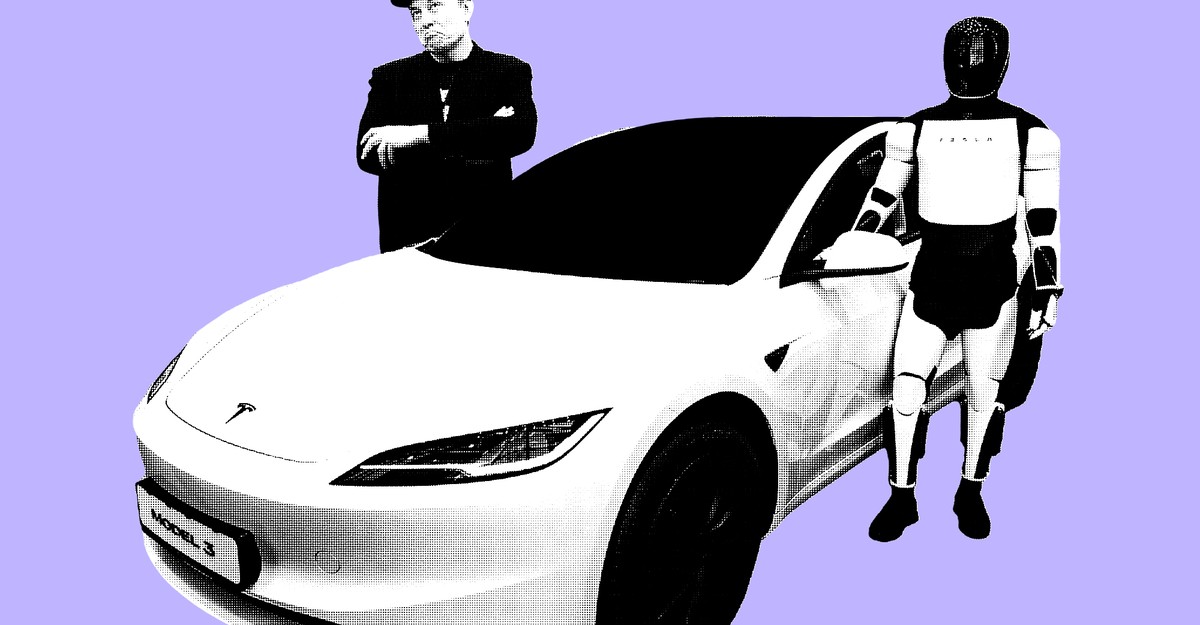
Nothing captures the decline of Tesla better than the Cybertruck. When the stainless-steel pickup hit the road in 2023, Tesla was the world’s biggest electric-car company. At the time, Elon Musk predicted that he’d eventually sell 250,000 Cybertrucks a year. In the first half of 2026, according to one estimate, Tesla sold roughly 7,000.
Tesla has faced several self-inflicted wounds. Musk’s affiliation with Donald Trump and his tenure at DOGE was a turnoff for electric-car buyers who lean to the left—which is most of them. A promotional event with the president himself on the White House lawn didn’t seem to do much good. Tesla’s worldwide sales fell 9 percent in 2025. The problem is not just a matter of Musk’s politics: He has gotten pretty bored with selling cars—or at least ones with steering wheels. Besides the ill-fated Cybertruck, Tesla hasn’t released a brand-new passenger model since 2020 as Musk has shifted the company’s focus to robotaxis and robots.
[Read: My day inside America’s most hated car]
It can be easy to write off Tesla, or even forget about it entirely. All eyes are now on Musk’s other trillion-dollar venture, SpaceX, with its grandiose goals of launching data centers into orbit and colonizing Mars. But Tesla has become more important—not less—to the future of electric vehicles in the United States. Of the roughly 463,000 EVs that Americans bought in the first six months of this year, more than half were Teslas, according to figures from Cox Automotive—a jump of nearly 8 percentage points from this time last year. The Tesla Model Y alone claimed more than a third of EV sales.
In some ways, Tesla’s comeback has more to do with the failures of other car companies than its own success. Last year, Congress nixed the EV tax credits meant to encourage Americans to go electric. The Trump administration followed suit by rolling back regulations on tailpipe emissions. The entire automotive industry has been scrambling as a result. EV sales have cratered by about 24 percent so far this year, though they are showing some signs of recovery.
Tesla isn’t immune to any of this. In the U.S., its sales slumped by an estimated 11 percent through June of this year. But the broader downturn makes Tesla that much more crucial to keeping the electric dream alive. In recent months, numerous automakers have yanked EVs from the market, delayed new arrivals, and canceled their plans to debut new EVs. Last year, Ford axed the F-150 Lightning, a battery-powered pickup that was supposed to anchor Detroit’s electric future. (Ford is hyping up a cheaper electric pickup truck—but it’s still in development and won’t come out until next year.) Just last week, Honda pulled the plug on its last remaining fully electric option, the Prologue SUV, after killing off a slew of upcoming models.
[Read: America’s car industry can’t go on like this]
Then there’s the matter of price. The cheapest Tesla will run you a little under $39,000, which is hardly a bargain, but is thousands below the going price for a new car these days. It’s all the more remarkable considering that Tesla makes money from the cars it sells—a feat that has eluded much of the industry. Automakers continue to grapple with the high cost of batteries and of designing new kinds of cars. Consider that from 2022 through 2025, Ford lost $16 billion selling EVs. The company expects its electric-car business to simply break even in 2029. That’s partly why so many automakers sprinted for the haven of high-margin gas-powered vehicles once the going got tough.
As sales of new EVs flounder, used ones are picking up the slack: Americans gobbled up an estimated 128,000 of them last quarter, smashing records. Since Tesla has sold EVs in large numbers for so long—its first mainstream hit was the Model 3 sedan in 2017—it carries the market. One of the cheapest paths to an EV that can run 250 to 300 miles or more in a single charge is a used Tesla.
Musk’s car company is crucial to the future of EVs in another way. It dominates the infrastructure of the electric era: plugs. One of the biggest speed bumps to wider electric-car adoption is the challenge of where to recharge. Tesla has been blanketing the country with its Superchargers since its early days in 2012, and now operates about half of all fast-charging plugs in the United States. This is great marketing for Tesla, of course. But it’s also a win for almost anybody looking to give up gas. In recent years, Tesla has opened up most of its formerly exclusive stations to other EVs.
No matter what Musk says about Tesla’s AI future, he may have no choice but to pay attention to his car business. This week, Tesla reported that despite surging revenue, its operating profits in the second quarter of 2026 were the lowest in six years, in part because of massive expenditures on AI. Musk is also hemorrhaging cash at SpaceX. All of that money has to come from somewhere. Beyond America’s troubled EV industry, Tesla is doing more than just surviving. A spectacular second quarter of deliveries worldwide stunned Wall Street analysts and points to the beginnings of a bigger rebound. (Musk did not respond to my request for comment.)
The EV market would be in far worse shape right now without Tesla. But the real shame is that Tesla could be doing so much more to get drivers to go electric. The automaker has managed to hang on in the U.S. by serving up little more than the microwaved leftovers of its limited, aging lineup. While Tesla’s automotive innovation has stalled, Chinese companies are releasing one affordable, high-tech model after another. Perhaps Tesla could roll out a truly budget EV. You know, something like the $25,000 car Musk once touted onstage but reportedly shelved in favor of the Cybercab, a robotaxi without a steering wheel. A less polarizing, smaller pickup could probably do a whole lot better than the Cybertruck has. At this point, almost anything would clear the bar.